
Small family farms make up the overwhelming majority of American farms but a modest slice of what American agriculture produces, according to a Chart of Note from USDA's Economic Research Service (ERS).
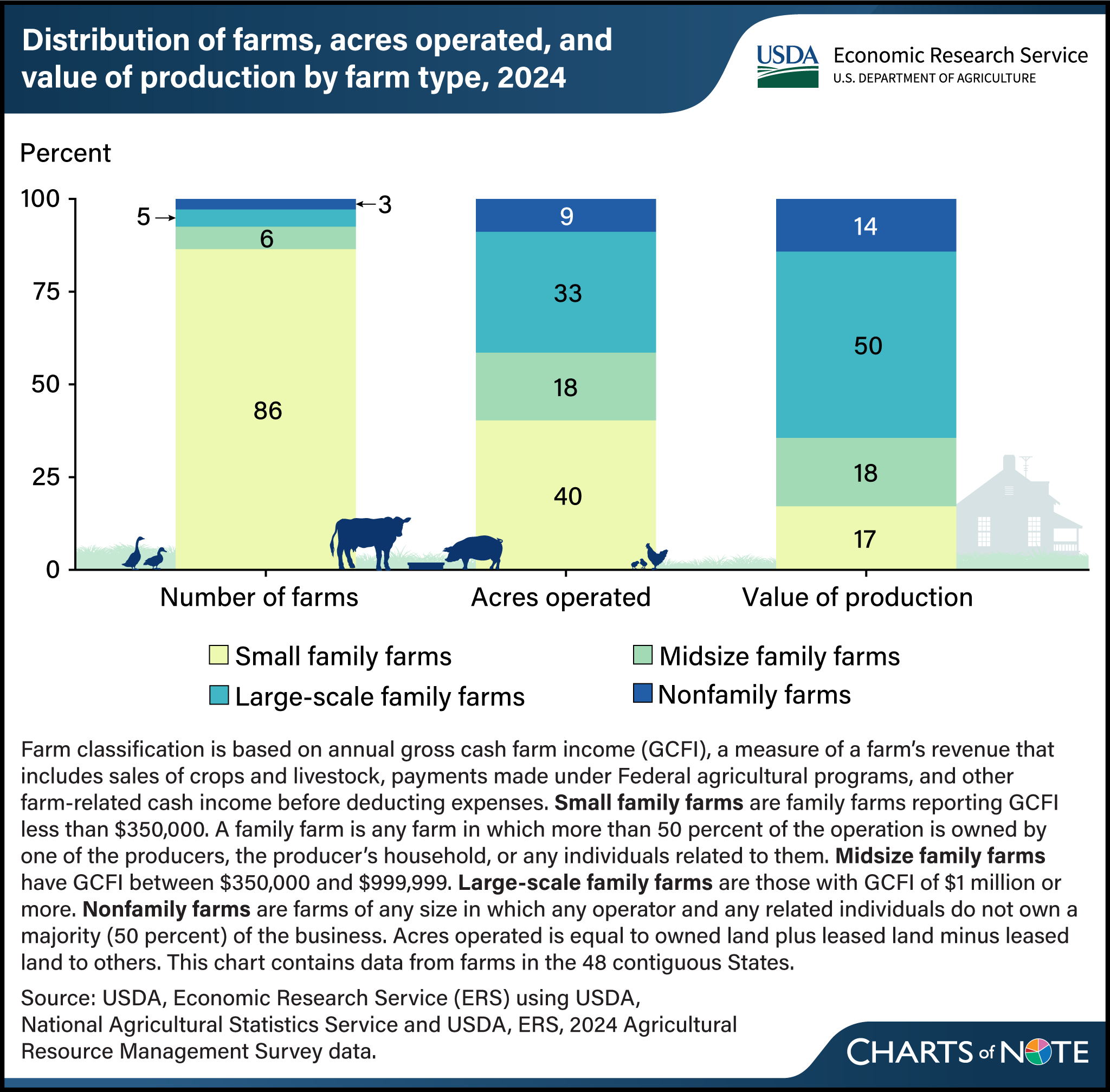
In 2024, about 86 percent of all U.S. farms were small family farms, defined as those with gross cash farm income (GCFI) below $350,000. They operated 40 percent of the country's agricultural land and produced 17 percent of the total value of agricultural production.
At the other end of the scale, large-scale family farms, those with GCFI of $1 million or more, represented just 5 percent of farms but contributed 50 percent of total production value and operated 33 percent of agricultural land.
Midsize family farms, with GCFI between $350,000 and $999,999, were 6 percent of farms and accounted for 18 percent of agricultural land and 18 percent of the value of production.
Taken together, family farms of all sizes were about 97 percent of U.S. farms, operated 91 percent of agricultural land and generated 85 percent of production value in 2024. The remaining 3 percent were nonfamily farms, a category that varies in size and ownership and includes partnerships of nonrelatives, nonfamily corporations and farms run by a hired manager unrelated to the owners. Nonfamily farms produced 14 percent of the value of agricultural production, down from 17 percent in 2023.
The numbers describe a sector in which the family farm is still the norm, but in which half of everything grown comes from a small group of very large family businesses. The chart, prepared by ERS economists Katherine Lacy and Katherine Lim, appears in America's Farms and Ranches at a Glance: 2025 Edition.
Source: USDA Economic Research Service



Comments
(0)