
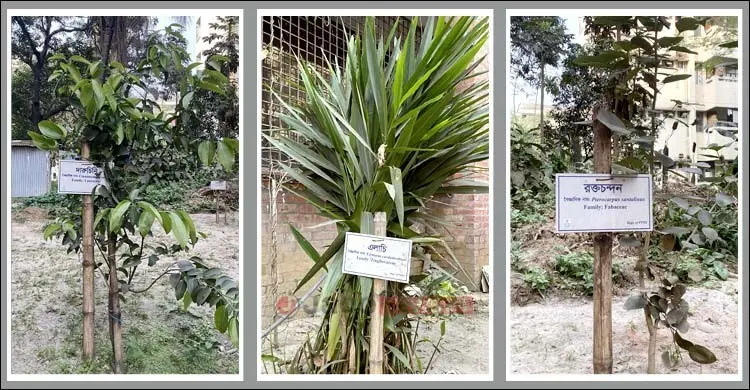
Cinnamon, cardamom, red sandalwood and many other medicinal plants can be seen in the medicinal garden of Sher-e-Bangla Agricultural University (SAU) in the capital. Many people think of these herbs as spices, but they have strong medicinal properties.
Those involved say the garden was created to broaden students' knowledge and for research.
Built by the Department of Pharmacology and Toxicology with funding from the Sher-e-Bangla Agricultural University Research System (SAURES) project, the garden now conserves and cares for about 41 species of plants with medicinal properties.
Students see a practical benefit
Students see the garden as a very useful step, and it is also raising their interest in research. They say it has increased the chances to learn about medicinal plants and to do lab work.
Ilham Rasul, a student of the Faculty of Animal Science and Veterinary Medicine, said: "We read about medicinal plants in our courses, but it was often hard to understand what they are really like and which part has which properties. Now that the garden has been made, we can observe the plants directly, which is raising our interest in research as well as helping our studies."
Rakibul Hasan Midul, another student of the same faculty, said: "As a veterinary student, practical knowledge of medicinal plants is very important. Before, this knowledge was confined to books and lectures. But with the medicinal garden on campus we can now see and identify different medicinal plants and learn their use and therapeutic importance hands-on. Such direct learning is still limited at many universities in the country."
"I have also personally felt the effect of using basak leaves," Rakibul added. "All in all, the medicinal garden is playing an important role in our academic and practical learning."
Sajjad Hossain, another student of the Faculty of Animal Science and Veterinary Medicine, said: "The garden has made plant identification easier and increased our practical knowledge. We are also getting a real idea of the use of herbal medicine in animal health. We think this initiative will make veterinary education more effective and research-oriented."
Teachers see a research resource
Md Sakil Islam, a teacher in the university's Department of Pharmacology and Toxicology, said: "Medicinal plants are one of humanity's oldest and most important sources of natural treatment. Many modern medicines are based on these plants. The plants in our garden contain various bioactive compounds that can play an important role in disease prevention, reducing inflammation, antimicrobial action and controlling toxicity. If alcoholic or aqueous extracts can be prepared from these plants and used through scientific trials in future, I believe they could contribute greatly to discovering new natural medicines and developing safe treatments."
Professor Dr Sharifa Jahan, chairman of the same department, said: "Through the medicinal garden, students will learn about plants with medicinal properties, which will make them interested in learning from nature as well as from books. Around the world it is often becoming hard to find effective treatments for new diseases, and our medicinal plants can play an important role here. There are many plants in nature with antibiotic, antibacterial, antiviral and antifungal effects that can fight various diseases."
She added: "This medicinal garden could serve in future as an excellent research field for students. From the plants we can collect new compounds and find ingredients for new medicines, which will make our health system stronger."
Source: Jagonews24. First published in Bengali on The Agro News.

Comments
(0)