
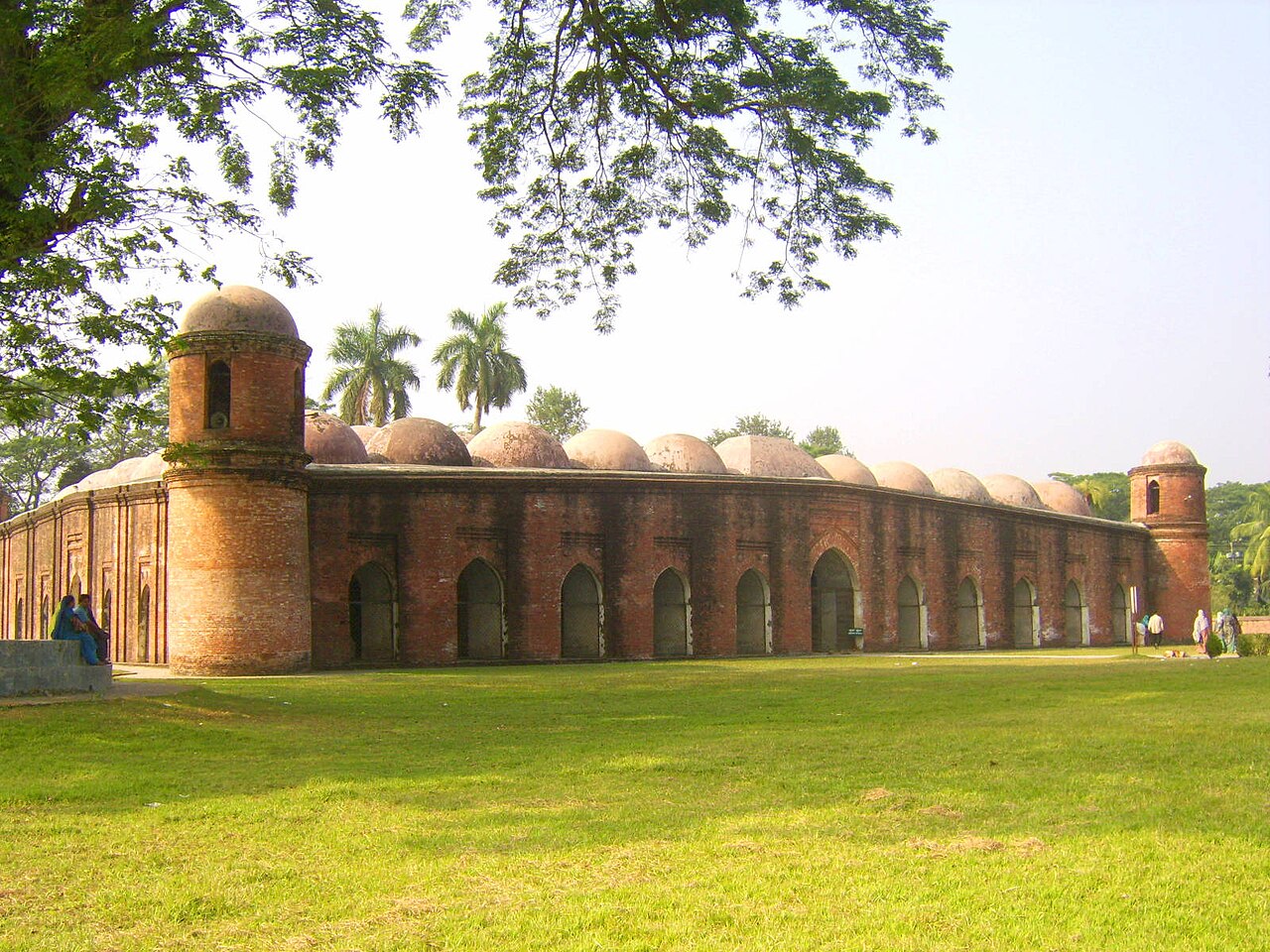
About seven kilometres west of Bagerhat town, at Sundarghona, stands the Sixty Dome Mosque (Shat Gombuj Masjid), one of the finest surviving works of medieval Muslim architecture in Bengal. The huge rectangular mosque of fired brick is still a place of prayer, a protected archaeological monument and one of Bangladesh's main tourist sites. In 1985 UNESCO inscribed the Historic Mosque City of Bagerhat on its World Heritage List.
The mosque is tied to Khan Jahan Ali, known historically as Ulugh Khan-i-Jahan. In the 15th century he built Khalifatabad, a planned Muslim city in south-west Bengal with roads, bridges, reservoirs, ponds and drainage alongside its mosques. UNESCO says the city covered about 50 square kilometres; after its founder died in 1459, much of it was swallowed by forest.
Despite its name, the mosque has 81 domes, according to the Department of Archaeology. The roof rests on 60 pillars, in six rows of ten, and one common explanation is that "sixty" refers to the pillars rather than the domes, though there is no single agreed account of the name. The department measures the building at about 160 feet north to south and 104 feet east to west on the outside, with walls about eight and a half feet thick. The west wall, with its mihrabs, has a door beside the main mihrab, one of 26 doors in all.
The architecture blends Bengal's own building tradition with the influence of the Tughlaq style of Delhi: thick walls, four heavy corner towers and a low, massive form. UNESCO describes a distinct Khan Jahan style. A turret on one southern tower holds a chamber called the Roshnai Kuthi. Legend says Khan Jahan floated stone by water from Chattogram or from Rajmahal in Odisha, but that remains folklore, not established history.
The greatest long-term threat now is salt and damp. UNESCO has long identified salt in the soil and air as a major danger to Bagerhat's monuments; conservation work has not fully solved it. A 2026 report described salt crystals on the bricks, damp walls and a greenish film. When salt enters old brick and lime mortar it crystallises as the wall dries, and repeated wetting and drying stresses the masonry. Being close to the coast, the site could face more of this as the climate changes. UNESCO documents also note that some original features were altered or damaged in past repairs.
The Department of Archaeology says the mosque was restored and a five-room, 2,055-square-foot Bagerhat Museum built under the Paharpur-Bagerhat project in 1991-92, and e-ticketing for the mosque and museum began in January 2026. Nearby stand the Singair, Nine Dome, Chunakhola, Bibi Begni, Reza Khoda and Ranavijaypur mosques and Khan Jahan's tomb, which together make up the Mosque City of Bagerhat.
Photo: Belayet (Bellayet) / Wikimedia Commons (CC BY 3.0)
Source: The Daily Observer


Comments
(0)