
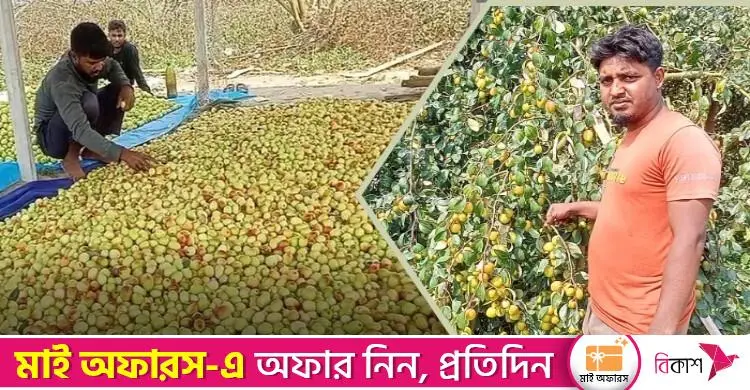
Alongside winter (rabi) crops, more profitable fruit farming is spreading across the country. In Sharsha and Benapole of Jashore, entrepreneurs are becoming self-reliant by growing jujube (boroi), a juicy and nutritious fruit. The crop is creating jobs, producing new entrepreneurs and bringing farmers a profit.
The growers cultivate several jujube varieties, including Apple kul, BAU kul, Thai kul and Dhaka-90 kul, which the report credits to the Bangladesh Agricultural Research Institute (BARI). Entrepreneurs dream of changing their lives with a crore-taka jujube harvest in only four to six months. They and local farmers are asking for government help, including the production of new pesticides, for modern jujube farming.
From jobless graduate to employer
Mahbubur Rahman of Jamtala in Sharsha upazila of Jashore was struggling with frustration after finishing his Masters examinations. Wanting to become an entrepreneur, he began growing improved jujube varieties named Thai, Ball, Apple and Nasrin on five bighas of land five years ago. The trees fruited within eight months and go on bearing for ten years. A bigha costs Tk 2 lakh to farm and returns Tk 5 lakh, so the profit is good for a small outlay in a short time. Mahbubur Rahman now grows jujube on 30 bighas, providing work for around fifty labourers. He is getting a good yield and good prices and hopes to earn more.
Jujube farming is growing in various parts of Jashore. Many people earn well working in these orchards: each worker gets Tk 500 a day, or Tk 15,000 a month. Worker Rakib Ahmed and farmer Omar Hossain said prosperity is returning to their families and they are living comfortably. Local people said that because jujube is so profitable, they hope to expand cultivation.
Jujube trader Atiar Rahman said they buy the fruit from different parts of Jashore at Tk 60 to Tk 110 a kg and sell it in markets across the country. Demand for jujube is rising, and traders are profiting alongside farmers.
Where the fruit grows
The agriculture department said jujube is grown throughout Sharsha upazila, but it is most visible in Benapole, Bagachra, Ulashi, Sharsha and Kayba unions. The crop is harvested four to six months after planting. Picking starts at the end of October and continues until mid-April.
The report also describes farmer Mahabubur Rahman (45), from Pipragachhi village in Sharsha, as having transformed his livelihood through jujube farming, inspiring others. Starting with little capital, he now owns two orchards, where the short trees bend to the ground under the weight of BAU kul, Apple kul and Narkel kul.
"The main reason I chose this profession is that everyone studies and then runs after a job," Mahabubur Rahman said. "After finishing my studies I did not chase a job but turned to jujube farming. Since childhood it has been my wish to become an agricultural entrepreneur. In the first year I grew jujube on 5 bighas and invested some money. I made double profit in the first year, and that increased my interest in farming. I gradually expanded the orchard and now grow jujube on 30 to 35 bighas. Forty to fifty workers work in my orchard. I make my living with all of them, and the workers' finances are improving too. Everyone here, including me, is very happy with jujube farming."
Sharsha upazila agriculture officer Dipak Kumar Saha said: "Because the weather was good, the jujube yield has been good and farmers are profiting. The agriculture department is providing all kinds of training, advice and support for jujube farming. We hope jujube cultivation in this upazila will increase further."
Source: Jagonews24. First published in Bengali on The Agro News.

Comments
(0)