
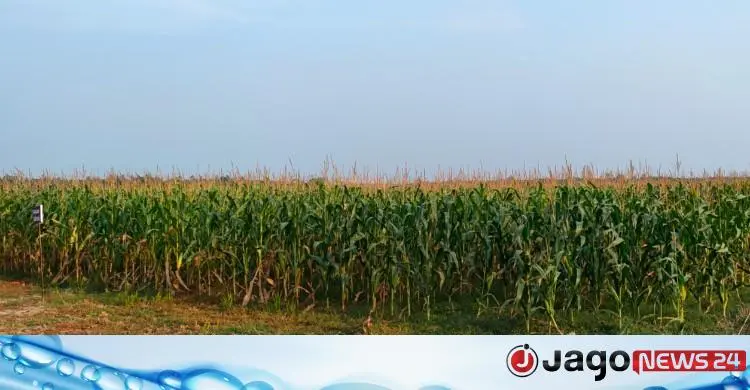
Local farmers Shila Rani and Ruhul Amin have succeeded with trial cultivation on long-fallow saline land in Hawalbhangi village, Atulia union, Shyamnagar upazila of Satkhira. By growing maize, BINA dhan10 and BRRI dhan99 on about 3 acres of land with a salinity level of 10, they have opened new possibilities for the area. For the first time in the area, maize was grown by dibbling, in which seeds or seedlings are planted in small holes made at a set depth and spacing.
Locally, several thousand bighas of land in this coastal area used to lie fallow for much of the year after the aman season for want of fresh water. Salinity made growing crops in the boro or rabi season almost impossible. That picture has begun to change since trial cultivation of salt-tolerant crops began, funded by BARC and carried out by the Satkhira sub-station of BINA with support from the Department of Agricultural Extension (DAE).
Field day
A field day was held in Hawalbhangi village on the afternoon of 25 April to mark the success. Moderated by BINA scientific officer Milon Kabir, it was attended by local farmers, agriculture officials, researchers and others. The chief guest was Dr Md Harunur Rashid, CSO of the Bangladesh Agricultural Research Council (BARC) and focal point of the Partner Programme. He said: "If the saline land of the coastal region can be brought into production, the country's food security will be further strengthened. Initiatives like this can bring major change to agriculture."
Special guest Md Saiful Islam, additional director of the DAE in Satkhira, said: "Success like this will come if technology can be taken to farmers in the field. We want the model to spread across Shyamnagar and the wider coastal region."
Dr Md Jamal Uddin, PSO and working scientist of the Partner Programme, said: "Using salt-tolerant varieties and the right management methods, even uncultivated land can be made productive. This is an effective strategy for tackling climate change."
Shyamnagar Upazila Agriculture Officer Waliul Islam said: "Local farmers' interest has grown a lot. We are trying to expand this initiative further with regular advice and technical support."
Presiding over the event, Dr Md Kamruzzaman, officer in charge and chief scientific officer of the BINA sub-station in Satkhira, said: "Seedlings can be planted by dibbling in land after the rice harvest without any tillage, so the farmer has no extra cost. Salt-tolerant varieties such as maize, BINA mustard and BINA dhan10 are very suitable for the coastal region. This way fallow land can be brought under cultivation."
Farmers hopeful
Farmer Shila Rani said: "Nothing used to grow on this land before. Now maize and rice are giving a good yield. We are very hopeful. And because we used dibbling for the maize, there was no extra cost for the land."
Farmer Ruhul Amin said: "We had to leave the land unused because of the salinity. Now, with the scientists' help, we are farming and making a profit. If we keep getting support like this, we will farm more land."
Other farmers at the field day also praised the initiative and expressed interest in growing salt-tolerant crops in future. The speakers said: "Expanding salt-tolerant crops in the coastal region is creating new possibilities in agriculture. This will play an important role in raising farmers' incomes, creating jobs and ensuring the country's food security."
Source: Jagonews24. First published in Bengali on The Agro News.

Comments
(0)