
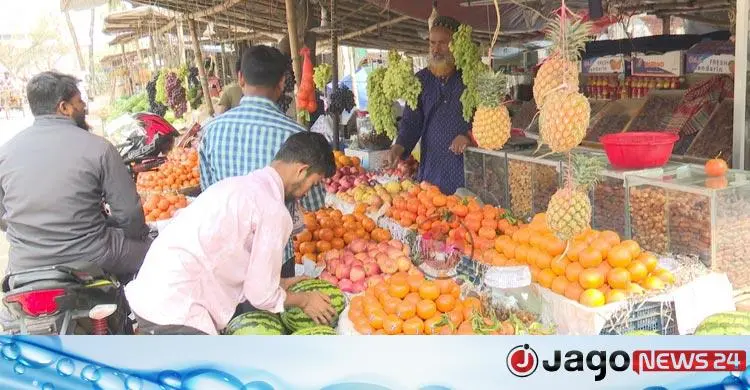
Demand for nutritious fruit at iftar is highest during the holy month of Ramadan, after a day of fasting. But in Satkhira's markets the prices of local and imported fruit have risen abnormally on the back of that demand. In a week, fruit prices have risen by Tk 20 to Tk 80 a kg. Low- and middle-income shoppers are leaving disappointed, unable to buy the fruit they want, and those who used to buy by the kilogram are now buying by the gram.
Information from fruit shops at Sultanpur Bara Bazar, Hater More, Thana More and New Market More in Satkhira town, and from markets in several upazilas, shows that fruit that was easy to buy before Ramadan is now out of ordinary people's reach.
Local fruit prices
Although Satkhira is known as a store of fruit, local fruit is no cheaper. Guava that sold at Tk 70-80 a kg before Ramadan now sells at Tk 100 to 150. Good papaya costs Tk 80-140 a kg. Lemons cost Tk 4 to 10 each; sapodilla Tk 3 to Tk 15 each depending on size; wood apple Tk 30-60 each, depending on size; and watermelon Tk 80 to 90 a kg. The winter jujube (kul) is also dear: narkeli kul, apple kul and BAU kul sell at Tk 60 to Tk 150 a kg. Sagar bananas sell at Tk 50-60 a kg and sabri bananas at Tk 80-100, while ordinary chapa bananas are now Tk 60 to 70 a kg. Green coconuts, a key source of nutrition, sell at Tk 120 to 150 each depending on size.
Imported fruit is even dearer. Red apples sell at Tk 300 to 350 a kg and green apples at Tk 350 to 400. Malta costs Tk 320-360, pomegranate Tk 400 to Tk 550, strawberries Tk 800, and good-quality grapes Tk 400 (white) and Tk 600 (red) a kg.
Dates caught fire even before Ramadan arrived. Starting from Tk 250, ordinary dates have passed Tk 400 a kg, while better-quality dates sell at Tk 800 and premium varieties at Tk 1,500 to 2,000 a kg.
Buyers go home empty-handed
Day labourer Masud Hossain said: "What I earn from a day's work barely covers rice and lentils for the family. The doctor told me to buy fruit for my sick child, but in the market I find every fruit beyond my means. The money for a kg of apples would buy two days' groceries for my family. So I am going home empty-handed without fruit."
Another buyer, van driver Mohammad Ali, said he had wanted to eat a little fruit with his family at iftar, but at these prices it is impossible for poor people like him.
Private-sector employee Belal Hossain said traders were raising prices through a syndicate. With no budget for good fruit, he was going home with only a kg of bananas and 500 grams of kul. Guava was a little cheaper, but that too went up at the start of Ramadan. "What fruit are we to eat? Every fruit has gone up," he said.
Housewife Fatema Begum, shopping at the town's Bara Bazar, said angrily that everyone needs a few dates and lemon sharbat for iftar, but ordinary dates have passed Tk 400, and at the price of lemons, even lemon sharbat is now a luxury.
Traders blame supply and costs
Retail and wholesale sellers deny buyers' syndicate allegations and blame supply shortages, transport costs and higher import costs.
Shamim Hossain, a retailer at "Shamim Fal Bhandar" in Sultanpur Bara Bazar, said the sudden rise in demand in Ramadan had cut supply and raised prices in the wholesale market, and added transport costs push up retail prices. "We buy at high prices, so we are forced to sell at high prices," he said. Sales have fallen a lot because of the higher prices, he added; those who used to buy by the kilogram now buy half a kg or 250 grams.
Idris Hossain, a trader in local fruit at Sultanpur Bara Bazar, told Jago News that demand for all fruit rises suddenly in Ramadan but the supply of local fruit is low by comparison. Vehicle hire and labour costs for bringing fruit from villages to market are also much higher, and village sellers are charging more. Altogether prices are high at the mokam (wholesale market). "We are buying dear and are forced to sell dear; we make no extra profit here," he said.
Importers blame the high dollar rate and import duties for the rise in imported fruit prices. Md Kabirul Islam, a fruit importer and wholesaler at Bhomra land port, told Jago News that the main causes are the rising dollar and excessive import duty. Importers also face various difficulties opening letters of credit (LCs) at banks. The cost of buying fruit dear from India or other countries, bringing it to the port and transporting it to local markets has risen a lot. "We are bringing fruit in at high prices at the wholesale level, so naturally the market is affected. There is no scope here for traders to raise prices through a syndicate," he said.
Authorities monitoring the market
Md Mehedi Hasan Tanvir, assistant director of the Directorate of National Consumers' Rights Protection in Satkhira, told Jago News that they are monitoring the market regularly and taking a strict stance so that no trader can hold ordinary people hostage by creating an artificial crisis or taking excessive profits. Traders' purchase and sale receipts are being checked in regular drives, and if dishonest syndicates or irregularities are found, strict action including fines is being taken under the law. The drives will continue until the day before Eid, he said.
Source: Jagonews24. First published in Bengali on The Agro News.

Comments
(0)