
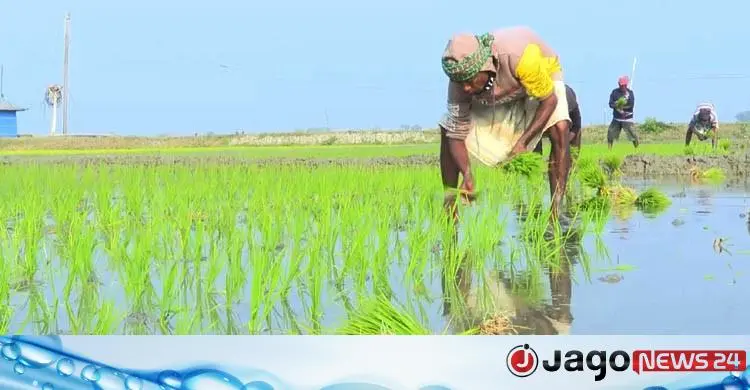
Living with an acute shortage of fresh water and rising soil salinity, farmers in Satkhira are growing boro rice. This time, though, the high price of fertiliser and pesticide has become a painful problem for them. In this situation the agriculture department is advising coastal farmers to plant early and to grow salt-tolerant rice varieties to cope with salinity and natural disasters.
Because of its geography on the edge of the Bay of Bengal, a large part of Satkhira district is at risk of salinity for most of the year. Salt water from rivers, canals and shrimp enclosures in particular hampers normal farming. Even so, for the sake of their livelihoods, coastal farmers keep growing boro by battling the salty soil.
Why plant early?
Local farmers say salinity in the area usually increases several times over in the dry months of March and April, which is a big obstacle to growing rice. To avoid that risk they have changed tactics this year and started planting before nature turns against them. Their aim is to use the fresh water left in canals after the rains to bring in the crop quickly and reduce pressure on groundwater.
Moazzem Hossain, a farmer from Gabha village in Satkhira Sadar upazila, has grown early boro this year. He said: "With early planting the rice ripens before March and April come, which protects the crop from salt water. And because we can use the rainwater stored in the canals, irrigation costs have also come down somewhat this year."
Worries over production costs
Although planting started early, the farmers still look worried. They complain that dear fertiliser, pesticide and fuel have raised the production cost per bigha several times over this year. If they do not get the price they hope for, they fear heavy losses.
Nazmul Islam, a farmer from the Fingri area of Satkhira Sadar, said: "Farming costs have gone up a lot compared with last year. With diesel and fertiliser prices up, we are struggling just to irrigate. We are farming at a risk, but if we don't get the right price for paddy at market we will suffer a big loss."
Nimai Mondal, a farmer from the same area, said that not only fertiliser and pesticide but also the wages of day labourers have gone up. All told, with what it now costs to grow rice on a bigha, making a profit is a big challenge.
Haripada Gain, a farmer from the Bangdaha area of Assasuni upazila, said: "We have to survive by fighting the salty coastal soil. If we suffer losses from natural disasters or the price of paddy stays low, it will become impossible for us to grow boro in future."
Agriculture department's advice
Even in these adverse conditions, the district agriculture department offers some hope. On its advice, farmers are now using improved salt-tolerant seed rather than only traditional methods.
Saiful Islam, deputy director of the Department of Agricultural Extension (DAE) in Satkhira, said: "We are encouraging farmers to plant early to protect their crops from salinity and natural disasters. In saline areas in particular, farmers will get good yields if they grow BRRI dhan67, 97 and 99 and BINA dhan10. We are also advising high-yielding hybrid rice in some areas."
According to the agriculture department, the target for boro this season in Satkhira district is 80,800 hectares. If the weather is favourable, the district could produce 241,000 tonnes of rice this season.
People involved believe that government support and regular training in modern farming methods are needed to overcome the twin challenges of adverse weather and market instability. If these can be ensured, boro production in this coastal region could be increased several times over.
Source: Jagonews24. First published in Bengali on The Agro News.
Comments
(0)