
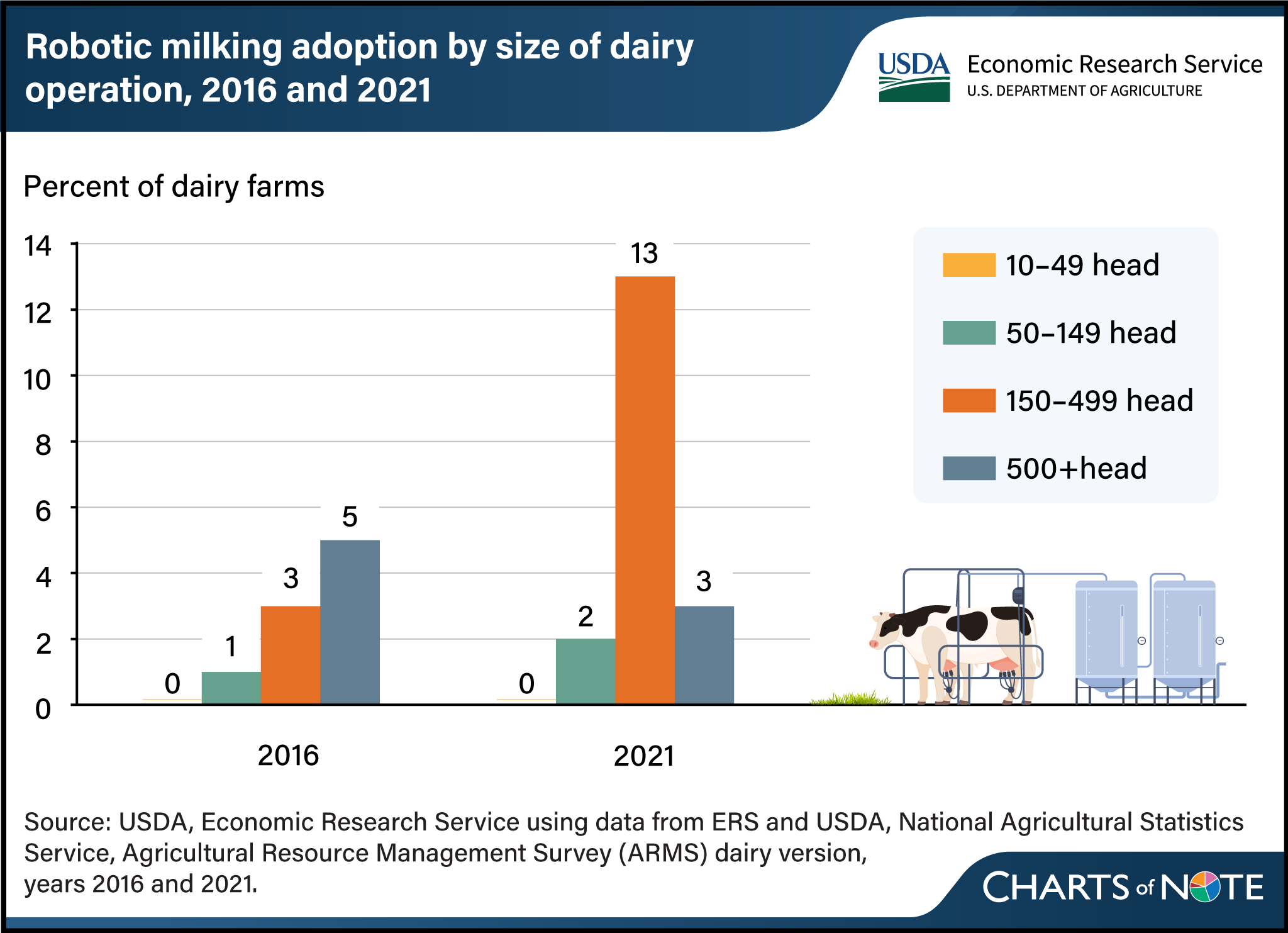
Robotic milking is spreading on American dairy farms, and the operations taking it up fastest are neither the smallest nor the largest but those in the middle, according to a Chart of Note from USDA's Economic Research Service (ERS).
In a robotic system, each cow walks into a box-like stall, is milked automatically without manual labour and returns to the herd. Robots produced 6 percent of U.S. milk in 2021, up from 4 percent in 2016, ERS reports.
Adoption varies substantially with farm size, and the pattern has changed. In 2016, robotic milking adoption rates were consistently higher on larger farms than on smaller ones, the familiar pattern seen with other farm technologies. By 2021 adoption was highest on midsized dairies: 13 percent of dairy farms with 150 to 499 head used robotic milking.
ERS researchers looked at why adoption lagged at both ends of the size range. On the smallest dairies, those with fewer than 50 cows, the data suggest that operators rely heavily on unpaid family labour rather than paid workers, so the technology may not reduce cash labour expenses enough to justify its capital cost.
Large and very large dairies face a different obstacle. Their production systems would need substantial changes to integrate robots, such as converting one or more milking parlours, and their labour costs per hundredweight of milk are already typically low, so the labour savings on offer are minimal.
The finding matters for a dairy weighing the investment: the economics favour a herd big enough to be paying for milking labour but not so big that a parlour already delivers low labour costs per hundredweight. The chart, prepared by ERS economist Jonathan McFadden, is drawn from the report Precision Dairy Farming, Robotic Milking, and Profitability in the United States, published in January 2026.
Source: USDA Economic Research Service


Comments
(0)