
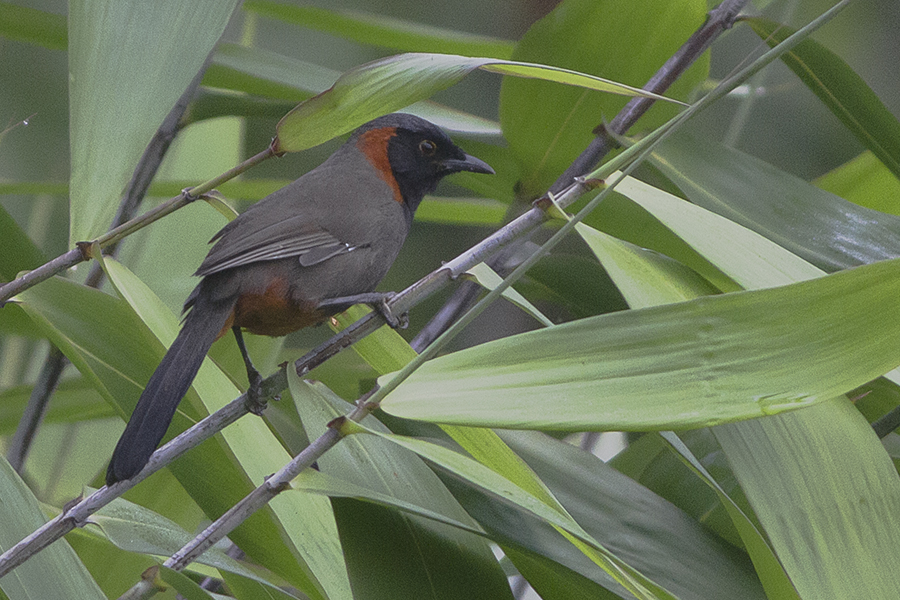
The rufous-necked laughingthrush is a rare bird in Bangladesh, usually found in the deep forests of Chattogram and Sylhet. Yet in three or four neighbouring villages of Rajarhat upazila in Kurigram, including Singhimari and Baidyer Bazar, it is easy to see and keeps close to people, much like a myna. Tuhin Wadud, a professor in the Bengali department at Begum Rokeya University, Rangpur, describes the birds in Prothom Alo.
He writes that the bird is resident, not migratory: it stays in the area all year and breeds there, and he once saw a nest in a latkan (Burmese grape) tree in August. The birds move in flocks or alone, pick food from the ground along roads, flit through bushes and feed in maize fields, often alongside mynas and babblers.
At a small roadside shop in Baidyer Bazar, the middle-aged woman who runs it feeds the birds bread every morning and afternoon. If she does not, she told him, they come into the shop for it. While he was there a flock of eight to ten arrived as soon as she put bread out. Local people say the birds also come when rice is thrown for chickens.
The rufous-necked laughingthrush, Garrulax ruficollis, belongs to the babbler family. Its body is grey and black, with a red patch on the neck that gives the bird its name, and red feathers on the belly and under the tail.
About three years ago Wadud took a group of photographers from Dhaka, among them Ashkar Ibn Feroz, who had come to Kurigram to help flood victims, to see the birds. They stayed an extra day, borrowed lenses from Rangpur's bird photographers and came back for pictures; since then bird photographers from across the country have travelled to Singhimari.
Wadud thinks the area's large betel nut groves and denser tree cover than the surrounding villages give the birds food and shelter. Other rare birds visit too, among them the puff-throated babbler, grey treepie and crimson sunbird, and older residents remember green pigeons there. Wherever the bird lives, he writes, it needs safe habitat and enough food to survive.
Photo: Dibyendu Ash / Wikimedia Commons (CC BY-SA 3.0)
Source: Prothom Alo

Comments
(0)