
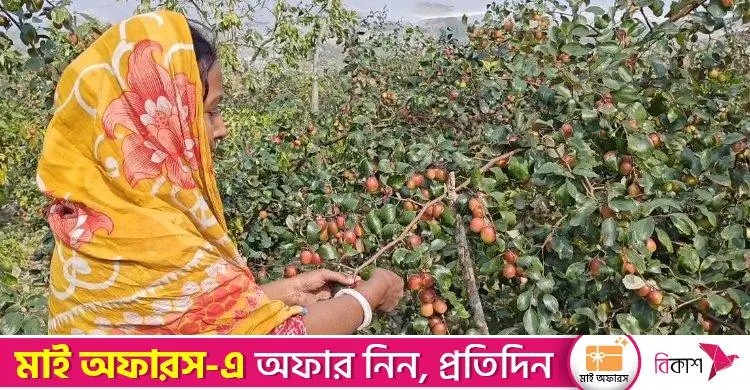
Low costs, good profits, strong market demand and relatively low risk are drawing many farmers in Pirojpur away from rice and other crops towards boroi, or kul (jujube). Boroi trees yield well with little irrigation, and with proper care a tree planted once bears fruit for several years. Local farmers are changing their fortunes by growing it.
In the boroi orchards of Tarabunia village in Nazirpur upazila, green, yellow and reddish fruit hangs from the trees. Because the fruit is large and sweet, all of it is sold in the orchard itself. Apple, Balsundari, Thai and Kashmiri boroi are the varieties most commonly grown. A single tree yields an average of 30 kg. After meeting demand in Pirojpur, the fruit is sold in Dhaka, Chattogram, Barishal and other districts.
With high yields at low cost, interest in boroi is growing by the day. Trees bear for several years after planting, creating a regular income for farmers, and with strong demand and fair prices, farmers in the area are choosing boroi over rice. Growers say that while rice did not even cover their costs, boroi is changing their fortunes, earning several times more from the same land.
About 146 hectares are under boroi in the seven upazilas of Pirojpur district, producing about 1,321 tonnes with a market value of about Tk 5 to 6 crore.
Growers and residents
Boroi grower Biren Biswas said: "We are making more profit from boroi. Various kinds are grown in the area and most people here are involved in growing it. It sells at different prices at different times: sometimes 4,000, sometimes three and a half thousand. Growing boroi costs us Tk 25,000 per acre. Income per bigha is over 2 lakh taka."
Biren Biswas's wife said: "I pick boroi in the orchard and look after it. Wholesalers come from various places and I sell to them. They come here to buy from Pirojpur, Inderhat, Nazirpur and other areas. Every tree has to be sprayed and given fertiliser and medicine, and weeds have to be cleared. That is the kind of work I do in the orchard."
Narayan Chandra, a resident of Tarabunia, said: "In our village of Tarabunia, 90% of people are involved in growing boroi. People here also grow lychee, mango and other fruit. Boroi sells at Tk 80 to Tk 100 a kg."
Local resident Arman Sheikh said: "People here live by growing boroi, mango, lychee and several other fruits. Wholesalers come from Swarupkathi, Inderhat, Pirojpur, Kawkhali and many other places to buy boroi. Growing boroi is now much more profitable than rice, and local farmers are turning to it."
Officials' view
Md Harun Or Rashid, additional deputy director (plant protection) of the district DAE, said: "Kul is grown on 146 hectares in Pirojpur district. Three varieties of boroi are grown in the district: Narikeli, Balsundari and Bharatsundari. Total production is 1,321 tonnes. The DAE gives boroi growers all kinds of help and training, and sub-assistant agriculture officers in the field are always on hand to advise farmers on diseases, fertiliser management and more."
Those involved believe that planned boroi cultivation would improve farmers' finances and have a positive effect on the country's fruit production.
Source: Jagonews24. First published in Bengali on The Agro News.

Comments
(0)