
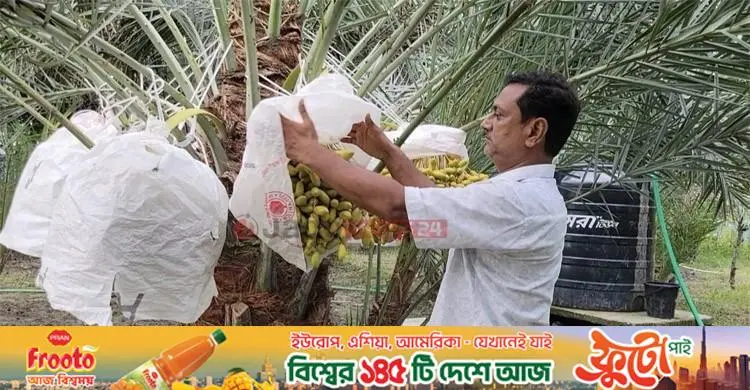
Can a crop of the Middle Eastern desert really be grown in Bangladeshi soil, especially a fruit that needs intense heat and dry weather? That was the question local people threw at young Saifuddin Hiru of Ekdanta union in Atgharia upazila, Pabna, when he started chasing this dream four years ago.
Many said of his venture: "How can a Bengali get Saudi dates from his own soil?" But brushing aside all doubts, Hiru is now a rare example. On his green 33 decimals of land, Ajwa, Mariam and other date varieties now hang in bunches. This successful growing of foreign dates in Pabna's soil has become a talking point.
Four saplings and YouTube
It was 2022. As a hobby, Hiru began the garden with just four saplings from a man named Rajib in the Goyeshpur area, on only 33 decimals of land. From the start he faced social and environmental challenges. Bangladesh's humid weather and heavy rainfall are major obstacles to growing dates, and experienced local farmers discouraged him.
With no formal training, he began learning only through the internet and YouTube. Refusing to give up, he moved ahead strategically and looked for varieties that could adapt to the country's weather. His garden now has about 10-12 improved varieties, including Ajwa, Mariam, Medjool, Sukkari, Warhis and Borhi, with 60 trees. He is thinking of expanding the garden with new plants, or "suckers", produced by the trees.
Visitors and one big question
People come from far and near every day to see Hiru's success. Hasan, a farmer from Tebunia, came to see the garden on his way back from Chatmohar after watching videos of it on social media, and was moved to see the dates on tree after tree.
Ruhul Amin, a young man from Ekdanta, said Hiru had proved that with the right effort even desert fruit could be grown in the country's soil. But many, like Rafin, a college student from Pabna town, now have one question: "Will these dates be as tasty as desert dates?" The future commercialisation of the crop depends on its taste.
The report says Hiru's success shows that with the right choice of varieties and modern technology, Bangladeshi soil could become an alternative to the Middle East, and that with government and institutional support this "sweet gold" could bring a new revolution to the economy.
Describing his feelings, Saifuddin Hiru said: "At first, when people mocked me, it hurt a lot. But I did not lose heart. Now that there is fruit on tree after tree, all the hardship feels worthwhile. But to expand this commercially, I now need government patronage and loans on easy terms."
Agriculture office watching closely
This is the first commercial date-growing venture in Pabna district. Department of Agricultural Extension (DAE) deputy director Jahangir Alam Pramanik welcomed it but raised an important point. "Entrepreneur Saifuddin Hiru has succeeded through personal effort. But compared with the desert, the growth rate of the trees and dates is somewhat lower in this country's soil. Our agriculture department is working on how to increase this growth and is keeping the garden under close observation."
"If the taste and market price of these dates are satisfactory, a plan could be made after scientific scrutiny to expand their cultivation across the district," he said.
Source: Jagonews24. First published in Bengali on The Agro News.

Comments
(0)