
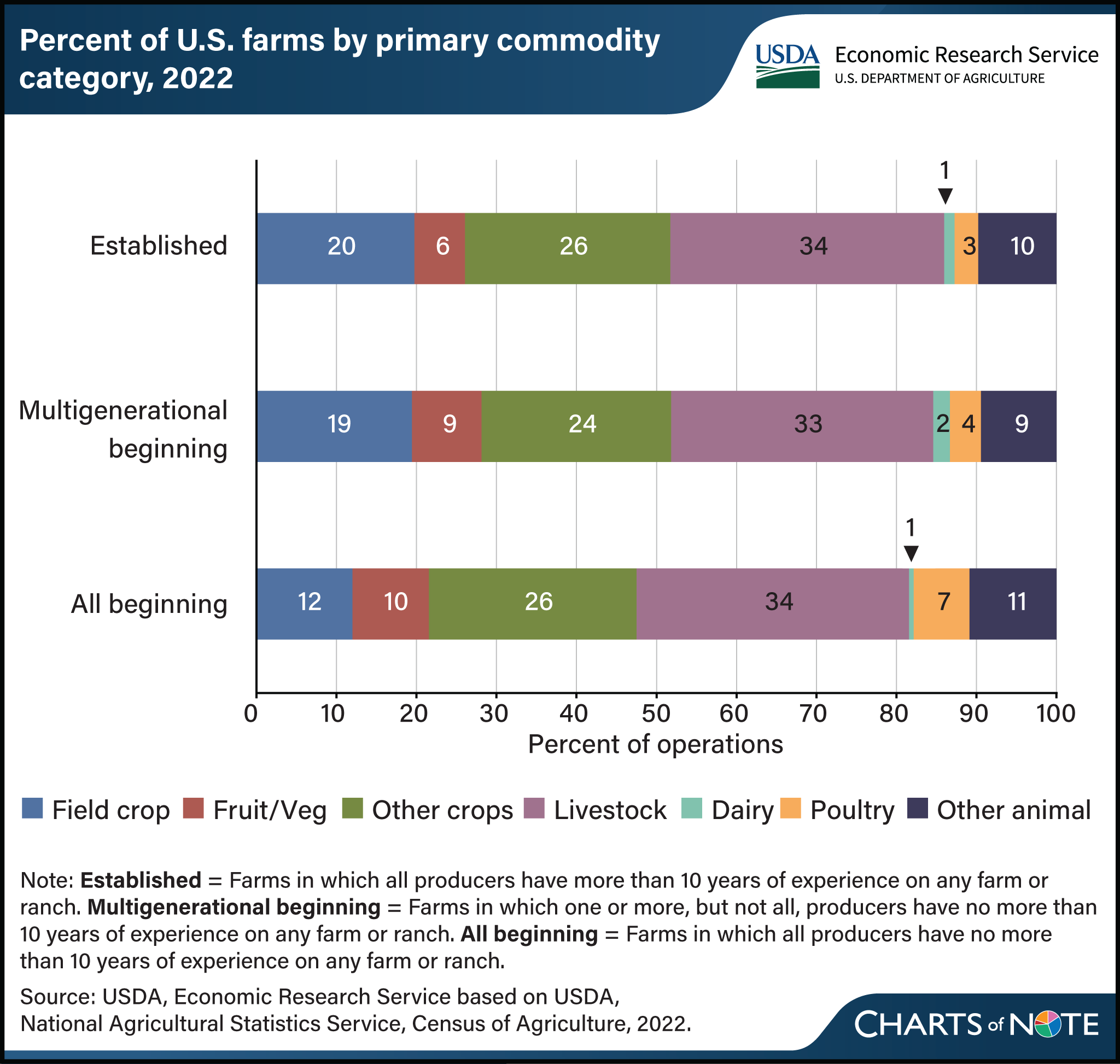
Farms run entirely by beginning operators grow a noticeably different mix of commodities from the farms of experienced producers, according to a Chart of Note from USDA's Economic Research Service (ERS) drawn from a report on beginning farmers and ranchers.
ERS divided U.S. farms into three segments by the experience of their operators. Operations where every operator has no more than 10 years of experience on any farm or ranch, the all-beginning group, made up 23 percent of all operations in 2022. Established operations, where every operator has more than 10 years of experience, accounted for 67 percent. The remaining 10 percent, called multigenerational beginning operations, mix beginning and established operators.
In 2022, all-beginning farms were slightly more likely to be primarily fruit or vegetable producers, at 10 percent, compared with 9 percent of multigenerational beginning operations and 6 percent of established ones.
The gap was wider in poultry. Seven percent of all-beginning farms were primarily poultry producers, against 4 percent of multigenerational beginning operations and 3 percent of established farms. ERS notes that the high degree of vertical integration in the U.S. poultry sector, where a large share of birds is grown under production contracts, may shape the mix of experience among the farmers in that business.
Field crops told the opposite story. Only 12 percent of all-beginning operations were primarily field crop producers, compared with 19 percent of multigenerational beginning operations and 20 percent of established farms. ERS says that pattern is consistent with increased consolidation and with changes in the availability of farmland over the past three decades.
For anyone advising a new entrant, the figures point to where the doors are open: contract poultry and high-value produce need less land than a field-crop operation, while the land base that grain and oilseed farming requires has become harder for a newcomer to assemble. The chart, prepared by ERS economist Katherine Lacy, appears in the report Beginning Farmer and Rancher Operations: Characteristics Associated With Business Survival, published in March 2026.
Source: USDA Economic Research Service


Comments
(0)