
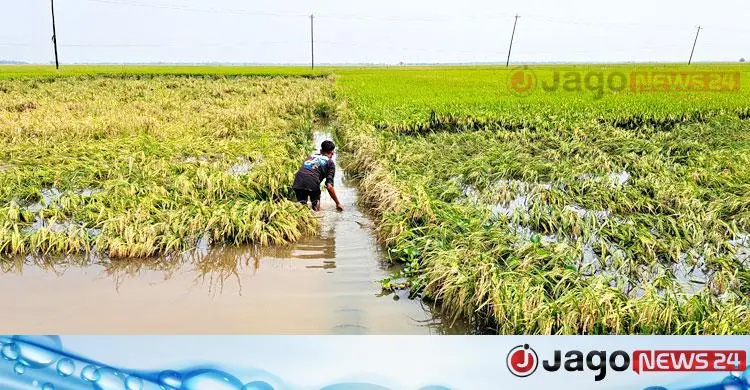
The boro harvest season has begun across Netrokona's vast haors, but instead of joy it has brought worry. Early rain and waterlogging have submerged much low-lying land, and damage now dominates the picture across the fields of ripe paddy. Farmers say the losses are far greater than the official estimate. Added to this are a fuel shortage and a lack of labour. Together, extra costs and uncertainty at the start of the season have made bringing the crop home a major challenge for haor farmers.
Limits on the use of machines in the fields have increased the pressure on farmers. Harvesting is fully under way, but machines cannot be used everywhere. Combine harvesters cannot work on waterlogged land, so farmers are forced to hire labourers at higher cost, which raises production costs and cuts their profits further.
Official and farmers' estimates differ
According to the district Department of Agricultural Extension (DAE), boro was planted on 185,320 hectares in the district, with a production target of 11.86 lakh tonnes of paddy. Farmers began harvesting on Sunday (12 April). But rain since the middle of the month of Chaitra has left water standing on low land in the haors. Officially, unripe paddy on 1,120 hectares has been destroyed by water, but farmers say the damage is nearly double that. Where water has collected, combine harvesters cannot be used.
District agricultural extension officer Aminul Islam said boro has been planted on 41,120 hectares this year across all the haors and low-lying areas of the district, most of it high-yielding hybrid paddy with a life cycle of 145 days. Harvesting is being done by labourers and by more than 700 combine harvesters, which need about 12,000 litres of fuel a day in the upazila. There is no petrol or diesel pump there, but the administration and the agriculture department have taken steps so that the machines do not run short of fuel. Barring a natural disaster, he said, all the paddy in the haors can be cut by the second week of May.
Shafiqul Islam, chairman of Barokhapon union parishad in Kalmakanda, said: "Several thousand acres of boro paddy in Medarbil haor have been destroyed by waterlogging. Where the paddy has survived, it cannot be cut by machine. We will be forced to cut it with labourers, which will raise costs a lot."
Farmers said light to moderate rain every night has left them anxious about the harvest, and there are fears of early flooding if heavy rain comes. Heavy rain could break the crop protection embankments and submerge the whole haor's crop, which would be a disaster for farmers.
However, Sakhawat Hossain, executive engineer of the Bangladesh Water Development Board (BWDB), said there is no significant forecast of rain or flooding at present.
He said that according to the Flood Forecasting and Warning Centre, no heavy rain is forecast until 20 April. Light to moderate rain may fall in Sunamganj and upstream in Cherrapunji in India, but it will not cause a flood. Officials have cancelled leave and are in the field at all times so that farmers can harvest their crops without disruption, he said.
No government paddy buying yet
A worrying point is that government paddy procurement has not yet begun. Marginal farmers are therefore forced to sell paddy cheaply to local moneylenders and middlemen. Having to sell at the start of the season under the pressure of debt, they are missing out on a fair price.
Wasim Mia of Jagannathpur village in Khaliajuri upazila said: "I have planted boro on about 60 acres. The paddy is ripe, but now I can't find labourers to cut it. Harvester drivers aren't getting diesel. Meanwhile the weather looks very bad. There could be an early flood. Hail is falling. All in all we are in a very bad situation."
Local farmers say that although steps have been taken to ease diesel supply, farmers' overall crisis is not easing. Even when fuel is available, natural disasters, standing water in the fields, extra costs and the lack of a fair price have left haor farmers living under uncertainty and pressure.
On one hand, harvesters cannot be used properly because of the fuel shortage; on the other, labour is scarce and wages are high. Farmers are therefore forced to sell paddy cheaply to moneylenders to meet their costs.
Kajal Chowdhury, a farmer of Gaglajur village in Mohanganj upazila, said: "Excessive rain has left water standing in the fields. There are no labourers. Everyone's paddy in the haor has ripened at the same time, but no labourers can be found. Because of the fuel shortage, paddy can't be cut by harvester either. Now I can't sleep for fear of an early flood in the haor."
Shamsul Haque, a farmer of Puranhati village in Khaliajuri, said: "This time, since the water hasn't come yet and there has been no other disaster, we are able to harvest safely. But because the government hasn't started buying paddy, we have to sell to local moneylenders."
Jalil Mia, a farmer of Nagar village, said: "Marginal farmers grow their crops with loans from moneylenders and others. They are forced to sell paddy at the start of the season to repay the loans. So we demand that the government start buying paddy quickly."
Asked about this, district food controller Moyetasemur Rahman said the date for starting government paddy procurement has not yet been set. The government may decide on it quickly, he said.
Deputy Commissioner Khandaker Mushfiqur Rahman said harvesting is in full swing in the haor areas, and everything necessary is being done so that farmers can bring their boro crop into their granaries without disruption.
Source: Jagonews24. First published in Bengali on The Agro News.

Comments
(0)