
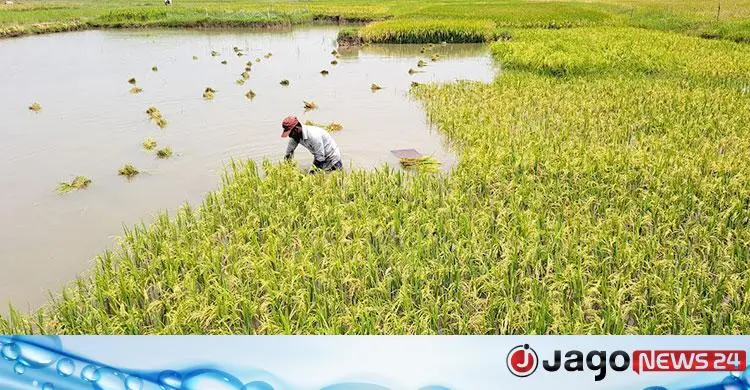
Heavy rain is falling in Cherrapunji in India, upstream of Netrokona, and the water is coming down as hill torrents into the district's rivers. Waterlogging has already set in and water has risen on the plains. Fearing an early flood, the local Bangladesh Water Development Board (BWDB) has used loudspeaker announcements to advise farmers to cut ripe paddy in the haors quickly.
Md Sakhawat Hossain, executive engineer of the BWDB in Netrokona, said the Dhanu-Baulai river had risen on the plains over the past 24 hours. Once 80 per cent of the paddy in a haor field is ripe, it is risky to leave it standing, he said. Netrokona has already had heavy rain and the haors are waterlogged; if water comes down from upstream, levels will rise further, so farmers have been advised to cut ripe paddy quickly.
The BWDB says it has been raining in Netrokona since the start of Chaitra this year, causing waterlogging in various haors. Cherrapunji is getting heavy rain, and when it rains upstream, hill torrents come down into Netrokona, raising the Someshwari, Kangsha, Dhanu, Uddhakhali and other rivers. An early flood could hit the haor areas at any time and damage the boro crop.
Harvesters stuck and labourers scarce
With water in many Netrokona haors, combine harvesters are struggling to cut paddy, and harvest labourers are in short supply. Although there is a diesel shortage for running harvesting machines in the haors, the district administration has taken no significant steps. Farmers are worried about their standing boro, and waterlogging is forcing them to pay high wages to have it cut by hand.
Farmers say harvest labourers once came to the haors from various parts of the country, and there were also many local labourers. Fear of death by lightning has steadily reduced the number of outside workers, and with water in the fields, labourers are unwilling to cut paddy.
With heavy rain upstream in Cherrapunji and the Dhanu rising, local farmers fear that if the water keeps rising they could lose their crop to an early flood as in 2017.
According to local farmers, the upazila administration, the agriculture department and the BWDB, Khaliajuri, Mohanganj, Madan and parts of Kalmakanda are mainly haor areas. Farmers there depend on boro, the haors' only crop, for a whole year's household costs, medical care, children's education and ceremonies.
Of the district's 134 large and small haors, 89 are in Khaliajuri. To protect haor crops from early floods, 138 km of submersible (temporary) embankments were built this year at a cost of Tk 31 crore, under the BWDB and the upazila administration. About 42,000 hectares of boro crop depend on them.
Rain over the past two weeks has raised several rivers in Netrokona, including the Kangsha, Ubdakhali and Dhanu. From Tuesday morning (21 April) until 1pm on Saturday (25 April), the Dhanu at Khaliajuri rose by about two and a half feet, worrying farmers with boro still in the fields. The crop grown on about 42,000 hectares of Netrokona's haor area has a market value of about Tk 700 crore.
Khaliajuri upazila agriculture officer Md Delwar Hossain said paddy had been grown on 20,232 hectares in the upazila, with a target of 148,000 tonnes. Harvesting began in full this week; there is some shortage of labourers and diesel, and officials are trying to solve it.
Upazila Nirbahi Officer (UNO) Nadir Hossain Shamim said the Dhanu had risen somewhat and water had collected in low-lying paddy fields. Farmers have been urged by loudspeaker announcements to cut ripe haor paddy quickly.
Source: Jagonews24. First published in Bengali on The Agro News.

Comments
(0)