
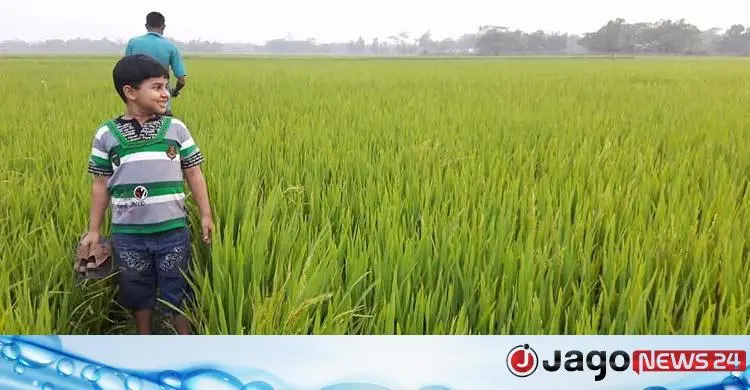
Wasim Mia (43), a farmer from Jagannathpur village in Khaliajuri, has grown boro rice on 15 acres of haor land this year. All of his family's expenses, from food to the children's schooling and medical care, come from boro, the only crop of the year. But the heavy rain, storms and hail of the past few days have left him worried, and the weather has him genuinely frightened.
"The light rain at the beginning was good for the crop," Wasim Mia said. "Then heavy rain left water standing in the haor. Several rounds of hail have damaged the rice. If it rains more now and an early flood comes, we will be ruined."
He is not alone. Many farmers in the haor areas of Netrokona are worried about their crops, and many are frightened. Heavy rain has caused cracks in many crop protection embankments, which could put the haors' only boro crop at risk.
Waterlogging and hail damage
The Bangladesh Water Development Board (BWDB) says light to moderate rain is forecast in Netrokona for the coming week, which will raise river levels somewhat. The heavy rain of the past few days has already caused waterlogging in low-lying parts of various haors, and widespread hail and storms have damaged the boro crop.
In some areas, including Pogla union of Kalmakanda, farmers are trying to pump the water out. Others are afraid to cut the haor embankments for fear of hill runoff and an untimely flood.
Farmers said the boro plants in the haors have not yet reached the booting stage and are still soft, so the hail has done more damage. Waterlogging from the heavy rain could also rot the base of the plants.
Kajal Chowdhury, a farmer from the Gaglajur area of Mohanganj, said the rain and hail water is very cold, and if it stays around the base of the plants for long they will rot. The full extent of the hail damage will only be clear a few days after the sun comes out. "Every haor has waterlogging," he said in the local dialect. "If it rains more, the damage will grow. Now the fear is a flood."
Inquiries found that the heavy rain has caused waterlogging to varying degrees in haors including Dingapota, Charhaijda, Chandrasonartal and Shoytankhali in Mohanganj, and Kirtankhola, Pangasia, Kotichapra, Lakshmipasha, Boali, Jagannathpur and Bilbilliya in Khaliajuri upazila.
Shamsul Haque, a farmer from Puranhati village in Khaliajuri Sadar, said: "In the haor there is water in one part and none in another. The embankment work was not done well this year either. Cracks have appeared in some embankments with the rain. Farmers are worried. If the only crop of the year is lost, the administration and the BWDB will have to take responsibility."
Embankment work behind schedule
Under the policy, project implementation committees (PICs) are supposed to be formed by 30 November, and projects selected by 30 October, under BWDB supervision. Construction of haor crop protection embankments is supposed to start by 15 December and finish by 28 February. This year, however, the BWDB could not finish the earthwork on the embankments on time, and because of the late earthwork crops on about 42,000 hectares of haor land are at risk if embankments break.
According to the BWDB, there are about 365 km of submersible (temporary) embankments under the board in the district. This year 202 PICs have been formed to build and repair 137.579 km of embankment, with an allocation of Tk 30 crore 52 lakh. Of the 202 PICs, 143 are in Khaliajuri, 29 in Mohanganj, 19 in Madan and 10 in Kalmakanda.
Sources said haor embankments were once repaired through contractors. But after embankments broke and crops were lost in the untimely flood of 2017, allegations of irregularities and corruption were raised against some dishonest BWDB officials and contractors. Contracting was then scrapped and the PIC system introduced. The upazila committee is chaired by the local upazila nirbahi officer (UNO), with a BWDB sub-assistant engineer as member secretary. The district committee is chaired by the deputy commissioner, with the BWDB executive engineer as member secretary.
Each committee has 5–7 members drawn from local farmers, who rebuild and repair the haor crop protection embankments. Each project is allocated from Tk 5 lakh up to a maximum of Tk 30 lakh for its work.
Seven haor districts and a heavy rain forecast
Sources said the seven districts of Sunamganj, Sylhet, Habiganj, Moulvibazar, Netrokona, Kishoreganj and Brahmanbaria grow 20 per cent of the country's total boro output. This year farmers have planted rice on 9 lakh 63 thousand hectares, and the crop has now reached the flowering stage.
Meteorologists said the Sylhet region has had 200 mm of rain in the past four days, and a further 200–300 mm could fall by 23 March. Such early and intense rain is unusual for March and raises the risk of flash floods. Hill runoff from Meghalaya and Assam in India poses this kind of threat to the haor basin every year.
The delay in finishing the crop protection embankments has made the situation more complicated. The work was supposed to be completed by February, but even after the deadline was extended it remains unfinished in many areas, raising fears of a repeat of the devastating floods of 2017 and 2022.
According to the Flood Forecasting and Warning Centre (FFWC), the Surma-Kushiyara and Dhanu-Baulai rivers are rising, though still below the danger mark. More rain is likely in the haor basin over the next few days.
Officials say embankments are ready
District BWDB executive engineer Md Sakhawat Hossain gave a different account of the embankments: "Earthwork has been completed on all the embankments in the haor, and grass has been planted on them. Even if there is some rain at this time, there is no fear of flooding. Cracks appeared in some embankments with the early rain, but they have been repaired quickly."
Deputy commissioner Khandakar Mushfiqur Rahman, who chairs the haor crop protection embankment implementation committee, said the embankment work is being supervised as closely as possible and monitoring has been stepped up on every embankment. Every step will be taken so that farmers can bring home their boro crop safely.
Source: Jagonews24. First published in Bengali on The Agro News.
Comments
(0)