
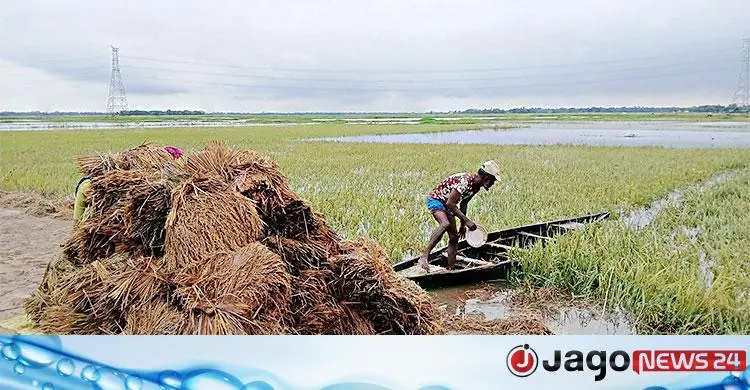
"I grew rice on 10 bighas. The water has swallowed it all. I paid Tk 4,500 in wages to cut the paddy on one and a half bighas, so that at least my family won't be short of food for a month or a month and a half. I have given up hope on the rest. After spending so much money, I have come back from the haor empty-handed this year."
That is how Chhanwar Mia, a farmer in the Kewlar haor of Kamalganj upazila in Moulvibazar, described his helplessness over his boro crop. He is not alone: thousands of farmers in all the district's haors, including Hakaluki, Kawadighi and Hail haor, are in the same situation.
Saying he is having to sell paddy for next to nothing, Chhanwar Mia said: "Workers can't be found even for money. And if you find them, their wages are very high. What is the point of paying to cut the paddy? This paddy has to be sold in the market for only Tk 350 to 450 a maund."
Harvest costs above paddy prices
A severe labour shortage in Moulvibazar's haors means farmers cannot bring their paddy home in time. Before the rice ripened, heavy rain and flash floods from the hills submerged the fields. In some areas paddy can still be cut from chest-deep water, but farmers are holding back for fear of high wages and losses on sale. In the haor, cutting one bigha of half-rotten paddy costs Tk 5,000 in wages, more than the market value of the paddy.
According to the district Department of Agricultural Extension (DAE), boro was grown on 62,400 hectares in the district this season. Of this, about 5,500 hectares were submerged by the floodwater and 4,200 hectares were directly damaged, affecting about 20,000 farming families.
On the ground, farmers cannot dry their half-rotten paddy even when the sun is out. Better-quality paddy sells for Tk 500 to 600 in the market, but rotten paddy fetches Tk 350 to 400. Although the rules allow paddy to be sold to government warehouses at Tk 36 a kg (Tk 1,440 a maund), strict conditions have made this a mirage for ordinary farmers, so they are forced to sell to wholesalers for next to nothing.
Workers afraid of the water
Workers said cutting paddy in chest-deep water is extremely hard and risky. After a worker recently died from a cold, many are afraid to work in the haor, leading to an acute labour shortage.
Tanu Mia and Koysor Mia, farmers in Kawadighi haor, said most paddy in the haor is cut with combine harvesters, but the high water makes machine harvesting impossible. For the same reason, workers are reluctant to cut paddy too. Cutting one bigha of paddy in the haor now costs Tk 4,500 to Tk 5,000.
Md Jalal Uddin, deputy director of the DAE in Moulvibazar, said paddy on about 4,200 hectares in the district has rotted. Because of the acute labour shortage, farmers in many places could not bring their paddy home. If workers could be found, the extent of the damage could have been reduced somewhat.
Source: Jagonews24. First published in Bengali on The Agro News.
Comments
(0)