
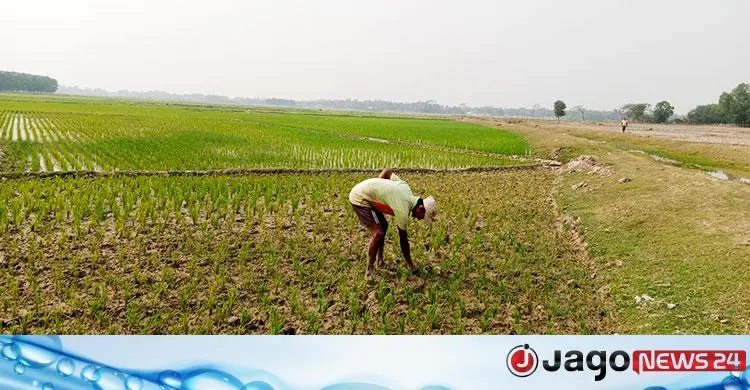
A shortage of water means at least 30,000 hectares of land in Moulvibazar cannot be planted with Boro rice. At the same time, nearly 60,000 farmers who are growing Boro are struggling for water. Many cannot get irrigation even if they pay for it. At the height of the Boro season, the irrigation crisis has left farmers in difficulty: some have run short of water after transplanting seedlings, while others cannot transplant at all.
Farmers in the affected areas say that if the government arranged water for Boro cultivation, they could grow Boro just as they grow Aman. But year after year passes without any irrigation being provided. Because irrigation canals are not dug, the water does not come. The problem exists everywhere, in haor and non-haor areas alike.
Fields drying out
Visits to Hakaluki, Kawadighi, Keolar Haor and non-haor areas across the district's seven upazilas found severe water shortages in both haor and non-haor land. On many plots, rice seedlings have dried out after transplanting, while elsewhere farmers could not transplant for lack of water. Farmers who spent Tk 22,000 to 25,000 an acre on Boro are losing everything to the water shortage. At least nearly 60,000 farmers in the district face the crisis, and the authorities concerned are taking no effective steps to solve it.
According to the Moulvibazar office of the Department of Agricultural Extension (DAE), the district's target for this Boro season is 62,400 hectares, about 27,345 hectares in haor areas and 35,055 hectares in non-haor areas. But these areas face a severe irrigation crisis. Fourteen government solar irrigation units are running in the seven upazilas; more of them would partly solve the problem. Without the irrigation crisis, at least another 30,000 hectares could be brought under Boro cultivation.
Where water is short
In Kamalganj upazila, the Patanushar, Shamshernagar, Alinagar and Adampur unions face an irrigation crisis because less water from the Laghata river reaches upstream. In Sadar upazila, several unions including Giasnagar and Mostafapur, and the low-lying parts of Kanjar Haor, are short of water. Several thousand farmers growing Boro on about 2,000 to 2,500 hectares served by Kudali Chhara are deeply worried by the water shortage. About 10,000 farmers in Rajnagar and Sadar upazilas fear a water crisis.
The 105-kilometre irrigation canal built to serve Kawadighi Haor has gradually silted up and risen because it has not been re-excavated, so every Boro season farmers around the haor worry about irrigation water. Several unions of Rajnagar upazila also face shortages. In many places, water is held back with cross-dams and sluice gates for cultivation, so farmers upstream get none.
In Kulaura upazila, several thousand farmers in Hajipur, Sharifpur, Prithimpasha and other unions are short of water. The upper part of Hakaluki Haor also faces a severe shortage, and water has to be brought from the deep part of the haor through flexible pipes. Boro cultivation is also being hampered by water shortages in Juri and Barlekha.
Farmers Salman Mia of Kulaura and Mortuj Ali of Kamalganj said they plant Boro in the hope of water, which then never comes. After spending a lot of money they return empty-handed. To save the crop they have to bring water from far away. Some water is available at the start of the season, but by mid-season there is none at all.
What officials say
Md Khaled Bin Olid, executive engineer of the Moulvibazar Water Development Board, said farmers in areas with irrigation canals are getting more or less water. He could not say anything about areas without canals. When there is a problem in a canal, the board tries to solve it.
Md Jalal Uddin, deputy director of the DAE in Moulvibazar, said various upazilas of the district face a water crisis because not enough water flows through the canals and chharas (hill streams), and problems with tubewells also leave farmers without water. With enough tubewells or irrigation, Boro cultivation in the district could grow by at least another 30,000 hectares. Re-excavating the Kodali Chhara irrigation canal alone would allow Boro on several thousand hectares. The DAE has asked the Water Development Board to dig the chharas and canals that are not carrying water, he said.
Source: Jagonews24. First published in Bengali on The Agro News.
Comments
(0)