
Livestock and poultry rearing plays a large part in reducing poverty and creating jobs among the rural poor. Many villagers earn extra income from keeping animals and birds, and some have built large commercial farms. Yet while the livestock sector has grown, many animals die for want of prompt treatment. Upazila livestock hospitals offer care, but distance keeps many farmers from using them.
To tackle this, mobile veterinary clinics are being launched in 360 upazilas of 61 districts to take treatment to farmers' doorsteps. The clinics will travel with a vet on board, and the service will be free.
How the clinics will work
The Department of Livestock Services' distribution of mobile veterinary clinics, aimed initially at bringing modern emergency animal treatment to farmers in 61 upazilas, was to be formally inaugurated on Wednesday (9 February), with the service to be extended to 360 upazilas in phases. It is run under the Livestock and Dairy Development Project (LDDP).
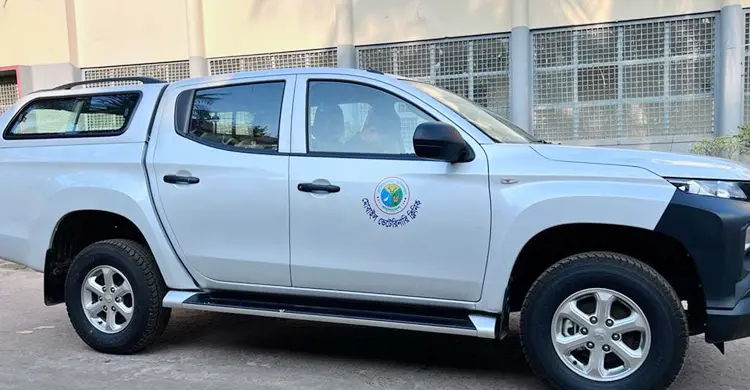
Each clinic is a vehicle customised with the logistics needed for animal treatment, with a steel box at the back holding portable machines. The words "Mobile Veterinary Clinic" will be written on the side. The upazila livestock officer will sit in the middle section with a veterinary surgeon, and a compounder or dresser will sit beside the driver. The vehicle will carry emergency equipment and medicines so that the vet can give immediate help when needed.
A Tk 4,280 crore project
According to the LDDP, the project, implemented by the Department of Livestock Services with joint funding from the World Bank and the Bangladesh government, has a total investment of Tk 4,280 crore. The World Bank's share is 500 million US dollars, the largest investment in the livestock sector. The five-year project began in January 2019 and ends in December 2023.
The project works to raise milk and meat production; increase the output of cows and bulls, goats and sheep, and ducks and chickens; build farmers' skills through training and technology demonstrations; create market links for milk; diversify products and add value; develop local entrepreneurs and jobs; increase animal protein production; and raise food-safety awareness among producers, transporters, traders, artisans and consumers.
Project officials said Bangladesh has come a long way in livestock and poultry rearing over the past decade. Farms of improved breeds of cattle, goats, buffalo, sheep, ducks, chickens, pigeons and turkeys are growing by the day. Where animals were once kept in a corner of the village yard to help with farming, for milk and eggs, or as a hobby, they are now produced and marketed commercially on a large scale.
Hundreds of Department of Livestock Services vets and a large workforce provide regular services at district, upazila and field level, and the government supplies vaccines, treatment and medicines free of charge. But no proper system has been built for immediate help when cows have difficulty calving. Special ambulances for emergency treatment of livestock and poultry were seriously considered, but unlike people, animals, especially large improved-breed animals, are not easy to carry to a treatment centre by ambulance.
A first for Bangladesh
Taking all this into account, the government has taken the initiative, for the first time and modelled on developed countries, to simplify animal treatment through mobile veterinary clinics. The upazila-based clinics will provide emergency treatment and advice in remote villages. From now on, a phone call from anywhere in the country to the upazila livestock office will quickly bring the clinic to the farmer's door.
According to the Department of Livestock Services, the clinics will carry diagnostic equipment, medicines and treatment supplies. Besides emergencies, vets and skilled staff will make routine visits in the clinic vans to the unions and villages of their upazilas, giving treatment, medicines, advice and training. The LDDP has arranged for the clinics to be supplied with the necessary equipment, vaccines and other medicines. Sixty-one clinics are already ready, and the project office said the rest would soon be sent to the upazilas.
Those involved hope that once this is in place, farmers will no longer worry about emergency treatment for their animals, and vets and staff will be able to bring more animals under health care more quickly. Farmers will no longer feel alone, and their confidence, investment and production will rise considerably. Bangladesh will also move a step closer to the "One Health" approach declared by the World Health Organization, ensuring good health for people, animals and the environment alike.
Tk 53 lakh per vehicle
Dr Md Golam Rabbani, chief technical coordinator of the LDDP, told Jagonews24 that veterinary treatment is one of the department's main services. Besides a vet, treatment needs logistic support, since an animal may need an X-ray or ultrasonogram, and without it a vet cannot work at full efficiency. That is what the upazila livestock hospital is for, but it is hard for a marginal farmer to bring a sick animal there, and a vet going out on a motorcycle cannot carry all that equipment. "That is why I want to develop the mobile veterinary clinic service," he said. The vet will reach the sick animal with all the logistic support, and the service will help in emergencies.
He said the service would bring treatment to farmers' doorsteps and increase the mobility of those providing it. "We have bought 360 vehicles in three phases. They will go to various upazilas of 61 districts. In the first lot we bought 61, and their BRTA work is complete. From 9 February they will be handed out to different places." For the second phase of 180, the project has applied to the BRTA for route permits, registration numbers and digital plates. All the vehicles have been bought.
He said the first round covers many districts, and the vehicles are being distributed according to animal population and disease levels, with every division covered to a greater or lesser extent. If the registration of the 180 comes through next month, those will also be distributed. The government has already given every upazila livestock officer a corporate mobile connection dedicated to that upazila, and the officer will coordinate the service. Each upazila has a veterinary surgeon and several sub-assistant officers, so there will be no shortage, he said, calling it a continuous process. Each vehicle costs Tk 53 lakh, and Tk 200 crore has been allocated to buy the 360 vehicles.
Minister: a new horizon
Fisheries and Livestock Minister SM Rezaul Karim told Jagonews24 that the livestock sector has undergone a revolutionary change and is an important partner in the country's development under Prime Minister Sheikh Hasina. Alongside higher livestock production, animal treatment is also improving, and a new horizon is opening, he said. "Our aim is to deliver emergency treatment to animals immediately."
He said the upazila-based clinics would give emergency treatment and advice in remote areas, reaching farmers quickly after a call to the upazila livestock office. They will carry diagnostic equipment, medicines and supplies, and farmers will not have to pay any fee. Besides emergencies, vets and skilled staff will make routine visits to unions and villages, giving treatment, medicines, advice and training, and will build a livestock and treatment database.
Source: Jagonews24. First published in Bengali on The Agro News.
Comments
(0)