
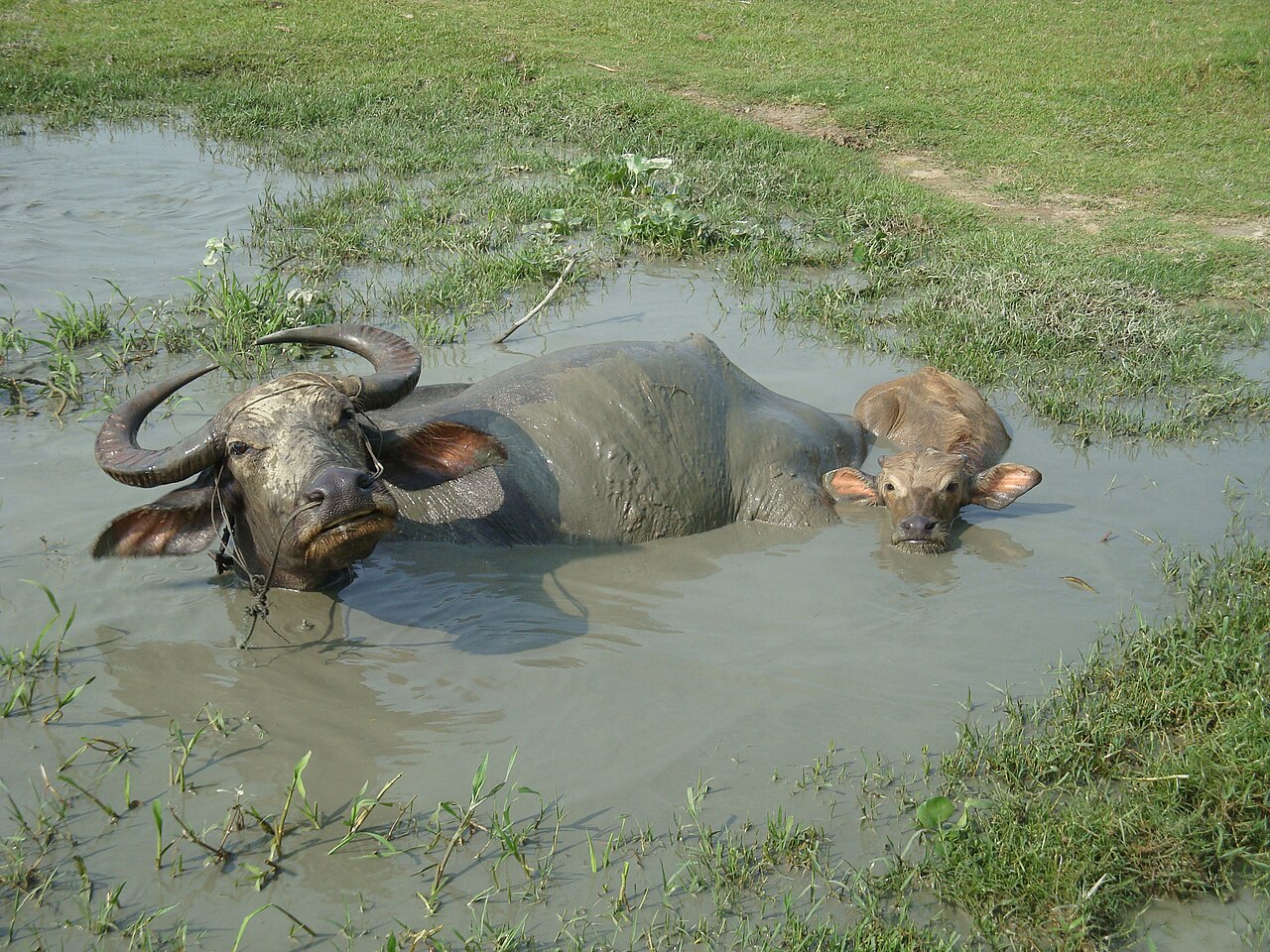
The free-ranging buffalo herds of Bangladesh's coastal islands and chars, known as bathans, are at risk of disappearing. A Prothom Alo investigation found four pressures driving owners to give them up: shrinking grazing land, cases filed by the forest department, feed shortages linked to climate change, and political and administrative harassment.
Figures from local livestock offices put more than 600,000 buffaloes in about 700 bathans across Barguna, Patuakhali, Barishal, Bhola, Lakshmipur, Noakhali, Feni and Chattogram. About 300,000 are milked in a year and more than 150,000 go for meat. Assuming 3 litres a day per milking buffalo for 300 days, Prothom Alo calculates milk sales at about Tk 3,510 crore a year; at 240 kg of bone-in meat per animal and Tk 600 a kilo, meat comes to about Tk 2,160 crore. That is roughly Tk 5,670 crore a year, though official statistics carry no separate figure for the bathans.
Ownership rests on a custom about 200 years old, the 'daag': a mark cut into both ears with a knife or blade. It has no legal standing. When storms or tides carry buffaloes to another char, officials demand papers; in 2013 an assistant judge's court in Companiganj, Noakhali, refused to accept the marks and ordered five buffaloes auctioned. This year 284 buffaloes were held by the administration for about two months at Kalir Char in Sandwip.
Herders say the bathans of Jahajjar Char alone held about 25,000 buffaloes 15 years ago and about 10,000 now, and five of the eight districts' livestock offices report a decline. In Subarnachar and Companiganj, Noakhali, ten families once owned 500 to 1,000 buffaloes each; one family in Companiganj now keeps 800 to 900. 'If we go into the plantations, the forest department files a case. If we move from one char to another, they say the buffaloes are stolen. I can't go on like this,' said owner Nizam Uddin.
Yet these native swamp buffaloes are among the livestock best suited to a coast hit by climate change: they swim for long periods in floods and tidal surges, live on poor fodder and cool themselves in water. A study cited in the report found that about 200 hectares of fodder land in Kalapara, Patuakhali, are damaged by salinity each year. The herds' dung also helps turn saline char soil into cultivable silt, and egrets, mynas and other birds feed around them.
'Without digital registration it will be hard to save the bathans. Each buffalo should have a unique identity number,' said Shakila Faruque, acting director general of the Bangladesh Livestock Research Institute, who also called for separate grazing and ownership rules for the chars. Md Reazul Haque, the recently retired director general of the Department of Livestock Services, said the forest department's plantations on newly accreted government land should be leased to the livestock department as pasture, and that online registration of buffaloes was something the department could carry out.
Bangladesh has no full livestock policy of its own and no legal category for grazing land. Owners and herders are asking for designated pastures with raised mounds (killa), ponds and deep tube wells, online registration of births and ownership, and online permission before moving herds from one char to another.
The report is by Nurul Anwar of Prothom Alo.
Photo: Balaram Mahalder / Wikimedia Commons (CC BY-SA 3.0)
Source: Prothom Alo

Comments
(0)