
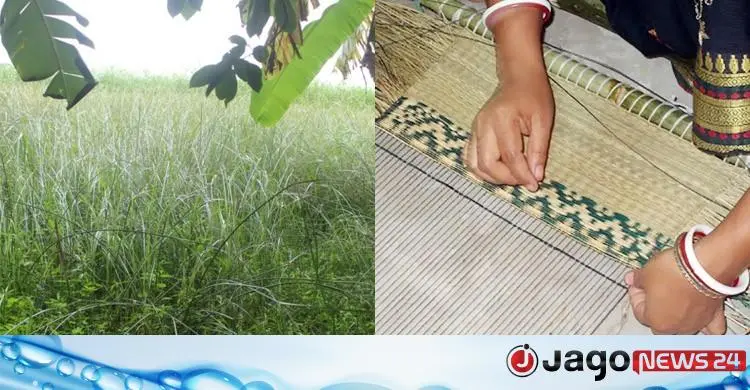
Once, a strip of madur mat spread on the veranda or in the courtyard on a hot afternoon felt like a small piece of cool heaven. This familiar seat of rural culture still comes to mind for many Bengalis. More than something to sit or sleep on, the hand-woven mat is a quiet witness to the region's folk art and refinement. In the past it was indispensable, from welcoming guests to the daily needs of the household. But with time this colourful craft faces a crisis of survival. Many artisans have left the trade of their fathers and grandfathers, and a tradition dear to Bengalis is sinking towards extinction.
A family craft
Mat weaving rests on a neat division of labour within the family. Usually the men cut "mele grass", the main raw material, from the fields, and the women of the house weave it with skilled hands. The weaving is done in two main ways, "ekhara" and "dohara". In ekhara, two sticks are passed alternately over and under the thread; in dohara, the sticks work over and under two cords. Sometimes several small pieces of mat are joined with cloth to make a very large one.
The surface of a mat is a pleasure to look at. Its designs are not only geometric lines but carry touches of Bengal's old poetry and folk tales: in one place the love of Radha and Krishna, in another the epic battle of Rama and Ravana. The weaving style resembles handloom work, while the fine detail recalls the traditional nakshi kantha.
Where the craft comes from
History shows that the craft originated in West Bengal in India, with Medinipur district as its heart. Mat-making goes on in household after household in Talda and Sarta of Sabang police station, Raghunathbari of Panskura, Moyna, Ramnagar, Haldia and elsewhere. It is also made commercially in Cooch Behar, Sriniketan in Birbhum and various parts of the Twenty-Four Parganas.
Bangladesh too has a rich history of mat-making, with the craft found in Rajnagar and Barlekha in Moulvibazar, Balaganj in Sylhet, Swarupkathi in Pirojpur, and Faridpur. But the most famous centre in the country is Assasuni upazila in Satkhira. Its Kadakati, Baradal, Khajra and Pratapnagar areas were once known as mat villages; today only a handful of people there cling to the memory.
Just two decades ago, 90 per cent of families in Tentulia village of Assasuni lived by weaving and selling mats. Today the village is silent. The cottage industry has suffered an alarming collapse across Bangladesh, for several hard, practical reasons.
Why the craft is declining
- Thin margins: after a full day's work an artisan earns almost nothing. Assasuni mat seller Afzal Mia said a small mat costs Tk 250-300 to make and sells for Tk 350. A large mat costs Tk 500 and brings a profit of only Tk 100. It is impossible to support a family on such an income.
- Scarce raw material: mele grass, the heart of the mat, is now hard to find. With low market demand, farmers are losing interest in growing it, and artisans face a severe shortage of raw material.
- Cheap substitutes: cheap and durable alternative mats have taken over the market, and the attractive, environmentally friendly mele-grass mat is losing out to these artificial products.
- No new generation: young people do not want to join a dying trade. Because of weak demand and economic uncertainty, artisan parents themselves are keeping their children away from the work.
What could save it
Despite the odds, representatives of civil society want to keep the folk craft alive. According to the artisans, easy-term loans from government and private banks, proper government patronage and buyer awareness are what could give the craft new life.
The West Bengal government has given the mat a geographical indication (GI) tag, raising it to international standing. If Bangladesh took a similar step to protect the craft, the scent of the soil and the lasting coolness of mele grass might return to Bengali sitting rooms.
Source: Jagonews24. First published in Bengali on The Agro News.

Comments
(0)