
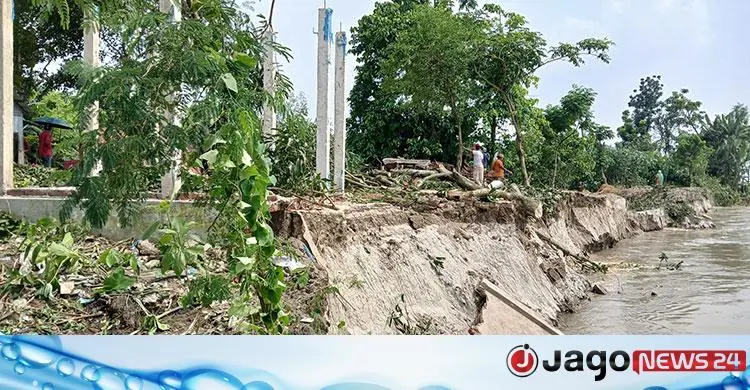
Floodwater has begun to recede in Kurigram, and the scars of the disaster are becoming clearer. On one side, severe river erosion is swallowing homesteads; on the other, hundreds of hectares of cropland have been submerged and ruined. Thousands of people in the district now face the twin crisis of possibly losing their homes and losing their crops.
Driven by onrush from upstream and the rise and fall of river levels, severe erosion has broken out along the Dharla, Brahmaputra, Teesta and Dudhkumar rivers. As the water drains away, the fields show damaged vegetables, Aman seedbeds and other crops.
Geobags at 30 of 40 erosion points
According to the Kurigram office of the Bangladesh Water Development Board (BWDB), geobags are being dumped on an emergency basis at 30 of the district's 40 erosion-hit points. But with no permanent protection at most sites, people living along the riverbanks remain anxious.
Visits to parts of Kurigram Sadar, Ulipur, Chilmari, Bhurungamari and Rajarhat upazilas found riverside areas collapsing into the rivers one after another. Many families have been left destitute after losing their homesteads. Having devoured farmland, the rivers have in many places come right up to people's homes, and those living on the banks spend day and night in fear.
Those affected said that river erosion has forced many of them to lose their homesteads five to 15 times in their lives. If their last shelter now goes into the river, they will have nowhere left to go. They are demanding swift, effective and permanent measures.
According to the BWDB, the banks of the five main rivers among the 16 that flow through the district have a combined length of 374 km. Only 66 km of that has permanent river protection.
BWDB executive engineer Rakibul Hasan said erosion had increased on several rivers because of the rise and fall of water levels. Of six kilometres identified as highly vulnerable, work is under way on four kilometres, and a proposal has been sent for work on the remaining two. Given the urgency, erosion control work is going on on an emergency basis, he said.
Around 500 hectares of crops damaged
As the floodwater recedes, heavy losses are also emerging in the district's farm sector. Around the district, pointed gourd, chilli, aubergine, Aman seedbeds, jute and other vegetables and crops have been badly damaged. Many farmers had borrowed money to cultivate, and a single flood has shattered their hopes.
Abdul Latif, a farmer from the Shulkur Bazar area of Panchgachhi union in Sadar upazila, said: "The floodwater has completely destroyed my vegetables of different kinds. After such a big loss I don't know what to do. I am very worried."
Abu Mia, a farmer from the same area, said his aubergine and pointed gourd field on 20 decimals of land had been completely destroyed.
The Department of Agricultural Extension (DAE) said crops on about 500 hectares in the district had been damaged in the recent flood. Work to establish the full extent of the losses at field level is continuing.
Abdullah Al Mamun, deputy director of the DAE in Kurigram, said affected farmers could grow chilli, aubergine, cucumber and various leafy vegetables once the water has gone down. If that is not possible, black gram (mashkalai) can be a profitable alternative. With the risk of further flooding, he also advised raising Aman seedbeds on high ground. He added that because the jute was already well grown, losses in that crop had been comparatively small.
Source: Jagonews24. First published in Bengali on The Agro News.


Comments
(0)