
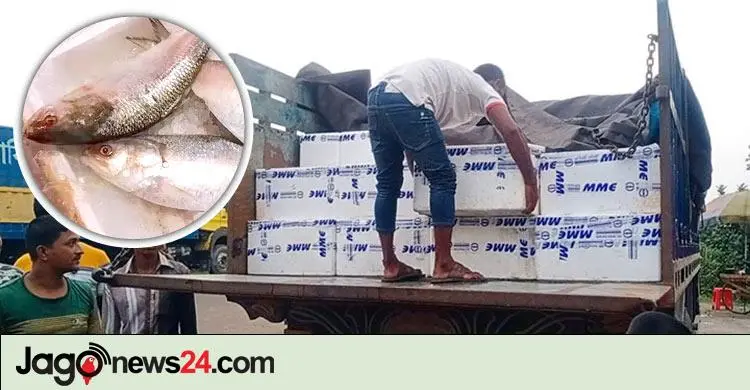
Under the Ministry of Commerce's conditions, Sunday, 5 October, was the last day for exporting hilsa to India. Of the 1,200 tonnes permitted this year, only 107 tonnes 226 kg were exported, and only 16 of the 37 exporters managed to ship any. Of the total, 106 tonnes 34 kg went through Benapole port and 1 tonne 192 kg through Akhaura port. Traders say the target was missed because of a shortfall in hilsa production and rising prices.
People in the trade said hilsa used to be on the export list like any other fish, but the previous government stopped hilsa exports in 2012, citing a production shortfall. In 2019 it again allowed conditional exports, under special consideration, during Durga Puja only. Since then hilsa has gone to India every year before the festival.
This year, on 16 September, the interim government allowed 37 exporters to export 1,200 tonnes of hilsa. Exports began on 17 September, and under the conditions 5 October was the last day. Within that time only 16 of the 37 traders exported, a total of 107 tonnes 226 kg.
A pattern of missed targets
Last year the government allowed 49 exporters to ship 2,420 tonnes. Only 26 of the 49 firms exported, sending 532 tonnes.
Those concerned say exporters are chosen on political considerations without checking their capacity, which is why foreign exchange targets from the exports are repeatedly missed.
Fisheries department data show that in 2023, 79 firms were approved to export 3,500 tonnes, but only 631.24 tonnes were exported. In 2022, 59 firms were approved for 2,900 tonnes, but only 1,300 tonnes went. In 2021, 1,699 tonnes were exported against 4,600 tonnes approved for 115 firms. In 2020, 1,450 tonnes were permitted for Durga Puja but only 500 tonnes went to India. In 2019, 500 tonnes were approved and 476 tonnes exported.
"The government is losing foreign exchange because exporters are chosen without checking their capacity," said Meherullah, port affairs secretary of the Benapole C&F Agents Association. "Everyone rushes to get permission before the export season, and then they cannot export a single fish. The same people get permission again the next year."
Fish buyer Azizur Rahman said: "When hilsa is exported to India, the price at home doubles and goes beyond ordinary people's reach. If export orders were not given, prices in the domestic market might fall."
Exporters point to prices
Nurul Amin Biswas, owner of Benapole hilsa exporter Biswas Traders, was permitted to export 30 tonnes but could not export any.
"The market price of hilsa is much higher than the export price," he said. "Meanwhile India has its own hilsa, so prices there are low, and Indian importers showed little interest. That is why most of the permitted firms held back. The short time allowed also meant the target could not be met."
Asawadul Islam, inspector at the fish quality control centre at Benapole port, said that under the conditions 5 October was the last day for hilsa exports. This year 106 tonnes 34 kg went to India through Benapole, each fish weighing a kilogram or more. The Ministry of Commerce set a minimum export price of $12.50 a kg, equivalent to Tk 1,535.
Source: Jagonews24. First published in Bengali on The Agro News.
Comments
(0)