
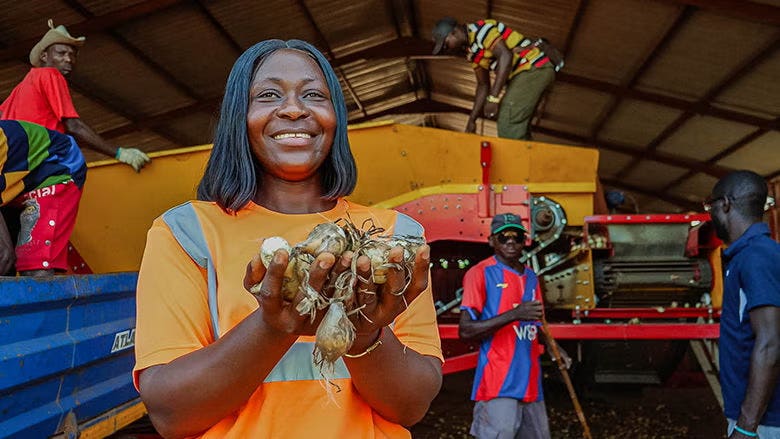
At the rural crossroads of Tanene, 50 kilometres from Guinea's capital Conakry, women run small stalls at dawn, smallholders walk to their rice plots and transport workers keep the roads busy. Beyond them stretch green plains, and this is where Bassam Merhi, CEO of BMI Farms, found a calling he never expected. "If someone had told me that I will be investing in agriculture, I would have said, you're crazy," he said, looking over rows of fruit trees fed by a modern irrigation system.
Five years ago his plan was a beer factory. When he approached the International Finance Corporation (IFC), the World Bank Group's private-sector arm, for financing, he learned the project would qualify only if it were linked to agriculture. He changed course, and the shift ended in a full commitment to farming and to the surrounding villages.
The start was hard. "The journey was not easy. We lost two years trying to find the right solution," Merhi recalled; early crops failed on irrigation problems and recurring water shortages, the same constraints smallholders face. IFC's Local Champions Initiative identified BMI Farms as a high-potential local business and connected it to the Guinea Commercial Agriculture Development Project (PDACG), financed by the International Development Association (IDA), which provided technical assistance and expert advice on fruit selection, soil management, irrigation design and processing equipment.
The farm now cultivates more than 1,000 hectares using precision agriculture. Two dams were built and circular pivot irrigation installed to use water efficiently and allow year-round cultivation, and with stable yields the company added a processing plant for juice concentrates and soft drinks, adding value to local produce and cutting waste. BMI Farms employs nearly 300 people from 27 villages around Tanene, has drilled more than 60 boreholes for clean water and has extended electricity to schools and nearby communities. "I feel really proud working here," said Lucie Maomie, who took her first job at the farm as an administrative assistant after university.
The case illustrates how IDA and IFC together support commercial agriculture and bring smallholders into value chains through matching grants. In Guinea, IFC reviewed 20 agribusinesses for potential investment while IDA provided $6.5 million in grants for their business plans, attracting $36 million in additional private capital. Through matching grants and market infrastructure, more than 14,800 jobs have been created along agricultural value chains, including 5,000 for women; more than 49,500 farmers and rural households have gained new commercial opportunities, and 493 private promoters have received support. IDA's backing for the third Guinea Investment Forum in 2024 helped agribusinesses secure $14.1 million in local funding, which Oliano Diana Kouyate, Director General of APIP, said has carried three projects, in cassava processing, food production and tarpaulin manufacturing, from concept to fully funded businesses.
Exports are moving too. According to Amadou Daff Balde, Director of AGUIPEX, Guinea's fonio exports rose from 57 tons in 2020 to 600 tons in 2024, helped by the first international fonio forum and a new regional network, and the Bank Group has updated digital tools at APIP and AGUIPEX to make it easier for entrepreneurs to grow agribusinesses. Guinea is one of 23 countries in the AgriConnect Compacts and, with the agricultural goals of its Simandou 2040 programme, is positioned to add more value to what its farms produce.
Source: World Bank
Comments
(0)