
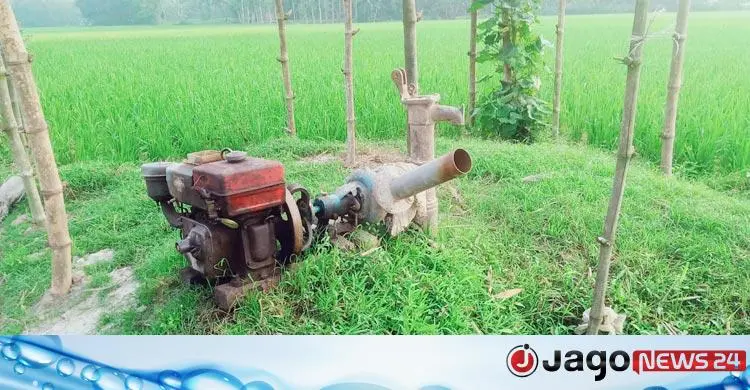
Farmers in Gaibandha are deeply worried and frustrated by the fuel oil crisis. Those who depend on shallow machines for irrigation are hit hardest. Costs had already risen with higher labour wages, expensive fertiliser and a falling water table, and the fuel crisis has come as a blow on top of it all.
Farmers say they will face heavy losses unless the fuel problem is solved quickly.
On the ground, green paddy stretches to the horizon, and farmers are counting the days until they can bring in the crop they have toiled over. But the sudden fuel crisis means they cannot water their fields on time at the height of the boro season. In many fields the ears are about to emerge, but there is no water, and in many the soil has cracked for lack of it. At a time when farmers should be smiling, they are worried. Many go from one filling station to another for fuel and still come away empty-handed after two or three rounds.
Officials urge water saving
The agriculture department says the necessary steps will be taken so that irrigation is not disrupted, and that farmers must also take care not to waste water. Sub-assistant agriculture officers are working in the field to give farmers this advice.
The Gaibandha Department of Agricultural Extension (DAE) says crops are growing on about 167,294 hectares in the district this season, including 129,020 hectares of boro.
Farmers said boro fields need regular irrigation at this stage. Water must always be kept at the base of the plants, with irrigation every other day. But without enough diesel at the pumps, irrigating has become difficult, and yields may fall.
By farmers' reckoning, it costs about Tk 16,000-17,000 to grow boro on a bigha, which yields an average of 24-26 maunds.
Farmers' accounts
Mojahidul Islam, a farmer from Lakshmipur in Gaibandha Sadar upazila, said: "When we go to the filling station they give one litre, at most two. Without fuel I can't irrigate the boro fields enough, and boro needs a lot of water now."
Abdul Matin, a farmer in Haripur union of Sundarganj, said: "Without diesel we can't water the fields on time. The paddy plants are drying up. If I don't water now, the whole crop will be lost."
Rahim Uddin, a farmer from Boali in Sadar upazila, said: "We used to get fuel as soon as we went to the station. Now we stand in line for hours and still go home empty-handed. The fuel price has also risen, so costs have doubled."
Majnu Mia, a farmer from Bishubari in Gobindaganj, said angrily: "We live hand to mouth. If we can't irrigate, there will be no crop, and without a crop it will be hard to support the family."
Local farmers complain that with irrigation disrupted by the fuel crisis, boro production could be badly hit, and they fear their losses will grow unless fuel supply returns to normal soon.
Filling station owners say the problem arises because less fuel is arriving than is needed, but they are trying to give everyone a share of what they get.
Sub-assistant agriculture officers in the field said enough water must be kept in the paddy fields at this time. Several spells of rain had meant irrigation was not needed, but the fields now need it. Farmers who use shallow machines are unable to water their land because of the fuel crisis, they said.
Atiqul Islam, deputy director of agricultural extension in Gaibandha, said boro fields must have water, and there is a risk of crop damage if water cannot be kept in the fields now. Farmers are being given various kinds of advice in the field, he said.
Source: Jagonews24. First published in Bengali on The Agro News.

Comments
(0)