
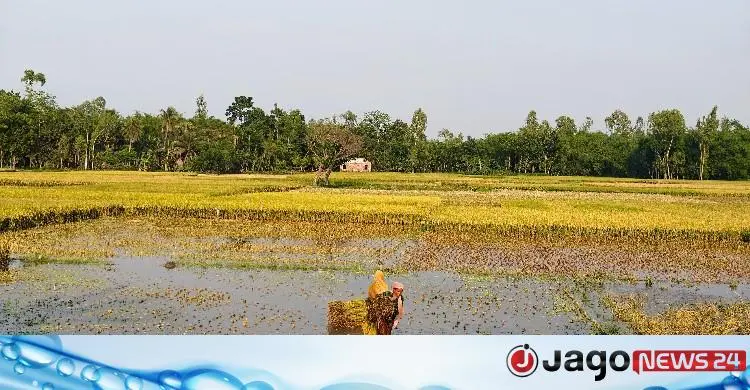
Several days of continuous rain have shattered farmers' hopes. Paddy on low-lying land has gone under water, and farmers cannot find labourers to harvest it, so many are wading into the water to cut the crop themselves. It is the peak of the season and threshing is under way across the district, but there are no smiles on farmers' faces: labour is scarce and wages are high, yet paddy is selling for next to nothing. Government procurement has begun, but farmers are running into various complications.
Gaibandha is a northern district where paddy is the main cash crop. This year farmers bought fuel, fertiliser and seed at high prices, and suffered repeated diesel shortages. They grew the crop through back-breaking work, hoping it would feed them for the year, and then a natural disaster struck.
Fields under knee-deep water
In the fields, golden ears of paddy peep out of knee-deep water. In many beels labourers are cutting paddy in groups, while many farmers are harvesting themselves because labour costs so much. Many borrowed to grow the crop; far from repaying their debts by selling it, they are worried about having enough to eat for the year.
Farmers say the boro crop is their income for the whole year. This year they paid more for everything than in other years. Because rain damaged the crop just as harvesting began, they are having to hire labour at double the rate, while the market price of paddy is very low. They expect to lose Tk 5,000 to Tk 6,000 per bigha, and for many, the paddy they had kept to eat through the year has also been ruined.
They say that although the government has set a price of Tk 1,450 a maund, paddy sells for Tk 700 to Tk 800 in the market, and farmers who try to sell to government warehouses face various kinds of harassment.
Farmers' accounts
Afsar Mia, a farmer from Malibari in Gaibandha Sadar upazila, said: "With the fall in paddy prices we will face a big loss. The cost of ploughing, irrigation, fertiliser and pesticide has all gone up. I am worried about how I will repay the shop credit and the loan."
Aleya Bewa of Palashbari upazila said: "This time the storm flattened all the paddy. I have 40 decimals of land, and water has risen over the paddy stalks. I eat from this land all year. The labourers' rate is such that if I hire them to cut it, I will get hardly any paddy; whatever I sell will go to pay them. So I am cutting it with my son and daughter, however hard it is. Even so, I will be short of food this year."
Another farmer, Jamir Ali, said: "There is practically no price for paddy in the market. Selling to the government would reduce the loss a little so we could recover our costs. I have been going around for four days, and they say the online system is down."
Salam Mia, a farmer in Sundarganj, said: "The cost of growing paddy has risen several times over in the past few years, but the market price has not risen in step; in many cases it has fallen. So we are struggling even to recover what we invested."
Omar Faruk, a farmer in Saghata, said: "I have been going around trying to sell paddy to the government warehouse. I went to the union parishad and several shops. They say the software is down. Those who registered last time can get in; those of us applying afresh cannot."
Farmers in the field say they will face heavy losses if the government does not buy their paddy and market prices do not rise.
What officials say
Gaibandha district food controller Md Mizanur Rahman said: "This season 9,000 tonnes of paddy will be bought in the district. Farmers will apply online, and paddy will be taken from those whose names come up in the lottery."
Asked about the problem, he said: "If there is a problem with the software, the whole country is in the same situation. It is a central problem; there is no separate software for Gaibandha. Those who cannot apply will have to keep trying. This is not in my hands."
Md Atikul Islam, deputy director of the Department of Agricultural Extension (DAE) in Gaibandha, said: "This boro season, high-yielding and local varieties of paddy have been grown on 1,29,020 hectares. Some paddy has been damaged by several days of storms and rain."
He said: "We want farmers to get a fair price for their hard-earned crop. The good yield made farmers happy at first, but they are somewhat worried about current market prices. If the weather stays good, farmers will get a fair price. If people do not get a fair price even after growing gold in the fields, they will lose interest in farming in future."
Source: Jagonews24. First published in Bengali on The Agro News.
Comments
(0)