
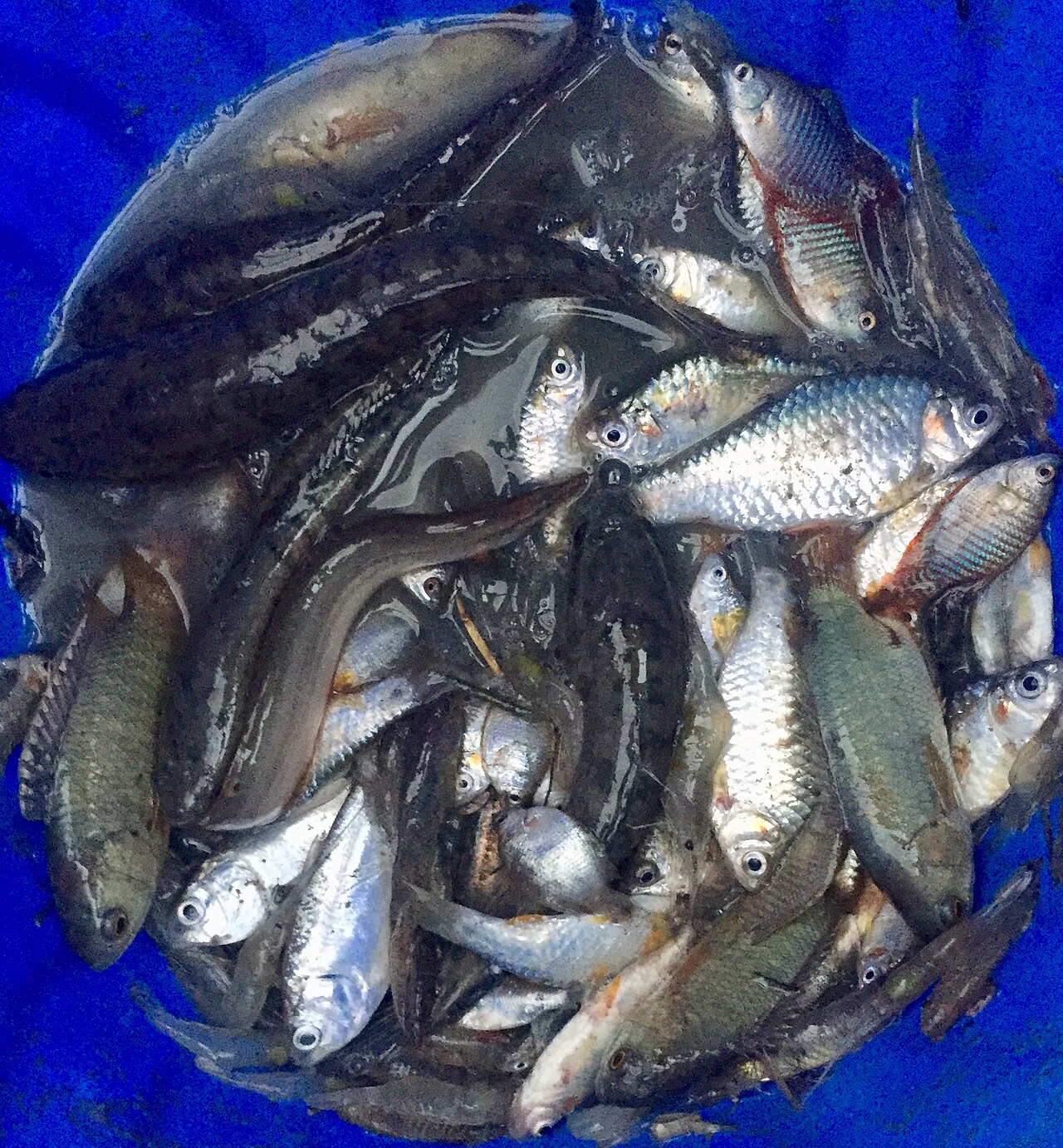
Under Islamic law halal land animals such as cattle, goats and chickens must be slaughtered in the name of Allah before they are eaten. One that dies without slaughter counts as carrion and is forbidden. Fish is the exception: it is halal without slaughter. A piece by the religion desk of Prothom Alo sets out the evidence and the reasons.
The Quran forbids carrion and flowing blood (Surah al-Maidah, verse 3), the piece notes. A hadith, however, says: "Two kinds of dead animal and two kinds of blood have been made lawful for us. The two dead animals are fish and locusts. The two kinds of blood are the liver and the spleen." (Sunan Ibn Majah, hadith 3314) Asked about sea water, the Prophet said: "Its water is pure and its dead are lawful." (Sunan Abu Dawud, hadith 83)
Three reasons are given. First, the main purpose of slaughter is to drain flowing blood, and a fish has no such flowing blood; Imam al-Qurtubi is quoted on this point. Second, a fish has no distinct neck or set of vessels as a four-legged animal has, and slaughtering countless fish one by one would be a hardship. Third, in the language of fiqh, catching a fish or separating it from water is itself its slaughter.
A fish caught in a net and left to die on land, or kept on ice, is halal. Views differ on a fish that dies naturally in the water, with no catching and no outside injury, and floats to the surface, which fiqh calls tafi.
In the Hanafi school, a fish that dies in the water and floats up without an outside cause such as a net, a hook, an injury, poison or the water drying up may not be eaten. The piece cites a hadith in Sunan Abu Dawud (hadith 3815) and the words of Imam Burhan al-Din al-Marghinani in Al-Hidayah. Jurists of the Shafii, Maliki and Hanbali schools hold that a floating dead fish is also halal so long as it has not rotted to the point of harming health.
Writer: Religion Desk, Prothom Alo.
Photo: Aminul joy / Wikimedia Commons (CC BY-SA 4.0)
Source: Prothom Alo


Comments
(0)