
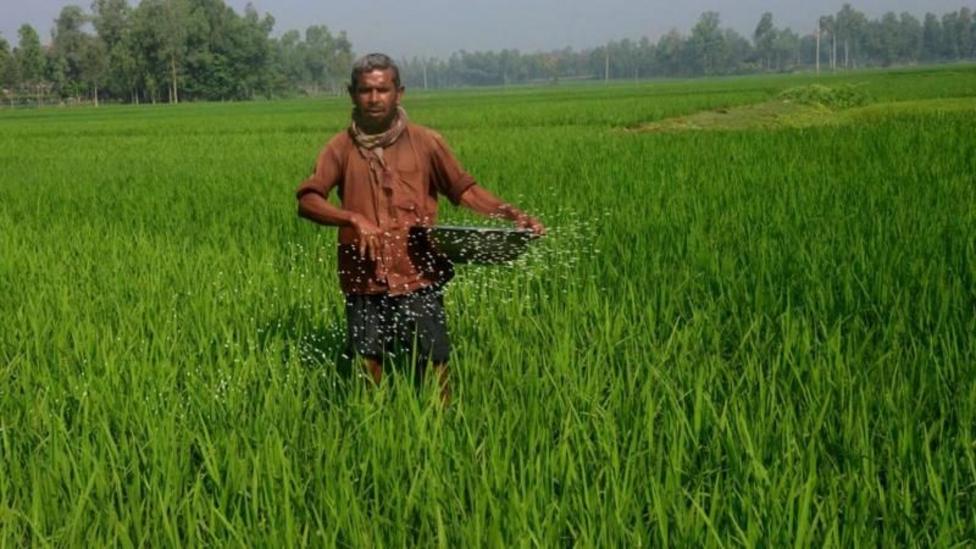
Bangladesh's fertiliser market is in turmoil at the very moment the aman rice season begins. The government says there is no shortage and stocks are adequate. Farmers in Rajshahi, Jhenaidah and Kurigram say the opposite: licensed dealers cannot supply what they need, and retail shops sell only at a premium over the government-fixed price. A video of a dealer's warehouse in Kurigram being broken into and its fertiliser looted has been shared widely on social media and sharpened the argument.
Torap Sheikh, a farmer in Durgapur upazila of Rajshahi, told BBC Bangla: "For five bighas I need five bags, they give one. I need it in the morning, they give it at noon. Can anyone farm like this?" Mohammad Jony, a farmer in Jhenaidah, said fertiliser was available in retail shops but at 200 to 500 taka more per bag. Dealers say they are squeezed too. One Rajshahi dealer listed his allocation for the month: 60 bags of TSP, 60 bags of BADC DAP, 70 bags of Bangla DAP and 80 bags of potash. Urea was available; everything else was short.
The government's figures tell another story. At a press conference on Tuesday, Zahed Ur Rahman, the prime minister's adviser on information and broadcasting, said the country held 1.365 million tonnes of fertiliser: 482,200 tonnes of urea, 369,000 tonnes of TSP, 368,000 tonnes of DAP and 146,000 tonnes of MOP. A further 210,000 tonnes of TSP, 280,000 tonnes of DAP and 375,000 tonnes of MOP were at the import stage. On 24 August the government purchase committee approved the import of 365,000 tonnes, a week after approving another 115,000 tonnes from Canada, Russia and Saudi Arabia.
The adviser conceded there were irregularities in distribution and said the marketing system would be changed. A three-member cabinet committee has been formed to review fertiliser lifting, distribution and dealer appointments. One member, Mir Shahe Alam, state minister for local government, rural development and cooperatives, said the government was considering raising dealers' commissions rather than cancelling existing dealerships. Another, disaster management and relief minister Asadul Habib Dulu, said the crisis was more rumour than reality and that one additional dealer would be appointed in every union.
Import dependence is the structural weakness. According to the Bangladesh Chemical Industries Corporation and the Ministry of Agriculture, about 83 percent of total demand had to be imported in the 2025-26 fiscal year, because gas shortages, mechanical faults and a lack of raw material keep the state-owned factories shut for most of the year. The Bangladesh Fertilizer Association puts annual demand at roughly 7 million tonnes of chemical fertiliser, of which about 2.65 million tonnes is urea.
Agricultural economists do not accept the official explanation that the problem is only distribution. Professor Mohammad Saidur Rahman argues that what farmers see in the field reflects a genuine stock shortfall: the aman season needs another one and a half to two months of uninterrupted supply, and trouble this early is a bad sign. He compares it with the recent diesel shortage, when the government said there was no deficit but pumps ran dry. Professor Ripon Kumar Mondal of Sher-e-Bangla Agricultural University says supply is plainly inadequate, but the bigger question is why the fertiliser that does exist is not reaching farmers, and whether a new set of intermediaries has moved into the marketing chain since the political changeover.
The risk for farmers is direct. Fertiliser applied late in the peak season means lower yields, and uncertainty pushes growers to hoard, which deepens the shortage. The economists' remedy is transparency: publish how much is allocated to each upazila and supply accordingly, and allegations of hoarding at dealer level will fall away.
Source: BBC Bangla

Comments
(0)