
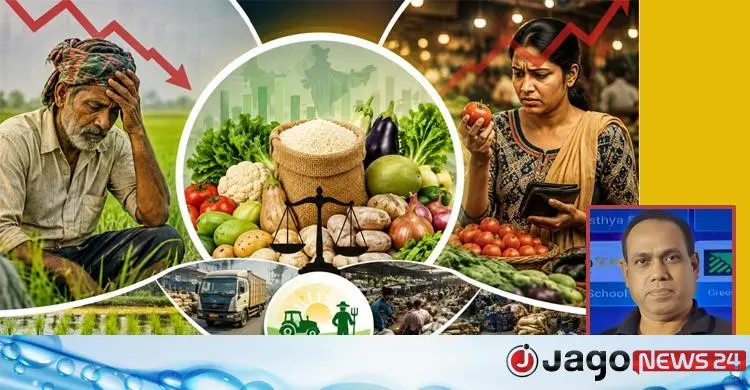
Farmers get low prices for what they grow, yet the same produce sells to consumers at several times the price. This contradiction is not new in Bangladesh's farm economy. On one side, farmers lose out because they cannot recover their production costs; on the other, consumers pay more for everyday farm products. Both farmer and consumer end up unhappy in the same market. The question is where the real problem lies.
In general debate, "middlemen" are often blamed for market volatility. Opacity, excessive profit, syndicates or unjustified price rises certainly need to be controlled. But it is not realistic to explain the problems of farm markets by the presence of middlemen alone. Between the farmer's field and the consumer's kitchen, produce passes through production, collection, sorting, grading, packaging, transport, storage, financing and marketing. Each step needs time, labour and money, carries transport costs and risks spoilage. A gap between the farmer's selling price and the consumer's buying price is therefore normal. But when that gap widens abnormally and both farmer and consumer lose, the weakness of market management must be questioned.
Balancing farmer and consumer
Fair prices for farmers matter, and so do fair prices for consumers. A market policy that helps one side by harming the other cannot be sustainable. Farmers want a reasonable profit on top of production costs; consumers want safe food at bearable, reasonable prices. Striking a balance between the two should be the main aim of farm market management.
In practice, however, the price of a product often falls suddenly at harvest. Farmers are forced to sell cheap. A few months later, when supply shrinks, the price of the same product rises abnormally. In other words, there is a lack of timing balance between production and the market. This is where market-led production comes in.
Producing for the market
A long-standing idea in farming is that the farmer produces first and then takes the crop to market. Modern agricultural economics is steadily changing that. Production now needs to be planned according to market demand. Farmers need information on how much demand there is for which product in which season, what output is likely, what the previous year's price trend was, how much land is under which crop in which region, who the likely buyers are and how much the processing industry needs.
For example, if thousands of farmers in different regions see strong demand for a particular vegetable or fruit and all start growing it on a large scale at the same time, supply can outrun demand at harvest. Prices then fall and farmers lose. Conversely, if too little of a product is grown, a supply shortage later pushes prices up. If farmers' production decisions are not based on reliable market information, periods of oversupply followed by shortage are to be expected.
The problem is not as simple as the mere presence of middlemen. Collectors, wholesalers, commission agents (aratdars), transporters, warehouse operators, processors and retailers each have some economic role in taking produce from farmers to market. Problems arise when competition falls, information becomes unequal and the farmer does not know the real market value of the crop. A farmer who does not know what the same produce fetches in another market will naturally have little bargaining power. The solution therefore should not simply be an attempt to cut out middlemen, but to increase transparency, competition and farmers' bargaining power. Farmers' organisations, producer co-operatives, contract farming, digital marketplaces and direct buyer-producer links can play an important part.
Data and storage
If farmers have the right market information at the right time, their ability to make decisions grows greatly, and in the digital age this is no longer impossible. Digital platforms can tell farmers what a product costs in which market, how prices have moved in recent weeks, what supply may look like in the coming weeks, which regions are producing more and which buyers want how much. Weather forecasts, likely crop output, pest and disease risks, input prices and storage facilities can be added. Data-based farm planning will not only raise output; it can also reduce market risk.
A major cause of volatility in many farm markets in Bangladesh is the limited storage and transport system. With highly perishable fruit, vegetables, fish and other produce in particular, farmers often cannot hold on to their crop. When supply peaks at harvest, they are forced to sell quickly, because if they do not sell cheap the produce risks rotting. With enough cold storage, modern warehouses, packaging and transport, farmers could be partly freed from the pressure of instant sale. Farm market reform must therefore prioritise post-harvest management, not only market prices.
Farming can no longer be seen simply as "crop production". It is a complete value chain in which seed, production, collection, grading, packaging, storage, transport, processing and delivery to the consumer are all linked. A serious weakness at any point ultimately falls on farmers and consumers. The Ministry of Agriculture, the Department of Agricultural Extension (DAE), market institutions, local administration, the private sector, farmers' organisations and technology firms must therefore work together.
Six steps
- First, market-led production planning is needed, helping farmers plan output on the basis of regional demand and supply analysis.
- Second, an integrated digital farm market information system should be built, where farmers can learn prices, demand, supply and price trends in simple language.
- Third, farmers' organised marketing must be strengthened; selling through producer groups or co-operatives instead of as individuals raises bargaining power.
- Fourth, storage, cold chain, grading and packaging infrastructure should be built close to production areas.
- Fifth, contract-based market links between farmers and large buyers such as processors, supermarkets, exporters and food companies should be expanded.
- Sixth, there must be effective surveillance of market manipulation, hoarding and syndicates, while the economic role of legitimate traders and intermediate market service providers is also recognised.
To ensure fair prices for farmers, it is not enough to try to set prices at market after the harvest. Planning must begin before the crop is grown. What will be produced, how much, where, when it will reach the market, who will buy it and how it will be stored: these questions must be answered before production starts. Digital technology, AI, IoT, weather information, market data and traceability systems can make this change possible. Technology is not a substitute for the farmer but a powerful tool to make the farmer's decisions better informed and more effective.
A new approach
Fair prices for farm produce are not only a matter of farmers' interests; they are directly tied to food security, consumers' interests, the sustainability of farming and the national economy. Farmers selling cheap while consumers buy dear is not the sign of a healthy market. Equally, the problem cannot be solved by blaming "middlemen" alone. What is needed is effective coordination between production, market information, supply, storage, transport, finance and marketing. A balance between fair prices for farmers and fair prices for consumers must be the core philosophy of farm market management.
It is time, the writer concludes, to move beyond the narrow idea of price control and build a modern, information-based and integrated framework for market management; time to ensure fair prices for farm produce and to bring a new outlook to farm market management. From production to market, integrated management is the answer.
Source: Jagonews24. First published in Bengali on The Agro News.



Comments
(0)