
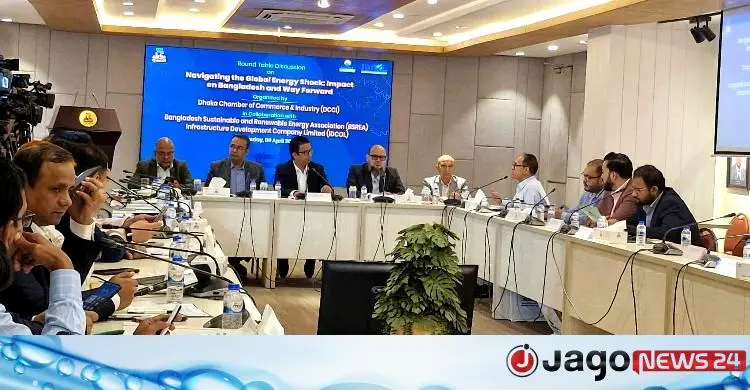
Because of the energy crisis, 30 percent of the vegetables produced in the country are spoiling for lack of storage, according to the Dhaka Chamber of Commerce and Industry (DCCI). Poor people are spending 22 percent of their income on energy, garment factory output has fallen by 50 percent because of the gas shortage, and higher cement production costs have raised the retail price by Tk 25-30 a bag.
These points were made in the keynote paper at a roundtable titled "Global Energy Crisis: Its Impact on Bangladesh and Setting Strategies to Tackle It", organised by the DCCI at Motijheel in the capital on Thursday, 9 April. DCCI President Taskeen Ahmed presented the keynote.
Industry and costs
The keynote said garment output had fallen by up to 50 percent because of the energy crisis. Within transport costs, container freight charges have risen by 20-40 percent, adding an extra $500 to $4,000 per container.
The DCCI president said the effect of higher raw material and logistics costs was visible in the steel and pharmaceutical sectors. The price of steel scrap has risen by $70-90 a tonne, and the cost of pharmaceutical production inputs by $700 to $1,800.
According to the chamber, the price of an LPG cylinder has risen from Tk 900 to Tk 1,890, and 45 percent of SME entrepreneurs have identified the energy crisis as the main obstacle to their business.
Farming and daily life
Describing the effect on daily life, Taskeen Ahmed said rural areas were suffering excessive load-shedding every day, while poor urban households were spending about 22 percent of their total income on energy alone. In agriculture, the import price of diesel has risen by 17.65 percent and the cost of importing fertiliser by about 90 percent. Amid the storage crisis, for lack of an effective cold chain, up to 30 percent of the crops and vegetables produced spoil soon after harvest.
He said that before the country had recovered from political instability and the energy crisis, the ongoing war had put industry under pressure on many fronts. The Middle East conflict, he said, was not just a foreign issue for Bangladesh but a direct crisis of economic and energy security, which had to be tackled through a collective, coordinated effort, with preparations made so that the country does not face such a challenge again.
The chamber's proposals
As immediate steps, the DCCI said the country should diversify its energy sources through government-to-government deals (Malaysia/Brunei) and negotiate deferred payment of 90-180 days. It called for making maximum use of daylight, setting air conditioners at 25 degrees Celsius, planned load-shedding through rationing in less important sectors, reconsidering capacity charges by invoking force majeure, and introducing a predictable, automatic fuel pricing system. To ease pressure on agriculture, the necessary subsidies on fertiliser and diesel must be given.
To keep the national economy running, uninterrupted energy supply must be ensured to export-oriented industries, and rooftop solar panels could be encouraged.
Among short-term proposals, the chamber called for a special budget allocation for energy-intensive industries, lower duties to soften the energy shock, a stable dollar exchange rate to ease pressure on foreign exchange reserves, regular energy audits, and repairs to the old Titas and Bakhrabad pipelines to cut system loss. It also called for running the Payra and Matarbari coal-fired power plants at full output and speeding up hydropower imports from Nepal and Bhutan.
The chamber added that work on a third FSRU and a land-based LNG terminal must be completed quickly to build up national energy reserves.
Also speaking at the event were Brigadier General (retd) Mohammad Shahid Sarwar, member (power) of the Bangladesh Energy Regulatory Commission; Md Obaidur Rahman, secretary of the Ministry of Industries; and Md Abdur Rahim Khan, administrator of the FBCCI, among others.
Source: Jagonews24. First published in Bengali on The Agro News.


Comments
(0)