
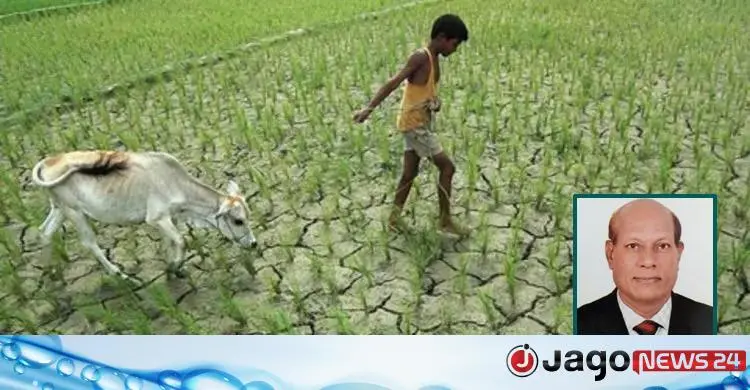
By Motahar Hossain
The country's population keeps growing, and so does the demand for food, while the amount of cultivable land shrinks day by day. To meet this challenge and feed a growing population, there is no alternative to prioritising higher crop production from less land. Raising production needs fertile soil, good seed, fertiliser, organic fertiliser and pesticides, applied in balance and on time, because soil is the cradle of food production. But converting single-crop land to double or triple cropping and growing improved varieties to raise production is also putting pressure on the land.
Besides excessive use of chemical fertiliser, land is losing its fertility every year through soil erosion, urbanisation, roads, mining and climate change, especially long-term drought. So, given the land's productive capacity, it needs to be rested from time to time; otherwise soil fertility falls. When soil fertility falls it harms the landscape and the environment. Crop production falls, nature suffers, and lower production raises the danger of a threat to food security.
Why soil fertility matters
Increasing and conserving soil fertility is urgent to ensure the country's food security. According to environmental scientists, more than 60 lakh hectares of fertile farmland become barren every year through desertification, causing losses of 4,500 crore dollars worldwide each year. This is a cause of serious disaster for developing countries like Bangladesh. The causes of declining soil fertility are salt water entering the land, river erosion, excessive chemical fertiliser, deforestation, the use of fertile topsoil in brick kilns and construction on cultivable land, along with soil erosion, urbanisation, roads, mining and climate change, especially long-term drought. For these reasons about 2 crore hectares of fertile land are being lost in Bangladesh and the world.
After seed, soil is one of the foundations of agriculture. Without suitable soil, rich in the nutrients crops need, the desired harvest cannot be had. The land and crop production are also being harmed by the adverse effects of climate change. Researchers say there is a risk that yields of the country's main crops will fall sharply by 2060 because of climate change. The Food and Agriculture Organization has stressed integrated policy for sustainably increasing soil fertility for food security. Specific action plans must be adopted and implemented in line with this policy at government and private levels; otherwise it will not be possible to meet the food demand of a growing population while coping with the adverse processes of a changing global climate.
Every year sea salt water enters Bangladesh's coastal areas and makes cultivable land barren, sharply reducing crop production, while the region's nature and biodiversity are also in crisis. According to agricultural scientists, no crop grows on land because of salt, and salt reduces soil fertility and plant growth. Many farmers use fertiliser in excess, based on guesswork rather than balanced doses, which is destroying the soil ecosystem.
A shrinking share and a growing population
According to statistics, agriculture's contribution to GDP was 60 per cent after independence; it now stands at 11 per cent. Farm production depends on temperature, rainfall, sunshine and climate change. Soil erosion, low organic matter in the lower soil layers, falling fertility, salinity and waterlogging are broadly hampering crop production. Although this is a global picture, its effect in Bangladesh is worrying. Because of global warming and carbon emissions, climate change has gained special importance and become a major challenge and a huge threat to the world and to Bangladesh. It is estimated that of the area of Bangladesh that will go under water by 2050 because of rising sea levels, 30 per cent will be farmland. The country now has about 20 crore people.
Every year 22-25 lakh new people are added, while farmland shrinks through industrialisation, urbanisation, house building, road construction and other causes. Climate change has been added to these two challenges. Because soil organic matter breaks down quickly, soil structure and its capacity to hold water are declining. High temperatures reduce plants' capacity for transpiration. One harmful effect of climate change is heavy unseasonal rain, and long unseasonal waterlogging disappoints farmers growing paddy and other crops. Meanwhile, to ensure balanced and timely use of fertiliser to raise production, the BFA and its roughly 550 members work in regular coordination with the government to take and carry out the necessary steps on all kinds of soil, fertiliser and plant nutrients.
Oversight and organic fertiliser
The BFA was founded in the 1990s. Its members, together with field-level agriculture officials, continue awareness programmes on protecting soil quality and on fake, adulterated and substandard fertiliser, seed and pesticides. But because of the indifference of law enforcement agencies, some dishonest traders are marketing and selling adulterated, fake and substandard fertiliser, pesticides and seed, harming farmers and agriculture. In this situation, the expectation is that effective and coordinated oversight of fertiliser producers, importers and dealers is essential to meet food demand. Otherwise, to keep food production targets from being hampered and the country's agriculture from being harmed, the use of organic fertiliser must be increased.
At the same time, organic fertiliser should be produced locally at no cost from farm or household waste and leftovers, and urea applied in moderate doses. Likewise, care is needed in applying TSP, DAP and MoP, and it is urgent to ensure balanced, measured use of fertiliser based on soil testing.
The writer is general secretary of the Bangladesh Climate Change Journalist Forum.
Source: Jagonews24. First published in Bengali on The Agro News.

Comments
(0)