
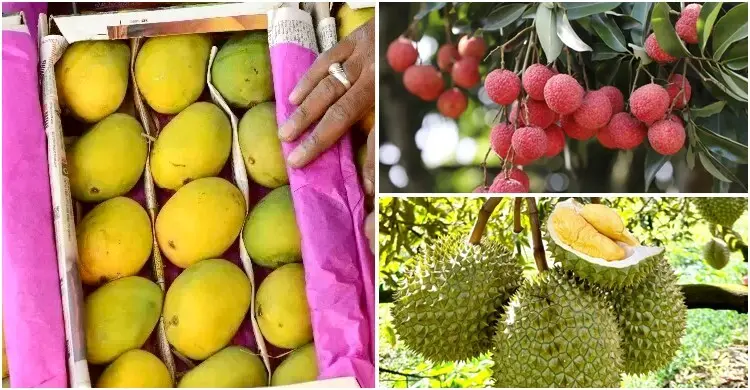
China's fruit market was once based mainly on domestic production. But over the past decade the world's second-largest economy has become one of the centres of the global fruit trade. Durian from Thailand and Vietnam, cherries from Chile, kiwi from New Zealand, blueberries from Peru and bananas from the Philippines are now readily available in markets in China's cities and villages.
China's growing middle class, rising health awareness and interest in quality food have taken its fruit imports to new heights. At the same time, farm sectors in many countries have become heavily dependent on the Chinese market.
New import record
According to China's Chamber of Commerce for Import and Export of Foodstuffs, Native Produce and Animal By-Products, the country's total fruit import and export trade was worth $25.2 billion in 2025.
Fruit imports were worth about $18.94 billion, with a volume of 9.032 million tonnes. Compared with the previous year, import value rose 6.7 per cent and volume 17.5 per cent.
More than 60 kinds of fresh fruit from 64 countries and regions are now approved for entry into China, creating fierce competition among fruit-producing countries to enter its market.
Durian: Chinese consumers' new favourite
Durian now holds the biggest place in China's fruit imports. In 2025 the country imported $7.49 billion of fresh durian, about 1.868 million tonnes, along with about $1.1 billion of frozen durian.
Thailand long led durian supply, but Vietnam is catching up fast. In 2025, Vietnam overtook Thailand in durian export volume for the first time, shipping 940,000 tonnes to China.
Durian's popularity in China grew further in 2026: in the first four months of the year the country imported about 356,000 tonnes worth $1.7 billion.
Chile's grip on cherries
After durian, the second-largest imported fruit is cherries. China imported $3.43 billion of cherries in 2025, about 99 per cent of them from Chile.
Demand for cherries surges every year around the Chinese New Year. Because red is seen as a symbol of good fortune, cherries have become a popular gift in the festival season.
Kiwi, blueberries and high-value fruit
Demand for highly nutritious fruit is also rising fast in China. New Zealand exported $610 million of kiwi to China in 2025, holding an almost exclusive position in that market. Over the same period, blueberry imports from Peru reached about $400 million. Market analysts say these fruits are most popular among health-conscious young consumers.
Vietnam's rise
Vietnam is now one of the biggest forces in China's fruit import market. By exporting $3.76 billion of fruit in 2025, it became China's second-largest fruit supplier. In the first four months of 2026, 14.54 per cent of China's total fruit and vegetable imports came from Vietnam, up from 11.71 per cent a year earlier.
Demand is growing in China for Vietnamese durian, jackfruit, coconut and other tropical fruit. But China's strict quality-control policy means the country's exporters face a new reality.
China tightens import rules
China's General Administration of Customs put "Order 280" into effect from 1 June 2026. Under the new rules, extra documentation, registration and quality-control conditions have been imposed on 2,589 products in 20 categories of farm produce.
Now even a slight mismatch between an imported product's registration number, certificates and customs declaration can cause problems in clearing goods.
Experts say China is moving from volume-based oversight to risk-based quality control, so production, storage, transport and food safety matter more than before.
Not just an importer but a big exporter
Although it is one of the world's top fruit importers, China also holds a strong position in exports. In 2025 its fruit exports were worth $6.28 billion, with a volume of about 5.483 million tonnes.
Apples, citrus, table grapes and pears are China's main fruit exports. Registered orchards, strict quality control and modern supply chains are raising the acceptance of Chinese fruit in international markets.
China's biggest fruit export market is Vietnam, which takes more than $1.2 to 1.4 billion of Chinese fruit every year. Thailand, Indonesia, the Philippines, Russia, Malaysia, Kyrgyzstan and the United States are also important destinations.
Centre of the global fruit trade
Analysts say China's fruit import market has not yet matured. The high-income class within its huge population is growing fast and is ready to spend more on quality foreign fruit, so demand for durian, cherries, kiwi, blueberries and other premium fruit is expected to keep rising in the coming years.
China, once known as the world's factory, has become one of the world's largest fruit markets. It is not only a huge buyer of fruit but one of the main drivers of the global fruit trade, and Chinese consumers' tastes, demand and policy changes are now important signals for fruit-producing and exporting countries.
What opportunity for Bangladesh?
Analysts say China's growing fruit import market also creates a big opportunity for Bangladesh. Tropical fruits such as mango, jackfruit, pineapple, guava, litchi and dragon fruit in particular could appeal to Chinese consumers.
Bangladesh has already begun exporting mangoes and some farm products to China on a limited scale. But to become a significant partner in China's vast market, it must ensure international-standard production, packaging, cold-chain systems and food-safety standards. If production and export processes are built in line with China's strict import rules and quality controls, Bangladesh's fruit sector could open new doors.
Experts say competing with Thailand, Vietnam and the Philippines in China will not be easy. But geographical proximity, relatively low transport costs and a diverse range of tropical fruit could gradually make Bangladesh a promising supplier. With the right policy support, better export infrastructure and more access to modern technology for farmers, Bangladesh's position in China's fruit market could grow stronger.
The report draws on VnExpress, Global Times, Produce Report and The Straits Times.
Source: Jagonews24. First published in Bengali on The Agro News.



Comments
(0)