
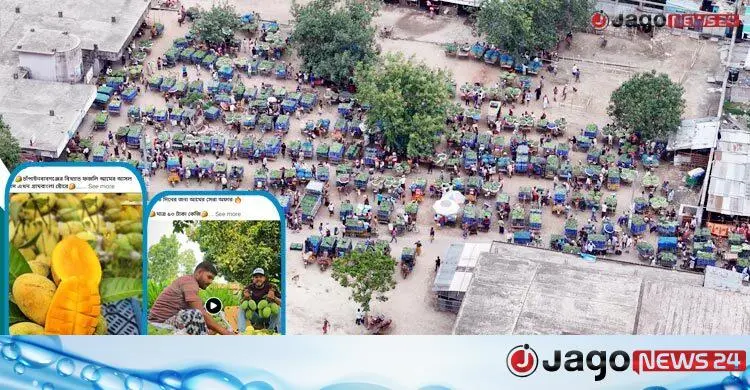
Online mango sales are growing steadily in Chapainawabganj. More than 30 per cent of the district's mangoes now reach buyers across the country through online platforms, and buyers are increasingly keen on the convenience of ordering from home.
Online mango entrepreneurs say that to attract buyers they shoot videos and promotional content in the orchards and run them as advertisements on social media. Advertising on Facebook and other platforms has to be paid for in dollars, and the sums are far from small. This is affecting mango prices, and hundreds of crores of taka are going abroad.
Building an online market requires substantial spending on advertising, particularly on Facebook and other social media, which must be paid in dollars.
How the payments work
People in the business say a seller first has to activate dual-currency facility on a bank card, then endorse a set amount of foreign currency against a passport. Such cards can be used for international transactions, and ad bills on Facebook and other digital platforms are paid with them. Getting a single order through these ads costs at least one dollar. The US dollar currently trades at about Tk 122 to 123.
Sellers say that even as online sales grow, advertising, packaging and transport costs make the expected profit hard to achieve. Courier charges for sending mangoes to distant districts in particular have risen considerably, leaving farmers and traders facing losses.
Sellers count the cost
Abdur Rahim of the Kansat area has sold mangoes online for five years. "The burden of spending dollars is now what puts us under the most pressure," he said. "To sell online we are forced to advertise on Facebook and other platforms and pay for it in dollars. That adds on average up to at least Tk 30 extra to every kilogram of mangoes sold. So a large part of the profit we hope for goes on advertising. Without ads it is now almost impossible to reach buyers online."
Shahin Ali of the Ranihati area also sells mangoes online. "The mango business is now entirely Facebook-based. To survive you have to spend dollars on ads. Orders come only when you advertise; without ads there are no orders at all. So we spend on ads every day. The problem is that ad rates are very high and keep rising. A big share of what we sell goes on advertising, profits are shrinking and often we make losses. We can no longer cover this cost, and the business is getting harder by the day," he said.
Another entrepreneur, Atiqur Rahman Swajan, suffered heavy losses selling mangoes online and was forced to wind up. After losing about Tk 5 lakh this season, he has suspended his online sales for now.
He said he had to run $50 of Facebook ads every day to find buyers, about Tk 6,000. Labour for order handling, packaging and other work cost about another Tk 2,000 a day, so advertising and labour alone came to about Tk 8,000 a day.
Yet daily sales brought in only about Tk 5,000 on average, a loss of more than Tk 3,000 a day, he said. "At first I hoped I could recover the losses towards the end of the season. But the longer it went on, the bigger the losses grew. In the end, after losing about Tk 5 lakh, I was forced to shut the business."
The biggest problem in selling online was the cost of advertising, he said. "Buyers think we are selling mangoes at high prices. But in reality we cannot buy mangoes from farmers much cheaper. And even if we sell cheaply, with advertising, labour, packaging and transport added, there is no profit. In a sense Facebook, like the middlemen, is taking a big share through advertising. By the time I understood this, I had already lost a lot."
A buyer's surprise
Nayan Ali, visiting the Kansat mango market from Uttara in Dhaka, was surprised at the prices. "Online, on various pages and platforms, I have seen mangoes selling at Tk 150 a kg or more. But at Kansat market the reality is different. Prices here are much lower, and yet the farmers are not getting the benefit."
"Those who sell mangoes online are selling at comparatively high prices. Buyers pay more, while farmers do not get a fair price. Various costs and intermediate steps in between take a large share of the real profit, so both producers and consumers lose," he said.
In his view, if it were made easier and more effective for mangoes to go straight from farmers to buyers, farmers would get fair prices and ordinary people could buy good mangoes more cheaply.
Crores going abroad
Ahsan Habib, member secretary of the Shibganj Upazila Mango Foundation, said at least 200 online mango traders are active in Chapainawabganj. Many spend $100 or more a day on advertising on Facebook and other social media to attract buyers, more than about Tk 12,000, on top of packaging, labour, transport and other costs. The effect of these extra costs ultimately falls on the mango market and on farmers.
Many think online sellers make big profits by selling at high prices, but the reality is different, he said. If one trader spends $100 a day on ads, the combined spending of hundreds of traders in the district runs to several crore taka, and much of it goes to foreign technology companies.
To cover advertising, packaging, labour and transport, traders are forced to raise their prices, he said. Buyers then think mangoes are sold online at inflated prices, but farmers get nothing from the higher price and are often forced to sell below their production cost. "Both producers and consumers are losing, and in between huge sums go out of the country as advertising costs."
Although online marketing is now important for the mango industry, the costs and outflow of money involved must be considered now, he said. Without alternative local digital marketing, stronger direct links between buyers and farmers, and government support, small entrepreneurs will find it even harder to survive. "This must be taken seriously now, because every day crores of taka are unknowingly going abroad through ad spending, directly affecting the mango market and farmers' incomes."
What officials say
Chapainawabganj district marketing officer Md Mominul Haque said various initiatives have been taken to make the marketing of the district's farm produce, especially mangoes, easier and more effective. Awareness activities and training programmes are being run at union level to connect marginal farmers directly with markets.
"We are running training and awareness programmes on agriculture and marketing in various unions, and holding regular meetings with marginal farmers so they can join modern marketing systems," he said.
Steps have been taken to link local farmers directly with superstores and other businesses to expand their market, which will reduce the influence of middlemen and improve farmers' chances of a fair price, he said. "We want farmers to connect directly with big markets and institutions. This will bring transparency to marketing, and farmers will get better prices for their produce."
Dr Md Sharaf Uddin, acting chief scientific officer of the Chapainawabganj Regional Horticulture Research Centre, said that if mango exports can be increased, the grip of middlemen on the market will ease considerably. If export quality is ensured from the production stage, farmers can connect directly with international markets, reducing pressure on the local market and the influence of middlemen.
"Our first goal is to ensure quality, exportable mangoes by following good agricultural practices. If we maintain the right standard from the start of production, demand for Chapainawabganj mangoes in international markets will grow," he said.
The research centre is working so that in future all mangoes can be produced to export standard, he added. That would bring farmers fair prices and open new prospects for foreign currency earnings from the country's mango industry.
Source: Jagonews24. First published in Bengali on The Agro News.

Comments
(0)