
"If you all wish to see Asmani, go to Rahimuddi's little house in Rasulpur. It is not a house but a bird's nest, thatched with bhenna leaves; at the slightest rain the water trickles down."
It is hard to find anyone who has not read these lines from the timeless poem by Palli Kobi (the rural poet) Jasimuddin. For the roof of Asmani's shabby hut, the poet chose bhenna leaves, which have remained a symbol of utter poverty and neglect for us. We usually know the plant, growing uncared for by village roads or in thickets, as a weed. But few may know that this neglected bhenna plant is the source of castor oil, prized around the world.
The plant
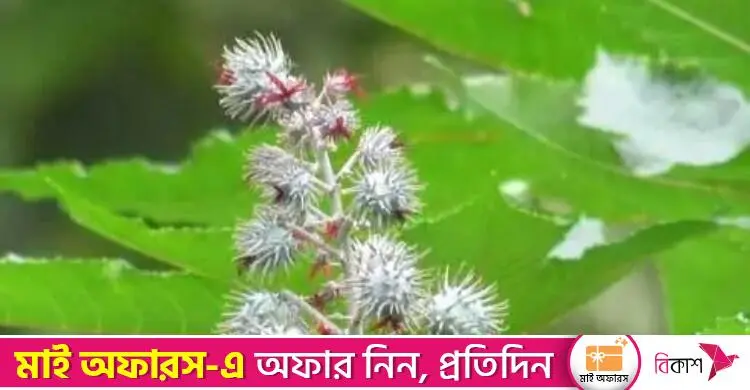
The bhenna or castor plant, also called redi, is known scientifically as Ricinus communis and belongs to the Euphorbiaceae family. Its leaves are large and palmate, spread out just like the palm of a hand, which may be why they were used to roof Asmani's house. The plant is usually a medium-sized shrub. Clusters of flowers bloom among its green or reddish branches, and its fruits look like small spiny capsules that hide precious seeds.
The castor plant's greatest trait is its remarkable ability to survive. It can be seen almost everywhere in Bangladesh: by roads, beside railway lines, on riverbanks and on fallow land, growing without any care. It survives drought and harsh weather comfortably and needs no fertiliser or pesticide.
Oil from a poisonous seed
The main attraction of the castor plant is its seed, from which the well-known castor oil, or redi oil, is made. The oil was once widely used in medicine. Recalling his childhood in his book "Amar Chhelebela", Rabindranath Tagore wrote: "By chance I sometimes had a fever; I barely even noticed it. The doctor would touch my body a little and prescribe, for the first day, castor oil and fasting."
Today the oil is highly valued in beauty care, especially for hair and skin. It is also an important industrial raw material, and its use is growing in lubricants, soap, paint and now in environmentally friendly biodiesel.
The seed shows a strange quirk of nature. Its coat contains ricin, an extremely potent and deadly poison, yet inside that poisonous shell lies such useful oil. The oilcake left after the oil is extracted works as a highly nutritious organic fertiliser and natural pesticide for crop fields.
An opportunity for farmers
There is considerable demand for castor oil in Bangladesh, and almost all of it has to be imported, even though the country's soil and climate are well suited to growing castor. If it could be grown commercially on fallow, infertile and unused village land, it could be a good source of income for farmers. Because it needs very little money and labour to grow, it has great potential to play a big role in the rural economy.
The castor plant is not only profitable but also helps keep the environment in balance. Its taproot goes deep into the soil, making it a very effective plant for preventing soil erosion in river erosion-prone areas, on chars and on hill slopes.
With climate change bringing drought or long periods without rain to many areas, a plant that can survive on very little water could be something farmers rely on. Without extra irrigation or care, it can green fallow land and also plays an important part in absorbing carbon.
The bhenna leaves that once found a place in poetry as the shabby roof of Asmani's hut could, with proper planning and initiative, help build a sturdy roof for our economy today.
Source: Jagonews24. First published in Bengali on The Agro News.

Comments
(0)