
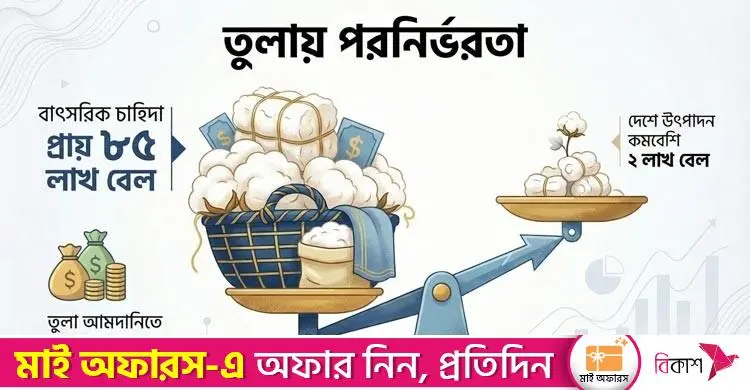
Bangladesh is one of the world's leading exporters of ready-made garments. Although cotton is the industry's main raw material, almost all of it comes from abroad. Bangladesh is among the top cotton importers and for a few years overtook China to rank first. About 97 per cent of total demand is now met through imports.
Cotton is now grown on roughly 50,000 hectares across the country, producing two lakh bales (182 kg per bale). Last year, 2 lakh 10 thousand bales were produced on 45,150 hectares.
As the export-oriented garment industry grew, domestic demand for cotton rose steadily. Yet local production meets only 3–4 per cent of total demand.
Blame on the board and the government
Those involved say that despite such demand, the government has not done the expected work on cotton production. The state-run Cotton Development Board has no effective research to raise output or develop new varieties. Because of the board's failures, combined with a lack of government support and neglect in allocations, not even the minimum cotton needed can be produced, even though higher output could have saved a great deal of foreign currency.
The Cotton Development Board believes that because of the shortage of land, Bangladesh has never been able to become self-sufficient in cotton, and that producing even half of demand is impossible. In present circumstances, with a determined effort, it says at most 10–15 per cent of demand could be grown.
Last year (2025), the agricultural research organisation Bangladesh Agricultural Economics (BAE) published a report analysing National Board of Revenue data, which showed that Bangladesh spends $4 billion to $5 billion a year on cotton imports.
Import bill year by year
The analysis shows that cotton imports and spending are substantial every year, although they fluctuate somewhat. Bangladesh imported 83 lakh bales in 2024 at a cost of $3.92 billion. The five-year study from 2020 shows that the country spent $3.29 billion on 65 lakh bales in 2020, $4.72 billion in 2021, $5.04 billion in 2022 and $4.02 billion in 2023.
This year (the 2025–26 fiscal year) the target is to grow cotton on 48,000 hectares nationwide, with a production target of 2 lakh 52 thousand bales. Last year, the report says in this passage, 2 lakh 19 thousand bales were produced on 46,760 hectares.
For several years production has hovered between 2 lakh and 2 lakh 20 thousand bales. Cotton is now grown in 132 upazilas of 39 districts, and the area under cultivation is rising slowly. Four types are grown: char cotton for river islands, hill cotton for the hills, upland cotton for the plains and drought cotton for the Barind area.
The country needs about 85 lakh bales of cotton a year. The 519 textile mills alone need about 80 lakh bales annually, and about 83 lakh bales have to be imported each year. Bangladesh currently imports most of its cotton from Brazil; India was previously the top source. Cotton is also imported mainly from the United States, the African country Benin and a few others.
Farmers turning away
Monirul Islam, a cotton farmer from Ranishankail in Thakurgaon, told Jagonews24: "The government does not pay attention to cotton production the way it does to food production. Sometimes there are problems getting seed, and the price is high too."
"Besides," he said, "on high land, other crops are easier and more profitable than the cotton yield that land gives. That is why many people are now giving up cotton."
The Cotton Development Board was formed in 1972, after independence, to increase the supply of fibre cotton for domestic textile mills. In 1991 responsibility for cotton research was transferred to the board from the Bangladesh Agricultural Research Institute. Since then the agency has been fully responsible for raising cotton output and for developing and extending new varieties and technologies.
In all this time the organisation has come nowhere near the desired success. Every year it receives large government allocations for research, extension, seed production and distribution, training, marketing and support for ginning, and it runs a microcredit programme for marginal farmers. Yet the expected output remains out of reach.
The board wants to produce 20 per cent of the country's demand, but it faces many limitations. Because of the shortage of land, self-sufficiency in cotton is practically impossible and even half of demand is largely out of reach. With a determined effort, at most 10–15 per cent could be grown, but because of the board's failures along with a lack of government support and neglect of research, even that amount is not being produced.
The board's response
The board's executive director, Rezaul Amin, told Jagonews24: "We are trying as hard as we can. Production is being increased through cotton and cotton by-products and suitable high-yielding varieties. We are trying to raise output by developing climate-suited technologies that meet farmers' needs through research, supplying quality high-yielding seed, expanding cotton into the country's low-productivity land as well as existing areas, and helping with marketing."
He said: "Despite our efforts, we cannot do much because of the shortage of land. Still, to make the most of the land, we are expanding vegetables, pulses and spices as companion crops with cotton, and this is getting a good response in different parts of the country. Cotton cultivation is expanding in the Barind, saline, char, agroforestry and hill areas."
He added that through research the Cotton Development Board has so far released 24 high-yielding varieties, named as CB-12, CB-13, CB-14, CB-15, CB-16, CB-17, CB-18, CDB Tula-19, CDB Tula-20, CDB Tula-21 and Pahari Tula-3. It has also released a high-yielding hybrid, CB Hybrid-1. Hybrid cotton seed has been grown in the field under government and private initiatives since the 2009–10 season, and the average yield has now risen to 12–15 maunds per bigha.
Elsewhere the report says the board has so far developed one hybrid, 26 high-yielding varieties and 60 technologies through research. In the 2024–25 fiscal year it also distributed free hybrid cotton seed, fertiliser, insecticide, fungicide and growth regulators to 21,100 cotton farmers under an agricultural incentive programme worth Tk 16 crore 88 lakh.
Source: Jagonews24. First published in Bengali on The Agro News.
Comments
(0)