
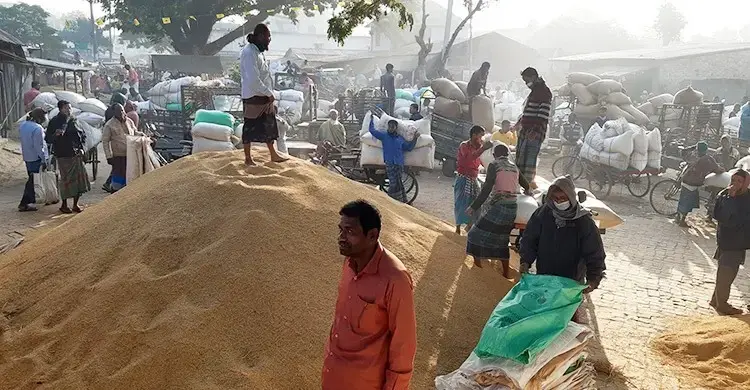
Aman paddy prices have fallen sharply in different parts of the country at the end of the season, with paddy selling for less than in other years. Meanwhile, the boro harvest will begin in earnest in the haors in about a week, and within a month the boro season will be in full swing in other regions too. The fall in aman prices has left farmers deeply worried about boro as well, and they fear they will not get a fair price.
Farmers and others involved allege that paddy prices have fallen because rice imports from abroad have continued. Rice is still being imported from India and Pakistan at a cost of Tk 44 to 46 a kg, which has drawn traders to import. With a good supply of foreign rice in the market, the price of farmers' paddy has dropped.
Imports up
Figures from the Directorate of Food also show a rising trend in private-sector rice imports. According to the directorate, more rice was imported privately in nine and a half months of the current fiscal year than in the whole of the previous year. In fiscal 2025-26 so far (up to 12 April), traders have imported 7.24 lakh tonnes of rice, against 6.01 lakh tonnes in the whole of fiscal 2024-25.
In addition, 3.99 lakh tonnes of rice have been imported by the government in the current fiscal year. In all, 11.24 lakh tonnes of rice have already been imported this year.
Aman prices down
Because of heavy imports, paddy prices have fallen in the north and other parts of the country. Farmers got reasonably good prices early in the season, but now they cannot recover their production costs by selling paddy.
In Naogaon, the north's top paddy-producing district, Swarna-5 paddy is selling at Tk 1,100 to 1,150 a maund, Zirashail at Tk 1,400 to 1,450 and Sampa Katari at Tk 1,800 to 1,950.
Helal Uddin, a farmer of Kola village in Naogaon's Badalgachhi upazila, told Jago News that these prices are Tk 200 to 300 a maund lower than last year. "Last year I sold Swarna for up to Tk 1,500 a maund. In this same market last time, Zirashail and Sampa Katari traded at Tk 1,800 to over Tk 2,000." He said: "Now there is no one to buy paddy. Forget profit, at current prices we can't recover our production costs. That's why I am now worried about the boro in the field. I can't cover the cost of cultivation by selling aman paddy."
The number of paikars (wholesale buyers) at different trading centres in Naogaon has fallen markedly. A farmer named Bulu Mia at the market in Manda upazila headquarters said: "There are no paikars at the market. Who will I sell paddy to? Buyers used to come from different areas and we got a good price through bargaining. Now there is no one to buy. I am selling at a loss."
Mozammel Haque, a farmer who came to sell paddy at Satihat in Naogaon Sadar, said the prices of fertiliser, seed, pesticide and everything else have gone up, and fuel costs have made harvesting and threshing more expensive. "Yet no one is paying a fair price for paddy."
Another farmer, Abdul Khalek, said: "The way aman prices have started falling, I doubt the price will even stay at Tk 1,000 in a few days. Soon the boro paddy will come in, and then there will be no one to buy this aman paddy."
Imports arriving under old LCs
Consignments of rice imported earlier from India are still arriving. Large consignments enter almost daily through the Benapole, Hili and Sonamasjid ports. This rice, brought in duty-free during the previous interim government, has now become a thorn in farmers' side, and is expected to hurt prices not only in the aman season but also in the coming boro season.
Sukumar Brahma, a commission agent at Satata Rice Agency in Naogaon, said: "Since the new government came to power, uncontrolled rice imports have stopped, but rice from LCs opened earlier is still coming into the country. Because of that mistake, paddy and rice traders are now suffering. If rice keeps being imported like this, farmers will not get a fair price in the boro season either."
Nirodh Baran Saha, a major wholesaler and importer in Naogaon, told Jago News that traders brought in Swarna rice from India at Tk 42-44. Swarna paddy has also come in during the aman season here, and naturally, with cheaper Indian rice available, farmers' paddy has no price.
No buyers at trading centres
Because of falling paddy and rice prices, the number of paikars in the Naogaon and Dinajpur region has dropped alarmingly, and the rice mills are not buying paddy as before. Nirodh Baran Saha said that with no sales, the mills have large stocks of rice left and are not buying paddy. Orders are not coming as before from mills in Kushtia and other parts of the country.
He said that in other years at this time, around 100 to 120 trucks of paddy went from Naogaon to different regions almost every day; now that has fallen to 20-30. With trading at a standstill, farmers are losing money and many traders who invested have fallen into debt.
Farhad Hossain Chakdar, general secretary of the Naogaon District Rice Mill Owners' Group, said allowing large rice imports despite an adequate harvest was a mistake, and farmers and traders are paying the price. Because imports were high and trading centres saw no sales, millers have built up large stocks, which will also affect the coming boro, he said.
What the government says
Moniruzzaman, director of procurement at the Directorate of Food, also now views the heavy rice imports negatively. He told Jago News: "It is true that rice imports were high under the previous government. Although that was right from a food security point of view, it has been harmful for farmers."
He said, however, that the present government is not giving any new permission to import rice, and imports under earlier LCs will end within a short time. The problem is expected to ease soon. To ensure a fair price for boro, he said, about 18 lakh tonnes of paddy and rice are planned to be procured in the coming season, and such large-scale buying will help raise prices. The government will procure boro rice from May to August, and a meeting to fix the price will be held soon.
In the aman procurement drive from November to February of the current fiscal year, the Directorate of Food procured 10.29 lakh tonnes of paddy and rice. There are currently 14.57 lakh tonnes of rice in government warehouses.
The agriculture department says about 1.65 crore tonnes of aman paddy were produced in the country this year. The boro target this time was 50.54 lakh hectares, with production expected to be close to 2.20 crore tonnes. Harvesting will begin in the haors next week; in Sunamganj's 137 haors the production target this year is about 14 lakh tonnes of paddy. Harvesting will then continue in different parts of the country until May.
Source: Jagonews24. First published in Bengali on The Agro News.

Comments
(0)