
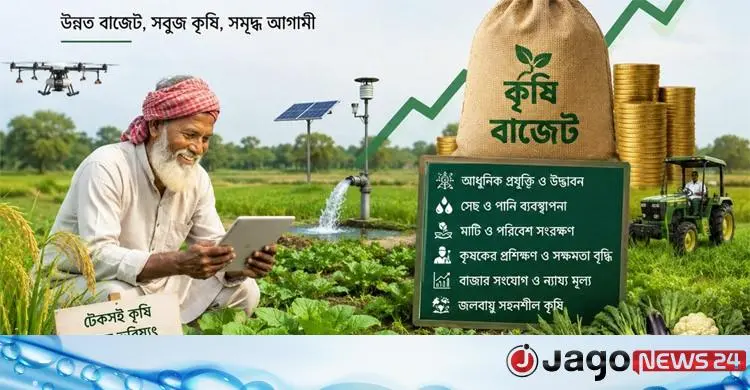
Agriculture is one of the main foundations of Bangladesh's economy and social stability. Agriculture and farm-based activity are closely tied to the livelihoods of a vast population, to food security, the rural economy and the supply of raw materials to industry. Against the background of climate change, global economic uncertainty, rising input prices and the growing food needs of the population, there is no alternative to strengthening the agriculture, food, fisheries and livestock sectors. With this in mind, allocations to these sectors have been raised significantly in the national budget for 2026-27. Presenting a total budget of Tk 9,38,000 crore in parliament on 11 June, Finance and Planning Minister Amir Khasru Mahmud Chowdhury proposed a total of Tk 43,335 crore for these sectors, equal to 0.63 per cent of GDP.
In the revised budget for 2025-26, the allocation for agriculture, food, and fisheries and livestock was Tk 37,126 crore, or 0.61 per cent of GDP. The new fiscal year therefore gives these three sectors Tk 6,209 crore more. The increase reflects the government's farmer-friendly policy and its commitment to ensuring food security and sustainable agricultural development.
Agriculture in Bangladesh is not just a means of producing food; it is a large economic activity involving millions of farmers, fish farmers, livestock farmers and agricultural entrepreneurs. Developing agriculture means reviving the rural economy, creating jobs and reducing poverty. Food security is a strategic issue in today's world, and raising domestic production capacity is vital for coping with volatile global markets and the adverse effects of climate change. That makes more investment in agriculture, food, fisheries and livestock a timely decision.
Food security, subsidy and mechanisation
One of the government's main goals is safe and adequate food for everyone in the country. To that end, priority has been given to expanding high-yielding crop varieties, using better seed, increasing research and raising productivity. Besides food grains, emphasis has also been placed on increasing production of vegetables, fruit, pulses, oilseeds and nutritious farm produce to ensure balanced nutrition.
Government subsidy is one of the main supports for farm production. Subsidies on fertiliser, seed, irrigation and other inputs help reduce farmers' production costs. The new budget takes steps to ease farmers' financial pressure through farm subsidies. With fuel and input prices rising on the world market, subsidies will be a major help to farmers.
Farm mechanisation is now a necessity to address labour shortages and cut production costs. The budget gives importance to plans for wider use of modern machinery such as combine harvesters, reapers, rice transplanters and power tillers. Mechanisation will shorten harvest time, lower production costs and speed up the modernisation of agriculture.
In the age of the fourth industrial revolution, there is no alternative to technology-based farming. The new budget emphasises digital farm management, smart farming technology, information-based agricultural services, farm apps, online advice and modern data management. Drone technology, soil sensors, weather-based farm advice, smart irrigation and artificial intelligence-based farm management can make the farming of the future more effective and profitable.
Farmer card and fair prices
An important initiative for marginal farmers in this budget is the farmer card programme. Under it, marginal farmers holding a farmer card will receive Tk 2,500 a year in support, and Tk 1,062.5 crore has been proposed for this. The initiative will give farmers direct financial support, encourage farming and further strengthen social protection.
In Bangladesh a significant amount of produce is lost after harvest for lack of storage facilities. These losses can be reduced by developing modern cold storage, warehousing and supply systems. At the same time, emphasis has been placed on modernising the market system, digital marketing and direct market links so that farmers get a fair price for what they grow.
Many farmers fall into financial difficulty because of natural disasters, floods, droughts or price volatility. Loan rescheduling, loan waivers and special financial support to rehabilitate affected farmers and bring them back into production have received attention in policy discussions.
Various tax benefits and incentives on farm products will encourage agricultural entrepreneurs and make the sector more competitive, which will also help agro-based industry grow.
If farmers cannot be assured a fair price, their interest in production may decline. Expanding the procurement of farm produce, curbing the dominance of middlemen and improving market management are therefore very important.
Research, irrigation and climate resilience
Agriculture can be made more profitable through research, innovation and technology transfer. Improved seed varieties, biotechnology, climate-resilient crops and modern farm management will open new possibilities for food production.
Irrigation is vital for farm production. Re-excavating canals, modern irrigation technology and better water management will make it possible to raise productivity.
Digital databases, farmer registration, input distribution, market information and online services can make the sector more transparent and accountable, and make it easier for government support to reach genuine farmers quickly.
The fisheries and livestock sector makes an important contribution to the national economy. Alongside self-sufficiency in fish, milk, meat and eggs, it has opened new sources of export earnings. Developing this sector under the new budget will create opportunities in farm management, disease control, spreading improved breeds, food safety and rural employment.
Bangladesh is one of the countries most vulnerable to climate change. Floods, salinity, drought and cyclones hurt farm production, so climate-resilient farming systems and wider use of adaptation technology are needed. This budget gives importance to sustainable farm management, environment-friendly production and the proper use of natural resources.
The increased allocation for agriculture, food, fisheries and livestock in the 2026-27 budget is undoubtedly a positive step. The extra Tk 6,209 crore is not just a financial decision; it reflects the government's long-term commitment to food security, farmers' welfare, technology-based farming, rural development and a sustainable agricultural system. If the allocation is managed with proper planning, transparency and effective implementation, agriculture will become more modern, productive and competitive. Farmers' living standards will improve, food security will be strengthened and Bangladesh will move a step closer to a sustainable, smart agriculture-based economy.
Source: Jagonews24. First published in Bengali on The Agro News.

Comments
(0)