
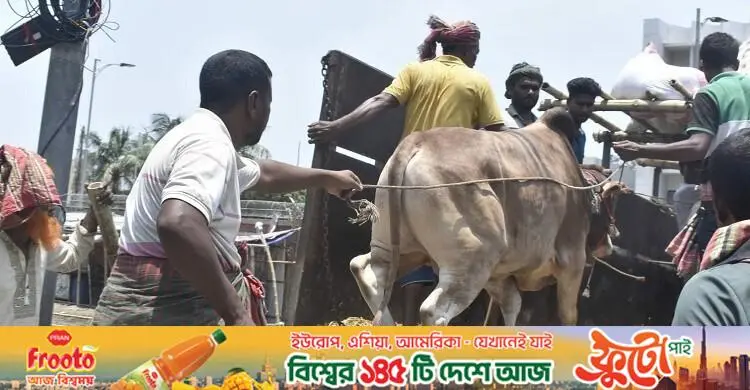
Farmers had built their dreams for the whole year around Eid-ul-Azha, hoping to make some profit by selling animals at the qurbani markets. But without the prices they expected, many were left with unsold animals. They still have to bear the cost of feed, medicine and care for animals brought back from the markets. Facing losses on one side and extra costs on the other, they are in deep uncertainty, and the unsold animals have become a further blow on top of their troubles.
According to the Department of Livestock Services (DLS) and the Ministry of Fisheries and Livestock, 1.23 crore animals were ready for sacrifice this year against an estimated demand of 1.0106 crore. About 92 lakh were sacrificed, about nine lakh fewer than the estimated demand, leaving about 31 lakh sacrificial animals unsold.
Sacrifices were slightly up on last year's 91 lakh. Last year's figure, however, was 13 lakh lower than in 2024, when 1.04 crore animals were sacrificed across the country for Eid-ul-Azha.
Those involved say seasonal traders and farmers suffered losses at the last minute under the pressure of unsold animals. As in previous years, high inflation and economic recession reduced the number of animals sacrificed.
Md Shahjaman Khan, acting director general of the DLS, told Jagonews24: "We are getting information that sacrifices were somewhat lower than expected. Data is still being collected from the field. A full list will be published at a press conference at the ministry by Thursday."
Why fewer animals were sacrificed
Analysts say economic weakness, a slowdown in business, rising poverty, high inflation and lower purchasing power could directly hit this year's qurbani market. Higher production costs have also pushed animal prices up rapidly in recent years, putting them out of reach of low and lower-middle income families. As a result, sharing a sacrifice has increased: people who used to sacrifice an animal alone now do so jointly. The recent political situation has also had some adverse effect.
Agricultural economist Jahangir Alam Khan, former director general of the Bangladesh Livestock Research Institute (BLRI), told Jagonews24: "Animal prices rose this year because farmers' costs increased, while high inflation reduced ordinary people's purchasing power. They are struggling to meet daily expenses."
"Apart from government employees and senior staff at good private companies, even businesspeople are facing a slump," he said. "So those who used to sacrifice an animal alone shared one this year, those who used to give a small cow gave a goat, and those who could barely manage could not sacrifice at all."
Ripon Kumar Mondal, professor of agricultural economics at Sher-e-Bangla Agricultural University, said: "The post-Covid economic weakness has not gone. Meanwhile animal prices have risen fast. Many middle-class people cannot afford to spend Tk 1 lakh or more on a cow, so they are buying goats, or not sacrificing at all. Financial weakness is now a major reason for the fall in sacrifices."
Moqbul Hossain, managing director of North Bengal Dairy Farm in Chholmaid, Bhatara, Dhaka, told Jagonews24 that shared sacrifices at his farm more than doubled this year compared with last year, and many did not sacrifice at all. "We found many customers who used to take a cow from the farm or share a sacrifice every year but did not do so this time," he said.
Weight loss and feed costs
Farmers say animals brought back from the qurbani markets often fall ill from the stress and lose condition. All the costs of feed, medicine and care until they are sold are extra, and at this time, after Eid, the glut of unsold animals drives prices down in the markets.
Mohammad Iqbal Hossain, president of the Bangladesh Dairy and Fattening Farmers Association, told Jagonews24: "Not all of a farm's cattle are taken to market, but the reality is that a cow of 5-6 maunds that is not sold at Eid later loses 50 to 100 kg, because these cattle are prepared specifically for Eid. So those whose cattle did not sell are now suffering heavy losses."
"Feed, medicine and farm running costs have risen abnormally over the past few years anyway," he said. "The government needs to give this attention."
The association's general secretary, Mostafizur Rahman, said: "A large part of the animals farmers brought to market this Eid remained unsold. From late 2025 until Eid, cattle feed prices were at an all-time high, but farmers sold cattle at last year's prices. Prices fell further a day or two before Eid, when most farmers had to sell at a loss, and those who still have animals are in an even worse position."
Source: Jagonews24. First published in Bengali on The Agro News.
Comments
(0)