
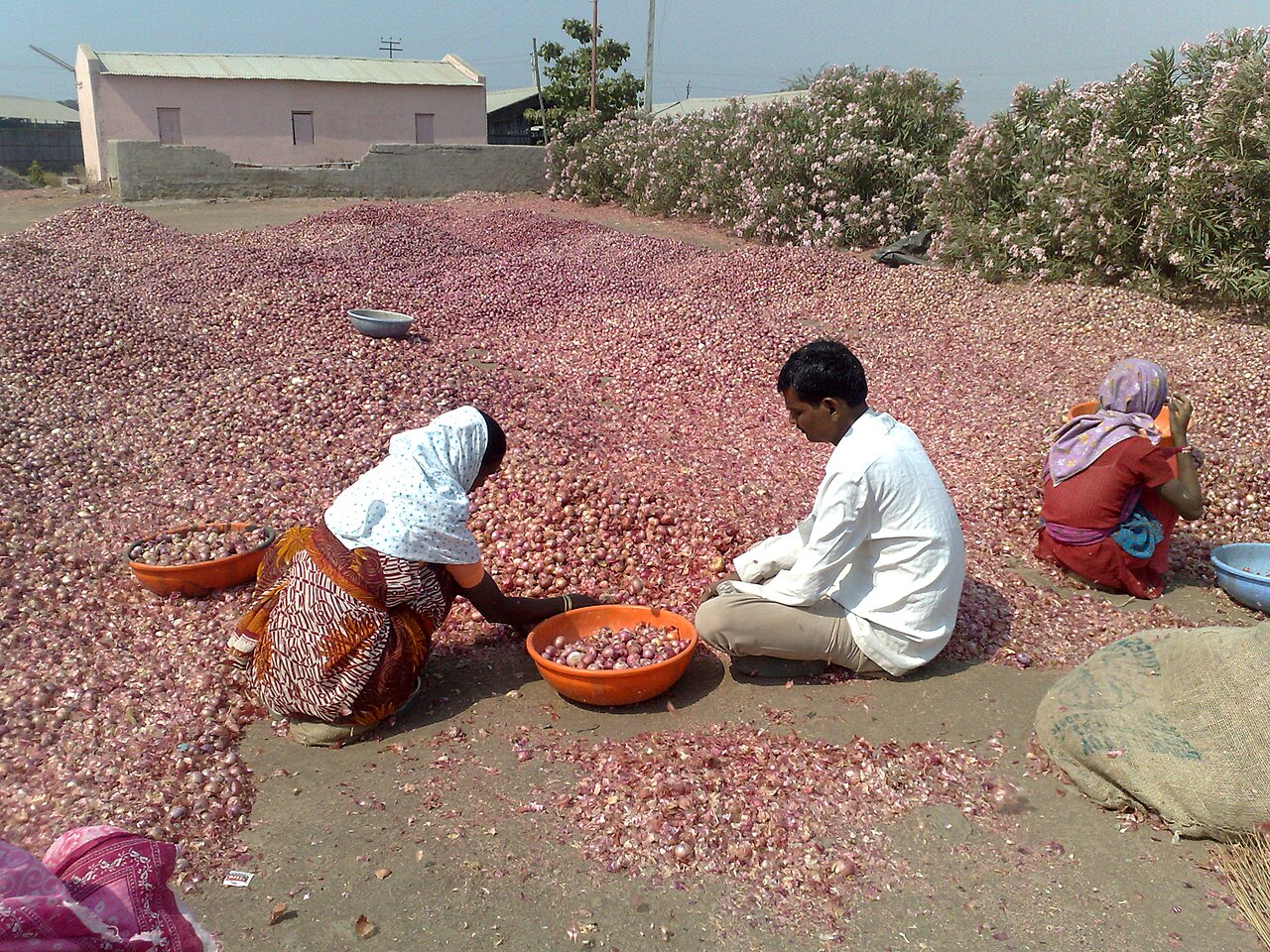
Scientists at the ICAR-Directorate of Onion and Garlic Research in Pune have identified onion lines that keep yielding well across very different growing conditions in India, AgroPages reported on 6 October. The study, led by Amar Jeet Gupta and published in the Indian Journal of Genetics and Plant Breeding, tested 43 red and white onion genotypes at five contrasting agro-climatic locations in the 2020-21 rabi season.
The trials, run under the All India Network Research Project on Onion and Garlic with ICAR funding, confirmed the breeder's central problem: genotype, environment and their interaction all had significant effects on marketable yield, so the best onion in one place was not necessarily the best in another.
Using the AMMI statistical model, the team found that a single interaction axis explained 91.3% of the genotype-by-environment interaction in red onions and 96.8% in white onions. Red lines RO-1769, RO-1773 and RO-1783 and the varieties Bhima Kiran and NHRDF Red-2, and white lines W-444, W-500 and W-045, combined high average yield with low sensitivity to location.
The results were cross-checked with several other stability measures, and Lin and Binns's superiority index proved the most useful single tool for picking high-yielding, stable lines, which the authors say offers a cheap screening method for breeding programmes with limited resources.
India is one of the world's largest onion producers and its crop is highly sensitive to weather, a vulnerability climate change is expected to sharpen. The eight lines are now candidates for large-scale evaluation and possible release as climate-resilient varieties, which could steady onion supply.
Photo: Nishaexport / Wikimedia Commons (CC BY-SA 3.0)
Source: AgroPages

Comments
(0)