
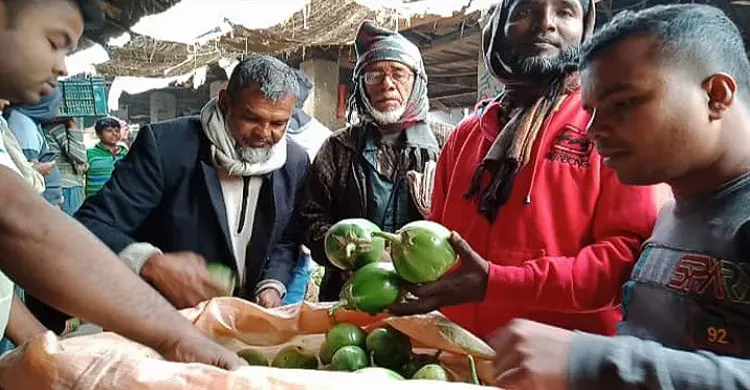
Brinjal growers in Sharsha upazila of Jashore have faced heavy losses this month. Although production is high, they are deeply frustrated at not getting the expected price in the market. This season, pest attacks on brinjal and unplanned pesticide use have also raised their costs and losses.
Whitefly sucks the sap from the leaves, which curl up and the plants are ruined. Fruit borers bore into the brinjals. Fearing losses, farmers are using pesticides, which experts believe increases the risk of illness in people.
Warning labels ignored
The toxicity of pesticides on the market is shown on the containers with red, blue, yellow and green marks. A red diamond means restricted use; yellow, blue and green mean it is safe. But in most cases farmers fearing losses use the toxic pesticides. The poison from such pesticides stays in brinjal and other vegetables for at least 15 days to six weeks. If the vegetables are sold in the market during that time, people who eat them may fall ill.
The farmers said: "Let researchers worry about how much poison is in the pesticides. Now there is a pest attack on the brinjal. On top of that, three days ago brinjal sold wholesale in the market for Tk 3-4 a kg. On 29 January it sold wholesale in the local market for Tk 6-8 a kg. Pesticides cost a lot. All in all, we are very frustrated."
They added: "Even though brinjal sells for Tk 15-20 a kg in the open market, we are getting only Tk 6-8. They buy from us and sell at high prices. We produce vegetables by the sweat of our brow and are making a loss. We are not getting even a fair price."
Sharsha upazila agriculture officer, agriculturist Soutam Kumar Shil, said: "There is more ignorance about pesticide use in vegetable farming than in any other farming. If farmers do not become aware of this, in trying to stop crop diseases they will spread terrible poison into people's bodies. Many farmers still do not want to understand this."
He also said: "If brinjal with pesticide residue is bought and soaked at home in boiled water mixed with salt for 15 minutes to half an hour, it can become about 90 percent free of poison. This season brinjal has been grown on 250 hectares in Sharsha, Jashore."
Source: Jagonews24. First published in Bengali on The Agro News.

Comments
(0)