
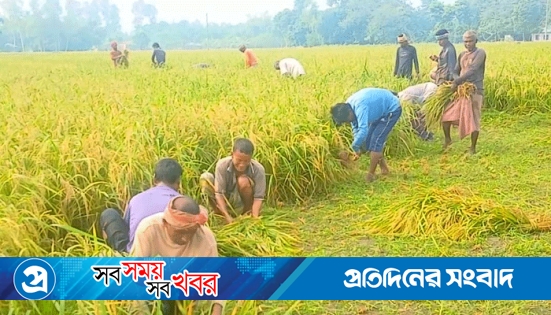
Across the five districts of the Rangpur region, the fields are now a sea of green. As far as the eye can see there are only green paddy fields, the rice plants swaying in the wind, and the crop looks healthy. Barring a natural disaster, there will be a bumper aman harvest everywhere this year, the region's agriculture department and farmers hope. Early aman varieties have yielded a bumper crop across all five districts, and farmers in many places have begun harvesting them, bringing smiles of relief.
According to the Department of Agricultural Extension (DAE) office in Rangpur, the Rangpur division has 12,97,964 hectares of land. This year the target for aman in the Rangpur agricultural region's Rangpur, Nilphamari, Gaibandha, Lalmonirhat and Kurigram districts was set at 9.5 lakh hectares, but aman was transplanted on far more land. With favourable weather the crop is good throughout the division, and if the weather holds a very good yield is expected.
Flood-hit areas bounce back
In many places farmers have begun harvesting early aman, and with the early crop doing well, farmers in the region are in high spirits. Flood-hit upazilas of Nilphamari, Lalmonirhat, Kurigram, Rangpur and Gaibandha have recovered. In several flood-affected areas visited, farmers had followed modern methods with the agriculture department's help and grown aman beyond the target despite two floods. Because silt was deposited on the land after the floods, the aman seedlings are comparatively better in these areas: thicker and sturdier than elsewhere. Farmers and the agriculture department see the prospect of an aman revolution there.
Farmer Sharif Uddin Khan of Birahim village in Pirganj upazila, Rangpur, said he grew a short-duration hybrid variety on 24 decimals this year and expects more than 12 maunds. It cost him about Tk 3,000, and he has sold paddy at Tk 900 a maund. With straw in demand as cattle feed he got a good price for it too. He is preparing to grow early potatoes on the same land, and to grow maize after the potatoes.
Farmer Tarequl Islam of Sarai Machhari in Kaunia upazila said he has grown the high-yielding BRRI dhan75 on two bighas and will harvest within a day or two. With favourable weather he expects 40 to 45 maunds. So far he has spent about Tk 15,000, and he expects to earn a good Tk 25,000 from selling the paddy.
Obaidur Rahman Mondal, deputy director of the DAE in Rangpur, said paddy has been harvested on about 550 hectares in the district so far.
Flood losses and targets
A DAE source in the Rangpur region said two floods this year damaged crops in the five districts of Rangpur, Gaibandha, Kurigram, Lalmonirhat and Nilphamari: 1,265 hectares of aman seedbeds, 111 hectares of transplanted aman, 4,598 hectares of aus, 1,244 hectares of vegetables, 29 hectares of maize, 31 hectares of groundnut, 379 hectares of sesame, 20 hectares of foxtail millet (kaun), 140 hectares of proso millet (china), 205 hectares of chilli and 6,443 hectares of jute. In all, about two lakh farmers' crops were damaged. Even so, the transplanted aman target was met in these areas.
Mahbubur Rahman, deputy director for the Rangpur region at the DAE, said this year's aman target for the region's five districts was 6,14,295 hectares. Although there were early fears about the target, it was exceeded long ago, and production is also expected to beat the target. The vegetable target for the region has been set at 41,000 hectares.
Across the region, field after field is green; as far as the eye can see there is only aman. Seedlings transplanted with irrigation because of a lack of rain have grown sturdy and turned the landscape green. Here and there the yellow ears of early aman sway in the wind, and in places farmers are cutting and carrying them home. This early aman has done much to ease Rangpur's age-old curse of monga, the lean season of Ashwin and Kartik. Farmers said they had been very worried about transplanting aman: with the land dried out for lack of rain, they had to irrigate to transplant. Those seedlings have now become fine aman fields, and pest attacks are much lower than in other years.
Source: Ittefaq. First published in Bengali on The Agro News.


Comments
(0)