
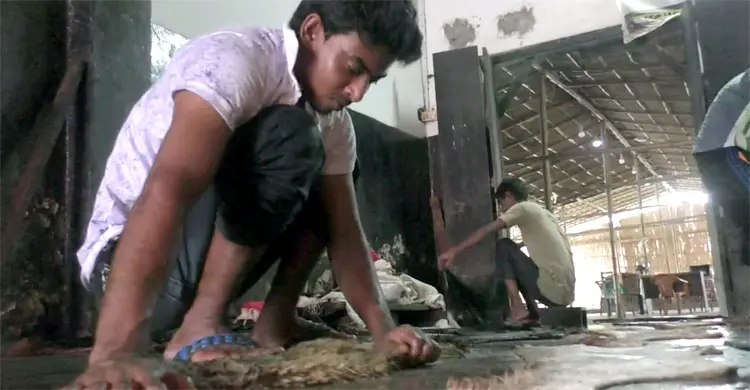
Chakbaidyanath in Natore is the country's second-largest leather market, and its traders will be busy from the day of Eid-ul-Azha. They have washed and cleaned their warehouses and stocked salt and other materials for processing hides.
But traders complain that a shrinking export market, the global recession and tannery owners' failure to pay their dues at home have put them in difficulty. Even so, they hope about 16 lakh hides will come to the Natore market from about 40 districts.
A visit to the Chakbaidyanath leather market in the municipal town on Thursday morning found workers busy. Rawhides will be brought to Natore from across the country from the day of Eid-ul-Azha, so the warehouses are being cleaned.
Traders short of capital
Leather trader Abdul Halim Siddiqui told Jagonews that tannery owners have paid last year's dues, but Tk 35-40 crore is still outstanding, leaving Natore's traders short of capital. "Even so, we have decided to buy hides for cash, because we want to keep up the reputation of Natore's leather warehouses. But salt has gone up by Tk 10 a kg, and other necessary materials have also become costlier, so we are worried," he said.
He added that last year the government exported wet blue leather abroad, and he hopes it will do the same this time, because exporting wet blue leather helps secure a fairer price at least to some extent.
Another trader, Al Amin, said state-owned banks give loans to tannery owners on time but give none to warehouse owners or leather traders, so traders remain short of capital.
He said the cost of processing rawhide, including salt, rose suddenly this year around the sacrifice, putting traders in difficulty. Hides from 40 districts come to Natore, where tannery owners or their representatives collect them. "We have made arrangements to preserve the hides," he said.
Leather trader Manjurul Alam Hiru said tannery owners owe nothing from last year, but older dues remain. If this money is paid, Natore's warehouses will be able to recover.
Association prepared to buy
Shahidul Islam, general secretary of the district leather traders' group, told Jagonews that whatever the problems, Natore's traders are ready to buy and sell hides. They hope to collect 16 lakh hides of cattle, goats and other animals this year. "We hope tannery owners will move to pay the old dues, so local traders do not face a capital crunch. But we are ready to keep up the reputation of Natore's leather traders at any cost," he said.
He added that steps have been taken so that traders coming from different districts get a fair price. Whether hides will be bought at the government-set price will be decided through a bilateral meeting between tannery owners and the government, and they will buy accordingly.
Source: Jagonews24. First published in Bengali on The Agro News.

Comments
(0)