
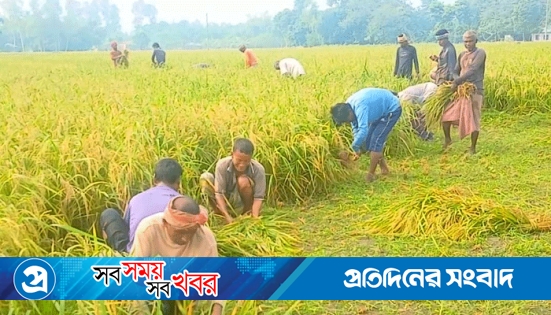
Farmers in Khulna are pinning fresh hopes on watermelon to make up for losses on their aman rice. Farm men and women are now busy in field after field. Because it brings a high profit in a short time, farmers have been turning to watermelon more each year, and this year the trend has grown further to recoup the aman losses.
Watermelon growers say the season usually begins between 15 December and 15 January. But because most of the district's watermelon land is muddy at that time, farmers plant about a month late.
Last Wednesday and Thursday, a tour of at least 20 villages, including Khejuria, Uttar Banishanta, Kalikabati, Harintana, Laudob, Kailashganj, Dhopadi, Dakop, Paschim Bajua and Purba Bajua in Dakop upazila and Baranpara, Gangarampur, Boyarbhanga and Debitala in Batiaghata upazila, found watermelon growers busy in every village. The fields are full of life. Seeds have been sown in most fields, land is still being prepared in one or two places, and elsewhere seedlings have begun to grow. Farm men and women are busy applying fertiliser, water and pesticide, and seasonal women labourers are at work in the fields.
A record of ups and downs
According to the Khulna district office of the Department of Agricultural Extension (DAE), this district grows the most watermelon in Khulna division. Although it has been grown for about twenty years, the largest area was in 2014, when 3,468 hectares were planted. That year, however, rain at harvest time and poor communications caused farmers losses, so in 2015 the area planted was one-sixth of the previous year's. From 2017 it began to rise little by little again. In 2017 about Tk 85 crore worth of watermelon was produced on 1,650 hectares in the district. In 2018, 1 lakh 15 thousand tonnes were produced on 2,485 hectares, with a market value of more than Tk 135 crore. Last year, 2019, 1,665 hectares were planted, of which about 950 hectares remained after the damage. This year the target is 2,000 hectares, and it has already been exceeded.
Dakop in Khulna is one of the best-known watermelon areas: 65 to 70 per cent of the district's watermelons are grown in this upazila, and more than 5,000 people there are involved in growing the crop. Besides the areas already growing it, watermelon is being grown for the first time this year in some villages of Tildanga, Pankhali and Kamarkhola unions.
Talking to at least 30 farmers in various villages of Dakop, it was learned that most of Dakop's farmland was once single-cropped. Some land was planted with watermelon around 1995, but the amount was very small. Then farmers in the area suffered a major blow in cyclone Sidr, after which watermelon farming grew to raise incomes. As a rule of thumb, a watermelon grower makes a profit equal to the amount invested, after costs.
Last year watermelon was grown on 917 hectares in this upazila, but several spells of rain from the end of February to the second week of March completely destroyed the crop on 700 hectares. This year, watermelon has so far been planted on 1,000 hectares.
Farmers hope to recoup losses
"This time, because of cyclone Bulbul and pests, we got almost no aman rice; no more than 7-8 maunds a bigha. Now I have planted watermelon on 12 bighas. Last year rain damaged the watermelons, so this time I have planted on all kinds of land, high and low. If the weather stays good, all the losses can be made up," said Joba Rani, a farmer from Kalikabati village in Dakop.
Kankan Mallik, a farmer and farmers' organisation leader from Boyarbhanga in Batiaghata, said many farmers in Batiaghata had turned to watermelon this year to make up for aman losses and because they got a good market last year. Watermelon carries some risk, but more than half the farmers in Gangarampur and Surkhali unions are growing at least some this year, he said.
"Last year Batiaghata's farmers made huge profits from watermelon. Because Dakop's farmers suffered losses from bad weather, Batiaghata's farmers got good prices. Last year I made a profit of Tk 13 lakh on 8 bighas. This year a great many farmers are growing watermelon," said Priyabrata Roy, a farmer from Sankemari village in Batiaghata.
Source: Prothom Alo. First published in Bengali on The Agro News.

Comments
(0)