
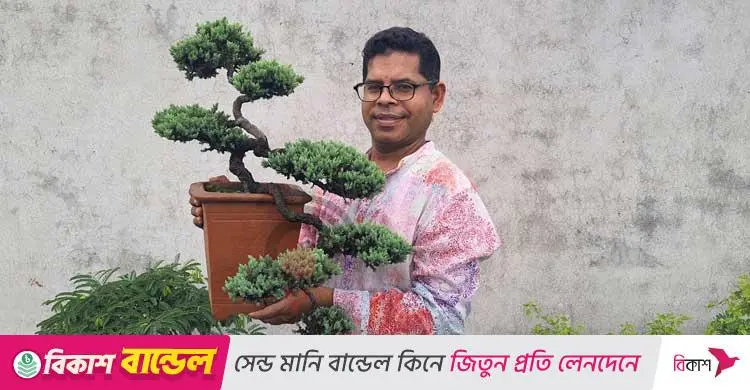
Having bought four tamarind seedlings for just Tk 100 and turned them into bonsai, Sabuj is now at the top of his field. Over 29 years, through many ups and downs, he has built up about 20,000 bonsai, large and small, of 450 species in progress at his nursery. Drawing on his long experience, he is working on creating a market for bonsai, among other things.
Anyone would be charmed by the bonsai nursery of tree-lover Sabuj in the Ambagh area under Konabari police station in Gazipur city. His rooftop is covered in bonsai.
KM Sabuj, whose full name is Khan Muhammad Sabuj, is a government employee from Char Pathalia village in Gazaria upazila, Munshiganj. He lives in the Ambagh Paschimpara area of Gazipur city, where his dream bonsai garden spreads over two and a half bighas of land and the roofs of two houses. He has been making bonsai for 29 years.
Young people from around the country are collecting bonsai and taking various training courses to escape unemployment. Sabuj said that with government patronage the bonsai industry could create jobs for many unemployed people and earn a large amount of foreign currency. Family members and several workers work regularly at his nursery.
Yet at one time he had to leave home because of the nursery. He found his place in the family again when a bonsai sold for Tk 40,000, and the family then gave him encouragement.
At the nursery, hundreds of bonsai trees stand in neat rows. Several employees were tending them, while Sabuj himself worked on various trees and gave advice to the staff.
From Sylhet to 20,000 trees
Sabuj told Jago News that he saw a bonsai at a nursery while visiting Sylhet in 1996. Out of interest, he bought four tamarind seedlings for Tk 100 and began. He now has about 20,000 bonsai of various species, with trees priced from Tk 1,000 to Tk 5 lakh. In all, his collection is worth more than Tk 1 crore. About 20,000 bonsai, large and small, are in progress at the nursery, and it holds more than 450 species.
In 2007 he took formal training from the noted bonsai artist Nazmul Hasan. He later trained in bonsai in China in 2017 and in Malaysia and Singapore in 2018.
When he started his nursery, there was no bonsai training. He kept working with bonsai for 12 to 14 years and took his first bonsai training in 2017, after which he began to think of bonsai commercially.
Training and exports
Sabuj said anyone who wants to work with bonsai can make a start. With academic training in bonsai, its artistic qualities can be brought out. The routine work of keeping a tree alive — care, watering, weeding, spraying pesticide and applying fertiliser — can be done any time and needs no academic training.
Training will certainly raise the quality of bonsai, he said. "We want every home to have a bonsai tree and people to know this art well. In the past few years we have been able to export bonsai to several countries. We have exported to India and Malaysia through a third party."
As a trial, five bonsai have been sent to Canada and two to America, and he is waiting to see how they survive in cold countries. If they survive there, it will be good news for the bonsai industry, he said: the country could then export bonsai to America and Europe, which would be great fortune and create a source of income.
Training is offered in various ways in the country. The Youth Development Academy arranged temporary bonsai courses in four districts, BSCIC industrial estates have arranged training, and the Ministry of Environment and Forests has also paid attention to the art. The horticulture centres in Dhaka each have a separate bonsai section. He said family members who stay at home, especially housewives or students, can earn by keeping two to four bonsai on a roof or balcony.
How to begin
Those who want to join the bonsai industry now should first collect trees, he said. There are two ways: buy bonsai trees from any nursery, or collect them from people who work with bonsai. Banyan-type trees growing neglected on buildings beside roads can also be collected to start a bonsai journey.
Beginners need to know how to care for bonsai: how much soil to give, what they feed on, and how much water, organic fertiliser and chemical fertiliser to apply. Training is essential for this, but those with experience of rooftop gardening can take up bonsai if they wish.
He said there are about 4,500 Ficus species of banyan in the world, and his nursery has more than 250 of them. Rare Bangladeshi nag lingam (cannonball) trees are also being presented as bonsai, and endangered trees such as hijal and tamal are being preserved as bonsai. In one sense the nursery could become a bonsai museum, as almost all kinds of endangered trees are preserved there.
Explaining the difference between an ordinary tree and a bonsai, Sabuj said nursery-grown trees are moved step by step from small pots to larger ones, whereas a bonsai moves gradually from a large pot to a shallow small one.
If a large mango tree is planted in a drum and, after years of fruiting, stops bearing, it can be converted into a bonsai through various processes, brought into a small pot and given measured feeding, he said. A tree needs 16 kinds of nutrients, and one must know how much water, fertiliser and food to give in a small pot. Bonsai need measured chemical fertiliser as well as organic fertiliser, and must also be sprayed with fungicide, vitamins and minerals.
Any bonsai can be made to bear fruit, he said. Fruit trees should be put in a slightly deeper pot rather than a thin tray, because they need extra food when they flower and fruit. Bonsai flower and fruit at the same time as ordinary trees, and though the tree is small, the fruit will be normal size.
Source: Jagonews24. First published in Bengali on The Agro News.
Comments
(0)