
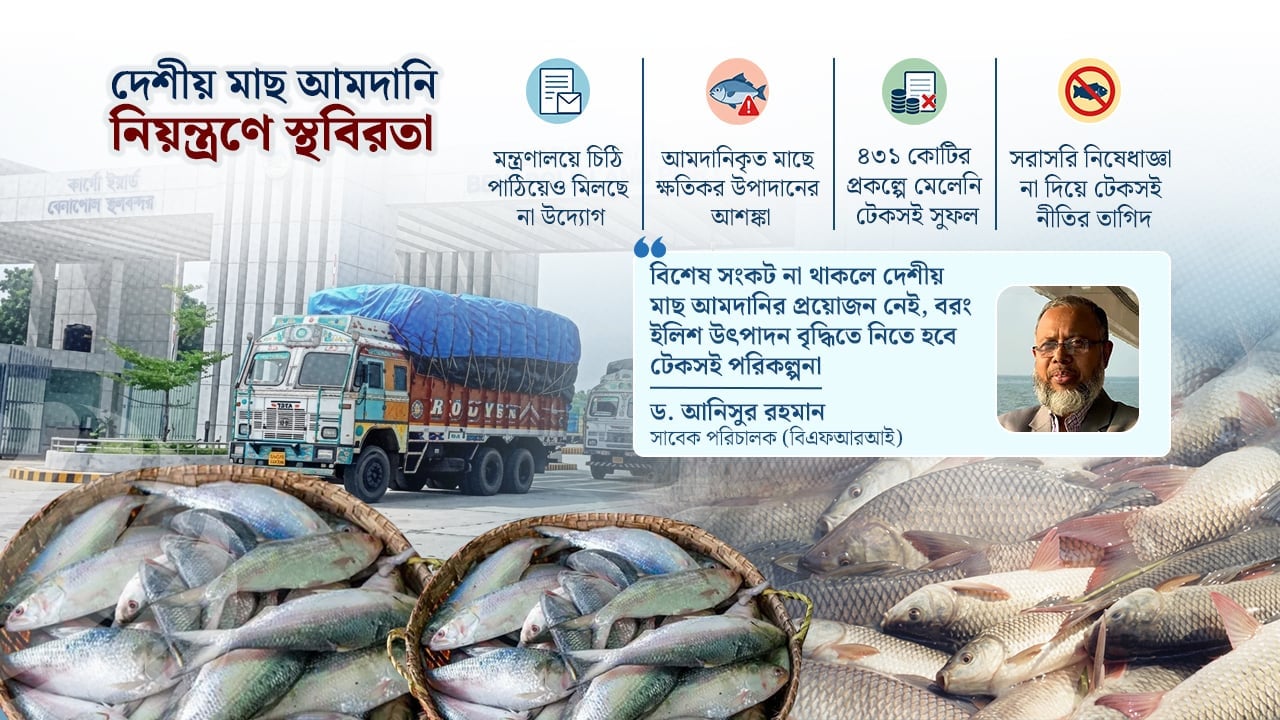
The Department of Fisheries has repeatedly recommended that Bangladesh stop importing hilsa and native species such as rui, katla, ayre and boal and raise domestic production instead, but the Ministry of Fisheries and Livestock has taken no effective step, Dhaka Post's Musa Mallik reports from documents seen by the paper. A letter signed by the then director general Abdur Rouf on 12 October 2025 asked for measures to control such imports and boost hilsa output.
The letter noted that the country produced 5.018 million tonnes of fish in 2023-24, 37.06 per cent of it (1.86 million tonnes) carp; that 90,620 tonnes of fish products earned Tk 6,144 crore in exports in 2024-25; and that about 12 per cent of the population depends on the sector. Under the import policy order, frozen rui, katla, bhetki, boal and kachki come in from India and Myanmar; indiscriminate imports of fish already abundant at home would hurt aquaculture, the letter warned, and imported fish carry risks of formalin, heavy metals, antibiotics, dyes, preservatives and histamine.
More than three months later, on 21 January 2026, the then secretary Abu Taher Mohammad Zaber forwarded the letter to an additional secretary for action, but nothing visible followed; a fresh letter on 15 September this year urging less import dependence is also sitting in the file. In 2016-17 alone 8,125.617 tonnes of hilsa were imported at a cost of about US$6.16 million; through Benapole, imports fell to 566 tonnes in 2024-25 and 765 tonnes in 2025-26, with 450 tonnes so far this fiscal year.
A Tk 431 crore hilsa production and management project taken up under the ousted Awami League government ended on 30 June this year without building any lasting structure, sources said, amid allegations of irregularities in spending. "What irregularities occurred in the project should be examined," DoF Director General Dr Md Khaled Kanak said, adding that a deep inquiry into who was involved and how the money went astray could reveal a great deal. Limited imports from a neighbouring country are attempted every year to steady prices when they rise unfairly, he said, but unless import dependence is cut, large sums of foreign exchange will be spent.
A total ban faces Article 11 of the WTO's General Agreement on Tariffs and Trade, which bars quantitative restrictions such as quotas or licences other than tariffs, the report notes. Those involved say import policy must weigh market supply, consumers' purchasing power, fishers' livelihoods and the balance of fish stocks, and that raising domestic output needs river and sanctuary management, protection of jatka and mother hilsa, and effective support for fishers; a clear, evidence-based long-term policy is needed rather than treating imports and production as alternatives.
Dr Anisur Rahman, hilsa researcher and former director of the Bangladesh Fisheries Research Institute, said he sees no need to import fish the country produces unless there is a particular crisis, and that plans are needed to raise hilsa output in the short, medium and long term.
Source: Dhaka Post — Reporting: Musa Mallik

Comments
(0)