
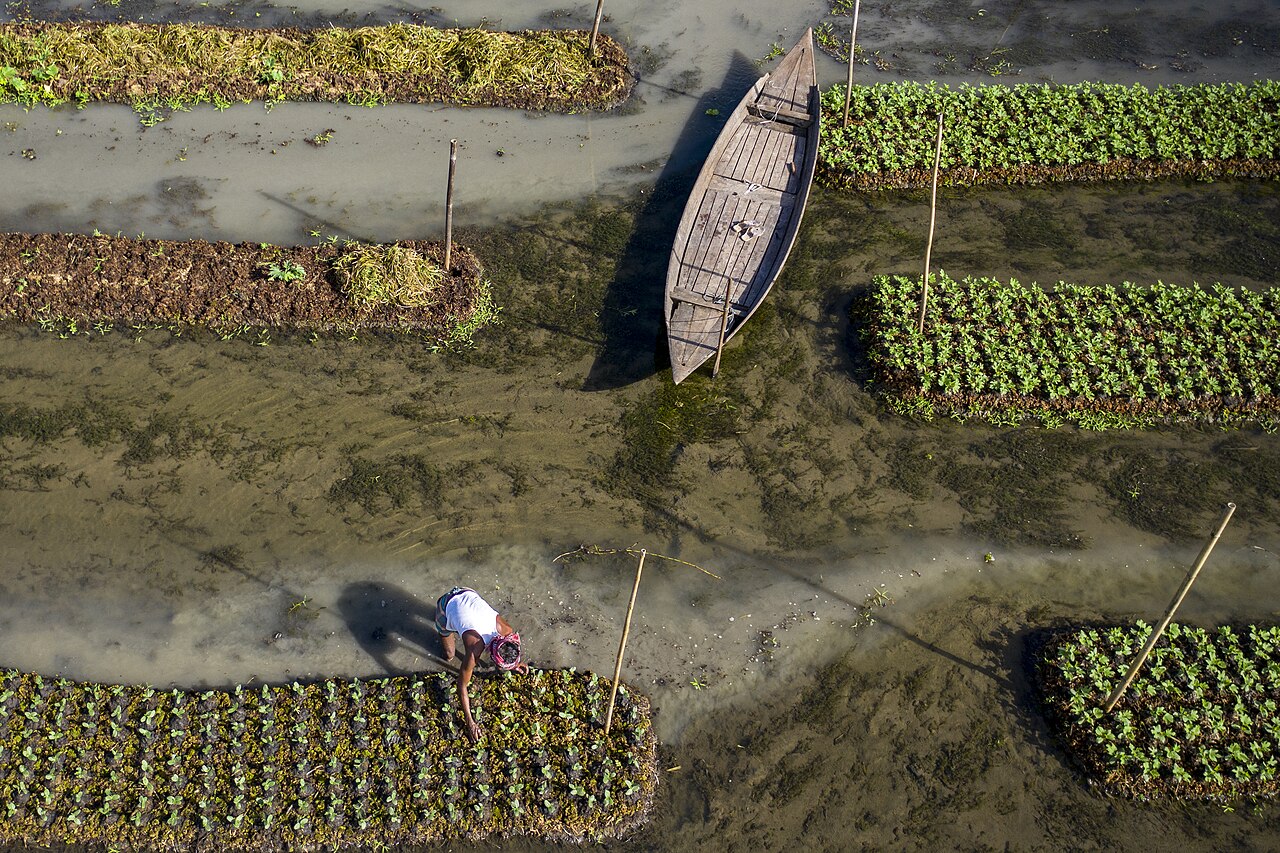
There is no soil, and the land stays under water for most of the year. On that water, farmers in several villages of Banaripara and Agailjhara upazilas in Barishal build floating fields from water hyacinth, algae and other aquatic plants and grow vegetables on them. Local people call it a 200-year-old tradition, learned from their forebears and still practised the same way.
Farmer Saiful Howlader of Umarer Par village said layers of water hyacinth, algae and dulali creepers are stacked to make a floating bed about two feet thick. Each bed is 50 to 60 metres long and about one and a half metres wide, and costs about Tk 10,000 to build. Seeds cannot be sown directly on the bed, so small balls called 'doulla', made of young water hyacinth, dulali creeper and coconut coir dust, hold the germinated seeds. Women mainly make the doulla.
After three to seven days the doulla are set in rows on the bed, and every five or six days roots and algae from the underside are pulled up and packed around them. A germinated seed becomes a full seedling in 20 to 22 days. While there is water, a bed can be farmed several times; adding fresh aquatic plants makes it usable again, but it is useless once the water dries up.
The beds produce aubergine, papaya, bottle gourd, beans, pumpkin, tomato, ridge and snake gourd, green and Bombay chillies, bitter gourd, cucumber and yardlong beans, as well as seedlings, which go to districts across Barishal division and to Pirojpur, Khulna, Bagerhat and Madaripur. A floating market for aquatic plants, the raw material of the beds, gathers every dawn on the Bisharkandi canal. Farmers say the profits are modest, but the income from drowned land is enough to run a household.
Banaripara upazila agriculture officer Md Hasnain said about 200 hectares in his upazila are farmed this way. Agailjhara's agriculture officer Suniti Kumar Saha said his upazila also has about 200 hectares of floating beds, involving 400 to 500 families; land that once lay idle in the monsoon after the boro harvest now earns money. Farmers, however, complain they get little help from the agriculture department.
Agriculture officers say the method is also used in Pirojpur and is spreading to other waterlogged areas, with the department encouraging its expansion.
This report is based on reporting by Bangla Tribune's Barishal correspondent.
Photo: Azimronnie / Wikimedia Commons (CC BY-SA 4.0)
Source: Bangla Tribune

Comments
(0)