
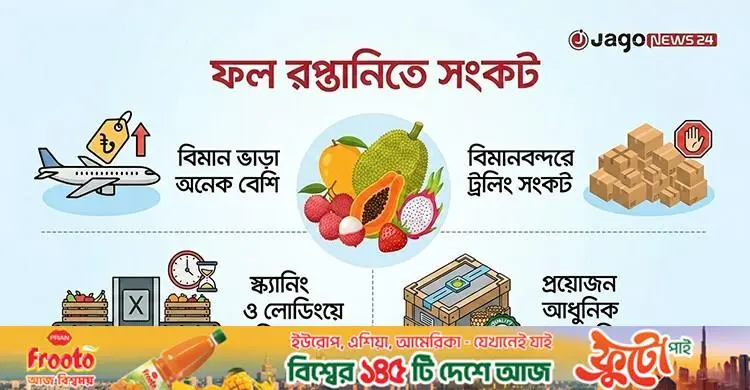
Bangladesh's fruit and farm produce export sector is gradually building a strong position in international markets. Demand for local mango, jackfruit, latkan (Burmese grape), hog plum, lemon, elephant apple and fresh vegetables is rising in the United Kingdom, Europe, Canada, the Middle East, China and elsewhere. But to make full use of this potential, exporters are calling for better packaging, modern technology, improved airport infrastructure and lower air fares.
Mohammad Martuza Rahman, proprietor of exporter MM Impex, said he has been in the business for about 25 years. His firm now exports various local fruits to the UK, is in talks to expand exports to Italy and plans to enter the Middle East market in future.
"We have already sent mango, jackfruit, latkan, elephant apple, lemon, hog plum and other local fruits abroad. The mango and jackfruit season is on now. Later we plan to export various vegetables too," he said.
According to exporters, mango is now Bangladesh's most sought-after export fruit, with significant demand also for jackfruit, latkan and fresh vegetables. The market for these fruits is expanding fast among Bangladeshi expatriates and South Asians living in Europe and the UK.
From orchard to airport
Explaining the export process, Uttam Kumar Saha of Tapan International said: "Mangoes are collected from various orchards in Rajshahi and first brought to our processing centre. There they are washed, graded and sorted. Then they are sent to the airport in quality packaging and exported from there."
Before export, officials of the Department of Agricultural Extension (DAE) check the quality of the fruit. If all is well, a phytosanitary or quarantine certificate is issued, without which no fruit can be sent abroad, he said.
The DAE's central packing house plays an important role. There, fruit and fresh vegetables are checked against international standards, and diseased, pest-infested or substandard fruit is removed during sorting.
Rakibul Islam Sujan, proprietor of RR Enterprise, said: "We are regularly trained on why a lemon or any other fruit is rejected for export. Fruit with canker, scab, pest attack or various kinds of spots is not accepted."
Training on fruit and vegetable diseases, grading, packaging and sorting is held almost every month, he said, but more modern training is needed to keep pace with international markets.
Exporters say packaging of local fruit has improved in recent years, but to enter the big superstores of the European Union, international-standard packaging and presentation must be ensured.
Mahbubur Rahman of NG International said: "To compete in the world market, there is no alternative to modern machinery and better packaging. The use of modern technology must increase, especially in packaging, sorting and preparing exportable products. That will improve product quality further."
Bangladeshi mangoes now go to the UK, Europe, Canada, the Middle East and China, he said. Foreign buyers are responding positively, and exports of local mangoes have risen significantly.
Freight costs triple
Exporters complain that despite the potential, high air fares have become a major barrier to competing internationally. They say the cost of shipping farm produce from Bangladesh to Europe is much higher than from neighbouring countries, adding to exporters' costs.
Mohammad Mansur, general secretary of the Bangladesh Fruits, Vegetables and Allied Products Exporters' Association, told Jagonews24: "The main reason fruit and vegetable exports from the country are falling is the abnormal rise in transport costs, or air freight. In the past few years cargo fares to the Middle East and Europe have almost tripled. What used to cost Tk 100 now costs Tk 300. At present, different airlines charge around Tk 500 to 550 per kg to carry goods to Europe."
"Bangladeshi exporters mainly compete with India, Pakistan and other countries, but our air freight is much higher than theirs. Exporters from other countries can get the same fruit or vegetables to market more cheaply. So Bangladeshi products end up more expensive in international markets and we fall behind," he said.
Abul Hossain, proprietor of Lee Enterprise, one of the country's top fruit exporters, told Jagonews24: "One of the main reasons fruit and vegetable exports are falling is the abnormal rise in air freight. It used to be about Tk 250 per kg, then it rose to Tk 320. Recently, especially on the pretext of the Iran-Israel conflict, it has risen further and now stands at Tk 547 per kg. It has become hard to compete internationally with such high transport costs."
Mohammad Martuza Rahman of MM Impex said: "If air fares could be reduced, Bangladesh's fruit and vegetable exports would grow several times over. There is huge demand for our farm products in international markets."
Rakibul Islam Sujan of RR Enterprise agreed. "We get enough orders from foreign buyers, but because transport costs are high we often cannot meet that demand, so buyers source from other countries," he said.
Airport bottlenecks and quality control
Sujan also pointed to infrastructure problems at the airport. "Sending one consignment often needs around 50 trolleys, but enough trolleys are not available. That delays scanning and loading, and scheduled flights are often missed," he said.
Uttam Kumar Saha of Tapan International stressed stronger quality control at the production stage. "Supervision must increase from the orchard level, not only at the time of export. We need to watch what diseases the trees have and how the fruit quality is. If quality is ensured from the start of production, Bangladesh's position in international markets will be stronger."
A person involved in the sector, speaking on condition of anonymity, said that with modern packaging, better processing technology, international-standard training, improved airport infrastructure and lower air fares, Bangladesh's fruit and farm export sector could reach new heights, and the country's agricultural export industry would gain a stronger footing as a major source of foreign currency.
Source: Jagonews24. First published in Bengali on The Agro News.

Comments
(0)