
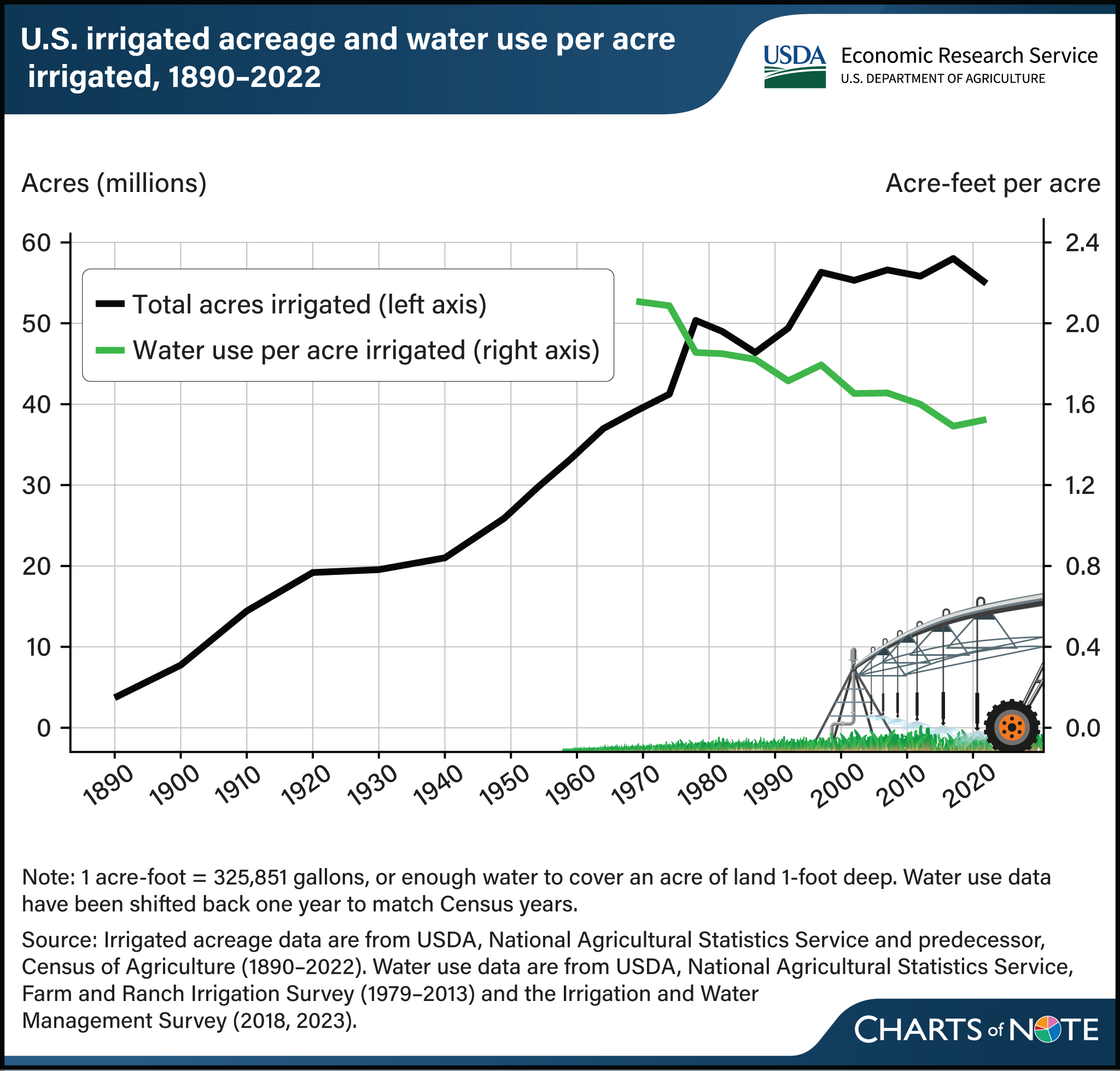
Irrigated farming in the United States has expanded more than tenfold since the Census of Agriculture first counted it in 1890 — and has now stopped expanding, according to USDA's Economic Research Service.
The long growth came from two directions. Federal, state and local governments invested in infrastructure to deliver surface water to farms and ranches, while improvements in well drilling and pumping opened up groundwater. Around 1997 water supply and other constraints brought the growth of irrigated area to a halt.
The latest figures show it has since gone into reverse. In 2022 the United States had 54.9 million acres of irrigated agricultural land, down from a peak of 58 million acres in 2017 and below the 56.3 million acres recorded in 1997.
What is applied to each of those acres has been falling for far longer. Water use intensity — the volume applied per acre, measured in acre-feet, where one acre-foot is 325,851 gallons — has generally declined since 1969. Average use per irrigated acre was more than 2 acre-feet in 1969, fell to a low of 1.49 acre-feet in 2018, then edged up to 1.52 in 2023.
ERS researcher Nicholas Potter attributes the decline to farmers adopting pressurized irrigation systems and other improvements in how water is applied to a field.
The combination is the point. American agriculture is now irrigating slightly less land with considerably less water on each acre of it — a pattern of doing more with a constrained resource that will be familiar to farmers anywhere groundwater is under pressure.
The chart updates the ERS report Trends in U.S. Irrigated Agriculture: Increasing Resilience Under Water Supply Scarcity, published in December 2021.
Source: USDA Economic Research Service

Comments
(0)