
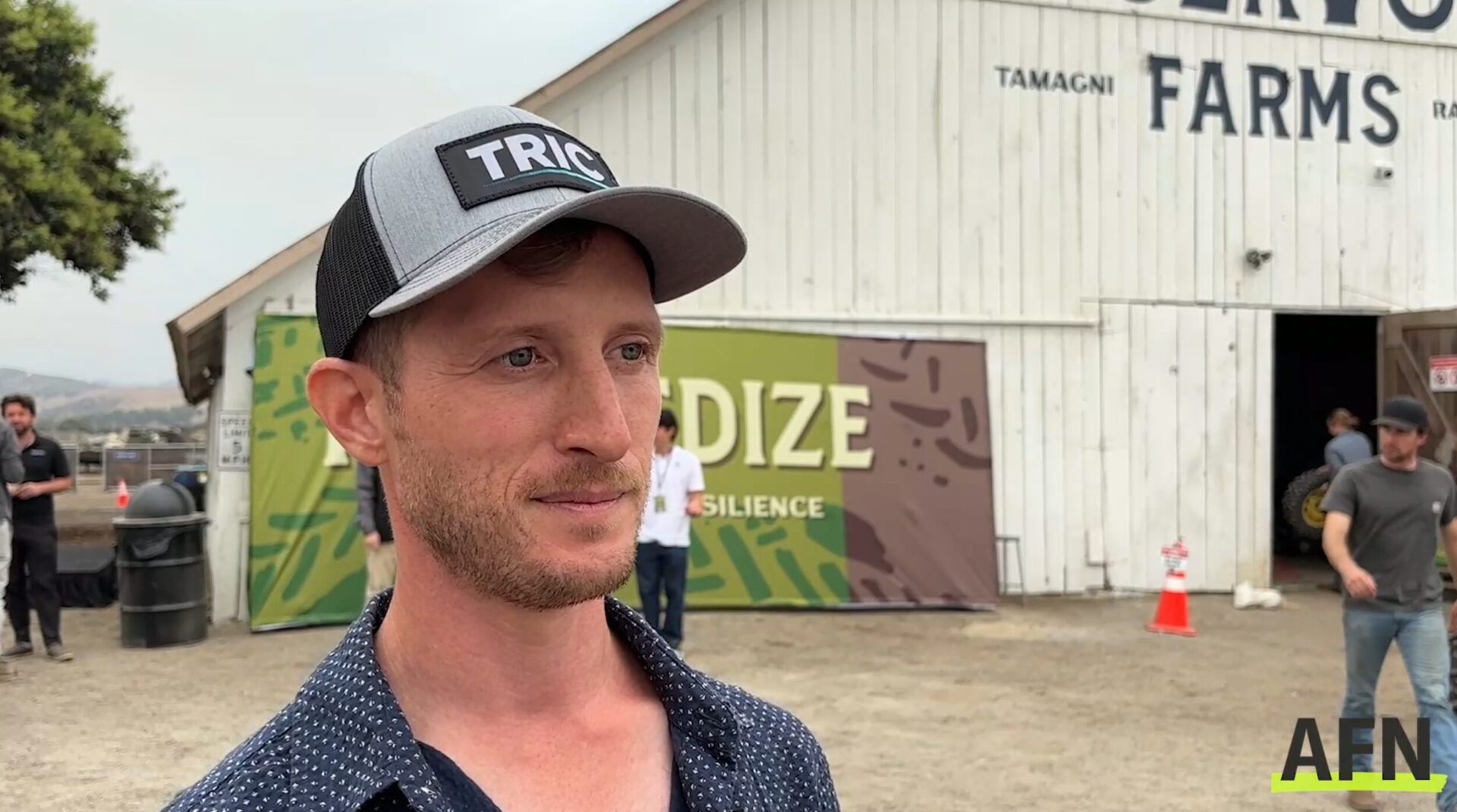
TRIC Robotics, an agricultural robotics start-up founded at the University of Delaware, has treated more than 1,500 acres of commercial strawberries this year with a fleet of 15 autonomous robots, a leap from the half-acre trials it began in 2021. The machines work at night in California fields, using UV-C light against fungal pathogens and vacuums to pull insect pests off the plants, so that growers can cut back on chemical sprays.
The company was founded by Adam Stager, PhD, and Vishnu Somasundaram. It sells robots as a service: growers pay per application per acre, much as they already pay for spraying, and put up no capital for equipment. “We charge about what farmers pay today, and the plants are physically healthier,” Stager said at the Ruggedize ag robotics conference at Reservoir Farms in Salinas, adding that growers also see their season last longer because the plants stay healthier.
TRIC’s machines are big. Where Saga Robotics, another UV-C company, runs small battery-powered units along single vineyard rows, TRIC’s diesel machines cover six or more rows at a pass, weigh 25,000 lb and ride on six-foot tyres built for open strawberry fields. The first prototypes, golf-cart-sized units Stager built in a garage, kept getting stuck in field ditches; the company worked with Andros Engineering to scale the design to tractor size and automated the light boom so its height above the plants adjusts to the field.
The California Strawberry Center ran its own case study of the system, Stager said, without being asked, and found that the bug vacuum alone pays for both the vacuum and the light treatment. Some growers who normally treat twice a week moved to three treatments.
Stager argues that the service model fits strawberries in particular. Production is concentrated in a small geographic area, growers run smaller tractors and rarely have the budget for million-dollar equipment, and they already buy spraying by the acre. Because TRIC owns the machines, it was able to add the vacuum as a second service without asking any farmer to buy a new robot. Working at night also keeps the robots clear of the daytime rush in a strawberry field.
The company puts its current strawberry market in the hundreds of millions of dollars and sees a billion-dollar opportunity in stacking further tasks on the same fleet. Simple jobs come first: some growers drag metal skis through furrows to flatten the soil so workers do not trip, and in Oxnard a tractor is run through the field once a week for that alone. Harder jobs follow. “Starting to pull those weeds would double our revenue,” Stager said of the weeds that grow beside strawberry plants. Expansion into other crops and international markets with existing customers is also on the list.
For growers of high-value fruit, the TRIC model shows one route into farm automation that carries no capital risk: a pay-per-acre robotic service that replaces fungicide sprays with light and pays for itself through pest control.
Source: AgFunderNews

Comments
(0)