
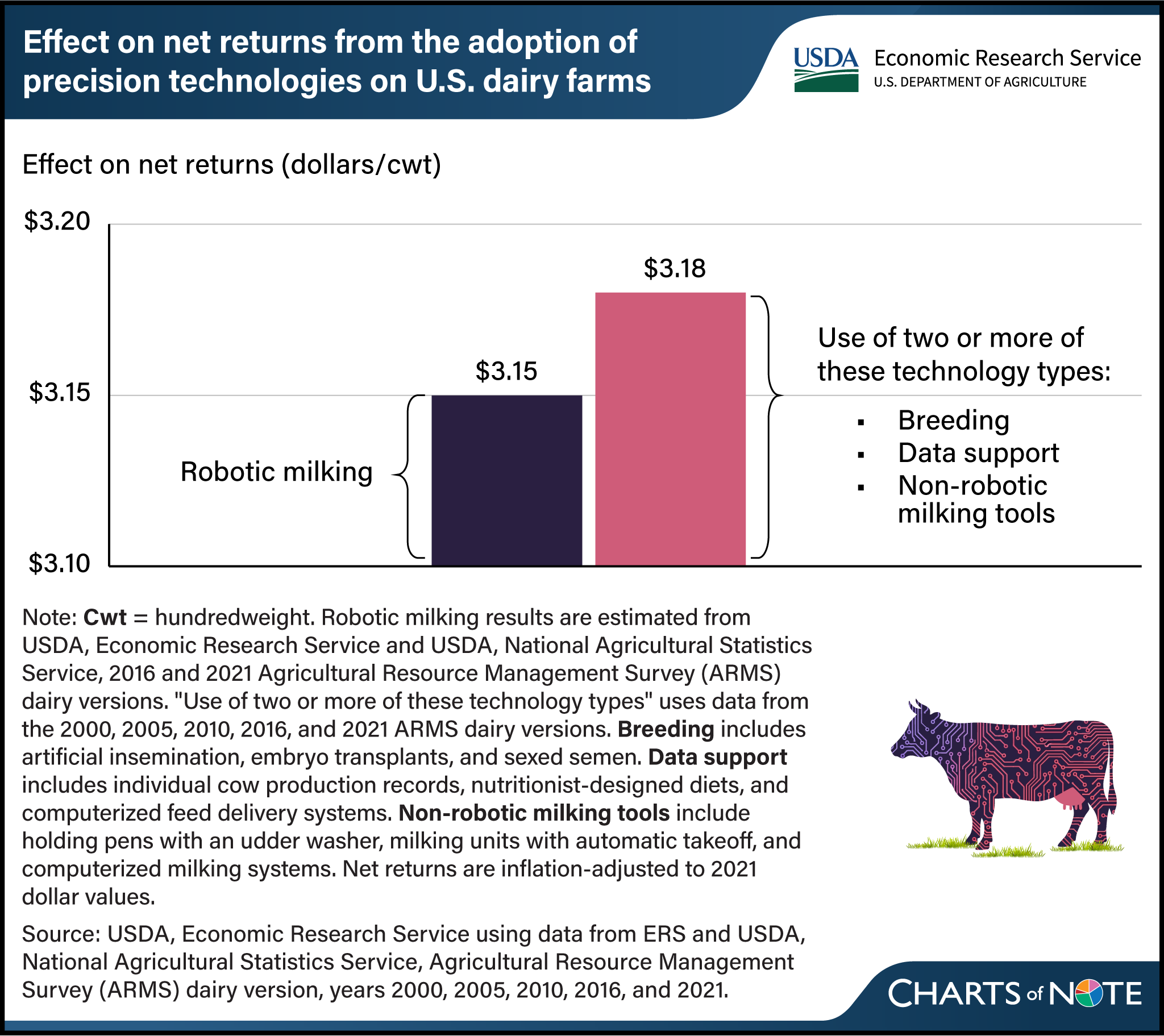
Dairy farms in the United States that have taken up robotic milking are earning more per unit of milk than those that have not, according to research from USDA's Economic Research Service.
Precision dairy farming, as ERS defines it, means using technology to manage cows more efficiently. Some of the tools are long established — production records for each cow, artificial insemination, diets formulated by a nutritionist. Others are still emerging, robotic milking among them: the cow walks into a box-like stall, is milked automatically with no manual labour, and walks out again.
To measure what the technologies are worth side by side, ERS economist Jonathan McFadden analysed United States dairy operations using data from the Agricultural Resource Management Survey.
After accounting for the attributes of each farm and the characteristics of its operator, robotic milking was associated with dairy net returns $3.15 higher per hundredweight of milk than on farms that had not adopted it.
Farms running more than one kind of precision dairy technology — data support, breeding, or non-robotic milking systems — did fractionally better still, with net returns $3.18 per hundredweight above non-adopters.
Net returns here is a measure of profit, not of revenue: it subtracts a dairy's operating costs and overhead from milk sales, cattle sales and other dairy-related income.
That gap of roughly three dollars per hundredweight is what a farm has to weigh against the capital cost of a robot, and it is why the question for most dairies is when the technology becomes affordable rather than whether it works. The findings come from Precision Dairy Farming, Robotic Milking, and Profitability in the United States, published in January 2026.
Source: USDA Economic Research Service


Comments
(0)