
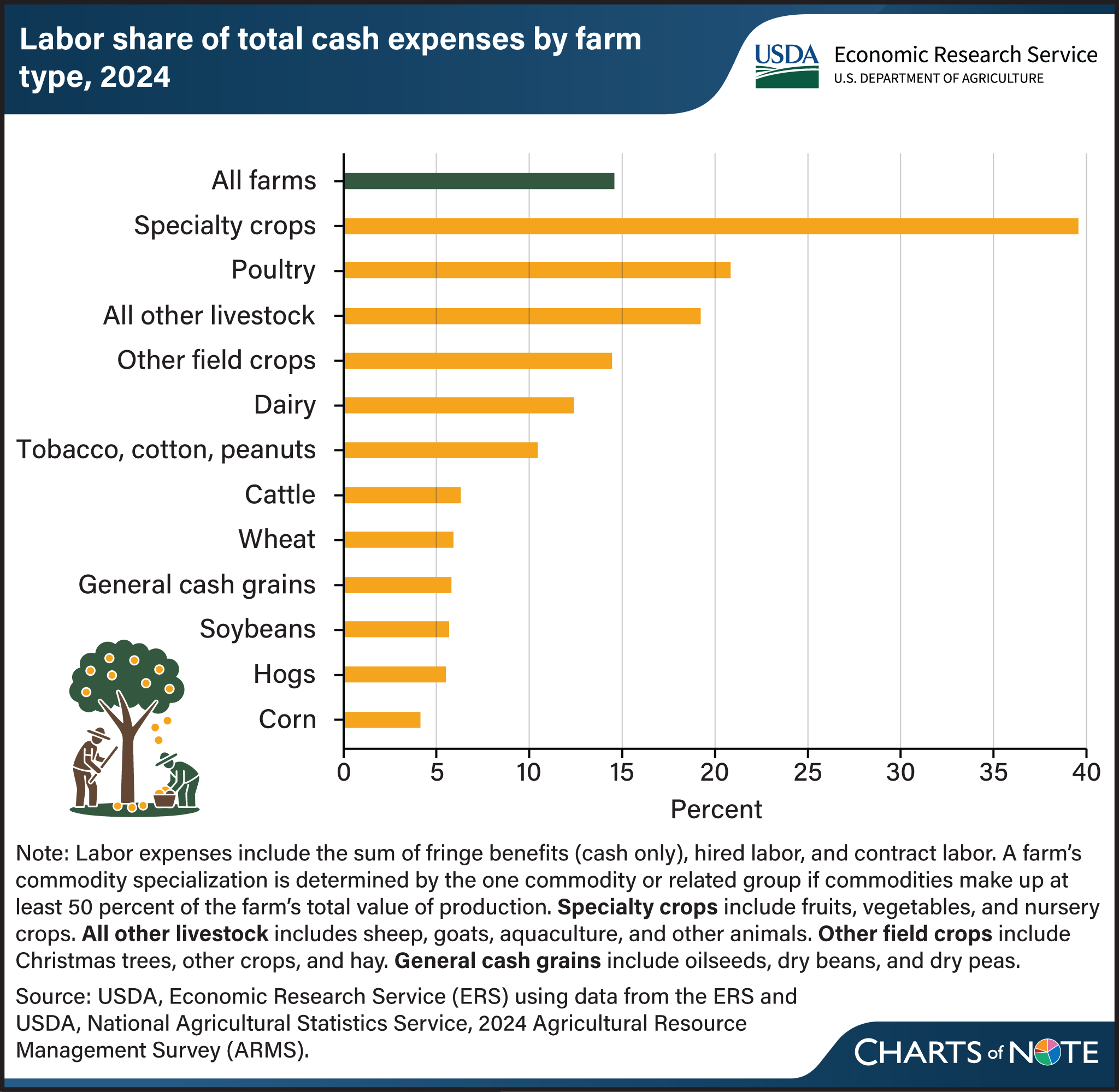
Labour accounted for about 15 percent of total cash expenses across all United States farms in 2024, but the burden falls very unevenly depending on what a farm grows, according to USDA's Economic Research Service.
Specialty crop farms carry the heaviest load. On operations growing fruit and tree nuts, vegetables and melons, or running greenhouses and nurseries, labour took about 40 cents of every dollar of cash expenses — nearly three times the all-farm average.
At the other end of the range are the big field crops. Labour represented 4 percent of cash expenses on corn farms and 6 percent on farms specializing in soybeans, cattle, general cash grains, wheat or hogs.
The gap follows the machinery. ERS economists Dipak Subedi and Anil K. Giri link the low shares on field crop farms to production systems that are far more mechanized than specialty crop production, and to higher adoption of labour-saving innovations such as autosteer guidance and insect-resistant and herbicide-tolerant seeds. Harvesting fruit, vegetables and nursery stock still depends largely on hands.
Livestock sits between the two. Poultry farms had the highest labour share among livestock categories at 21 percent, followed by the broad "all other livestock" group at 19 percent and dairy farms at 12 percent.
The pattern matters wherever farm wages are rising. A cost structure in which two-fifths of spending is labour leaves a grower far more exposed to a shortage of pickers or a rise in the wage rate than a grain farm whose main costs are seed, fertilizer and fuel — and gives far more reason to look for mechanization.
The chart updates figures first published in the ERS report America's Diverse Family Farms: 2021 Edition.
Source: USDA Economic Research Service


Comments
(0)